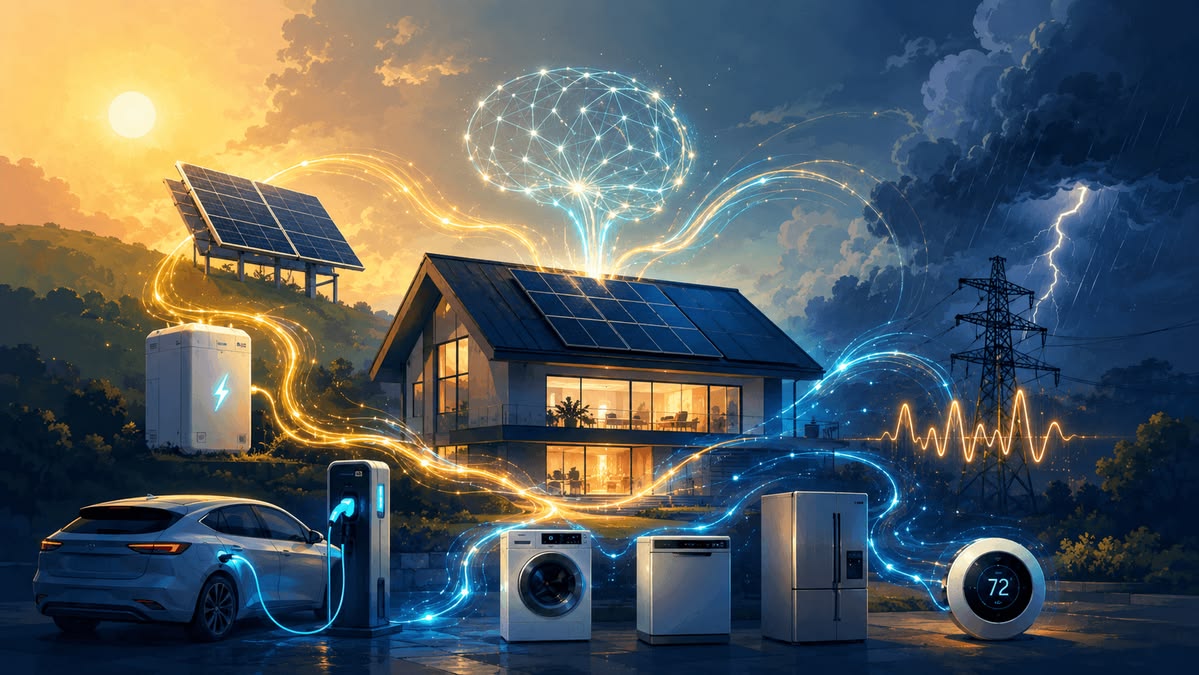
Electricity consumption in modern homes is increasing due to the growing use of air conditioners, lighting systems, refrigerators, washing machines and other electrical appliances. Managing energy usage efficiently has become important for reducing electricity expenses and avoiding unnecessary power consumption.
A Home Energy Management and Control System Using IoT Technology is an intelligent solution designed to monitor, analyse and control household electricity usage through connected devices.
The system uses smart sensors, energy measurement modules and microcontrollers to collect electrical parameters such as voltage, current, power and energy consumption. Users can access this information through a web or mobile dashboard and monitor individual appliances in real time.
By integrating IoT technology and automated control mechanisms, the system can identify high-energy-consuming appliances, provide usage information and support remote switching of electrical loads.
This project combines embedded systems, electrical engineering, wireless communication and smart home automation to demonstrate an efficient approach to residential energy management.
Key Features & Benefits
Objectives of the Home Energy Management System
The main objective is to develop an intelligent system that helps homeowners monitor and control electricity consumption.
The major objectives include:
Monitor household electricity consumption in real time.
Measure voltage, current, power and energy usage.
Control electrical appliances remotely.
Identify appliances with high power consumption.
Generate energy usage reports.
Reduce unnecessary electricity consumption.
Provide alerts when power usage exceeds predefined limits.
Key Features
Real-time electricity monitoring.
Individual appliance control.
IoT-based remote access.
Automatic load switching.
Daily and monthly energy reports.
Power consumption analysis.
High-energy usage notifications.
Web-based monitoring dashboard.
Historical electricity usage tracking.
The system can support automatic and manual operating modes, allowing users to control appliances according to their requirements.
Implementation Guide
Technologies Required for Development
The project combines electrical measurement hardware, embedded controllers and software technologies for intelligent energy management.
Hardware Components
ESP32: Main controller with integrated Wi-Fi communication.
Voltage Sensor: Measures the electrical supply voltage.
Current Sensor: Monitors current consumption.
Energy Meter Module: Measures electrical energy usage.
Embedded C/C++: Implements sensor reading and control logic.
Python: Supports data processing and analysis.
Flask: Develops backend APIs.
MySQL: Stores energy consumption records.
HTML, CSS and JavaScript: Creates the monitoring dashboard.
MQTT or HTTP: Enables communication between devices and the server.
Development Requirements
The ESP32 collects electrical measurements and transmits them to the backend. The dashboard displays energy consumption and provides appliance control options.
For accurate energy monitoring, use suitable calibrated measurement modules. Mains voltage connections must use properly rated, isolated and enclosed circuits with appropriate electrical protection.
Technical Specifications
Working Principle of the Home Energy Management System
The system continuously monitors electrical parameters and provides users with information about household energy consumption.
Step 1: Electrical Parameter Measurement
Voltage and current sensors measure the electrical parameters of connected appliances. An energy measurement module can calculate power and accumulated energy consumption.
Step 2: Data Collection
The ESP32 collects the sensor readings and processes the measured values.
Step 3: IoT Communication
The controller transmits the collected information to the backend server using Wi-Fi and HTTP or MQTT communication.
Step 4: Data Storage
The backend stores electricity consumption records in a MySQL database for historical analysis.
Step 5: Appliance Control
Users can switch connected appliances ON or OFF through the dashboard. The backend sends control commands to the ESP32, which operates the appropriate relay.
Step 6: Energy Monitoring
The dashboard displays voltage, current, power, energy consumption and appliance status. Users can analyse usage patterns and identify appliances consuming excessive electricity.
System Architecture
Electrical Sensors → ESP32 Controller → Wi-Fi Communication → Flask Backend → MySQL Database → Web Dashboard.
User Dashboard → Backend API → ESP32 → Relay Module → Electrical Appliances.
Implementation Steps
Connect voltage and current measurement modules.
Interface the sensors with the ESP32.
Develop the embedded program to collect readings.
Implement Wi-Fi communication and backend APIs.
Store energy consumption data in MySQL.
Develop the appliance monitoring dashboard.
Integrate relay-based remote control.
Test energy measurements and appliance switching.
This architecture provides a practical foundation for developing an IoT-based smart home energy management prototype.
Conclusion & Next Steps
Applications of Home Energy Management Technology
Home energy management systems can be implemented in different residential and commercial environments.
Smart Homes: Monitor and control household electrical appliances.
Residential Apartments: Analyse electricity consumption across individual units.
Office Buildings: Monitor lighting and electrical equipment usage.
Educational Institutions: Demonstrate energy monitoring and automation.
Solar-Powered Homes: Monitor solar generation and household energy consumption.
Smart Buildings: Integrate energy monitoring with building automation systems.
Aislyn Technologies, Bangalore
Phone: +91 97395 94609
Email: info@aislyntech.com
Website: https://aislyn.in
Contact us today to start building your Embedded project in Bangalore with our expert support!