ABSTRACT
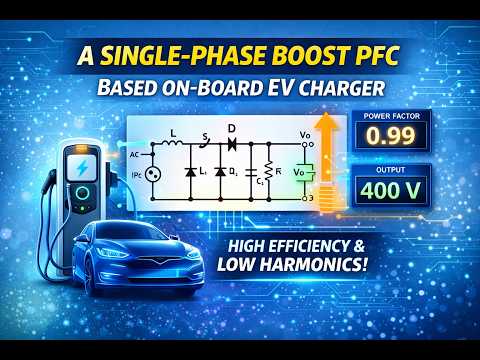
This paper proposes a two-stage battery charger using an bridgeless power factor correction (PFC) AC-DC converter at the first stage. The converter at the front end improves the input current shaping and power factor while providing adequate DC link voltage. At the back end, a half-bridge LLC converter is used to charge the battery. This onboard charger (OBC) executes nearly unity power factor throughout a broad input voltage range. Furthermore, input current and voltage sensors are not required for AC-DC conversion due to the discontinuous inductor current conduction mode (DICM), further increasing the converter’s reliability and reducing the overall cost. This OBC solution practically suits the majority of low-voltage (LV) battery chargers. The design equations and a thorough steady-state analysis of the proposed charger are also presented. Simulation work is carried out using MATLAB/Simulink.
INTRODUCTION
Recent years have seen a surge in interest and study of electric and hybrid electric vehicles (HEVs). The battery is the heart of electric and hybrid vehicles because it stores the energy that powers them. A non-power-factor-corrected charging system consumes a current that is high in harmonics from the input mains supply as the batteries are mostly capacitive. As a result, the nearby devices that are connected to it suffer severe consequences. Any EV charging solution must have a PFC stage in order to meet defined power quality standards. With approximately 80% of the total EVs on road are accounted by two-wheelers and three-wheelers, EV sector in India sees enormous opportunities in charging solutions for EVs. To power an electric vehicle’s battery, a charger can be installed either within the vehicle (called an “on-board charger”) or outside (called an “off-board charger”). Off-board chargers are utilized for high-power AC and DC charging, whereas the on-board chargers are used for low-power AC charging as shown in Fig. 1. On-board battery chargers (OBCs) usually incorporate an AC-DC converter followed by a DC-DC converter with galvanic isolation. AC-DC conversion at the front end plays a pivotal role in OBC solutions. Conventional front-end converters have low THD, power factor, and device count. These demerits will make the battery heavier. In an OBC, it is essential to fulfill requirements like reduction in current harmonics at the input, better regulation of output voltage and power factor correction (PFC). Obtaining an effective OBC is facilitated by PFC-based AC-DC converters, a crucial component of an EV charger. These converters provide the same flexibility as any other power converter, allowing for operation in either continuous inductor current conduction mode (CICM) or DICM or boundary inductor current conduction mode (BICM). Boost PFC converter topologies are widely preferred in the PFC converter based on-board charging. These configurations convert AC to DC with a diode full bridge rectifier (DBR) and then power up with a boost converter. However, this design introduces issues including heat dissipation due to the high output capacitor current ripple and worrisome amounts of DBR losses. The common-mode (CM) noise, ripple current, sensing circuit complexity, and voltage stresses of many bridgeless (BL) topologies are all higher than that of their boost, buck-boost, Cuk, SEPIC, Luo, and Zeta-derived counterparts. Though bridgeless dual-boost and totem-pole dual-boost reduce CM noise, they do so at the expense of additional conducting devices for each half cycle. Majority of single-stage, isolated and non-isolated topologies contain high conduction losses demanding bulky heat sinks, further leading to thermal failure. Hence, they are unfit for low-voltage and high-current applications. Whereas high-voltage and lowcurrent single-stage OBC applications in the literature fails to discuss heating issues. Two-stage topologies with PFC converters can either work in a post-regulator mode at the back end or a pre-regulator mode at the front end. At front-end, PFC is accomplished, while back-end voltage and current are controlled by a pre-regulator type. In CICM operation, PFC needs three sensors at the front end to work. Back-end converters, on the other hand, use two sensors to keep the charging voltage and current in control. Because the input phase must be tuned to match the grid, these converters are difficult to control and cost higher. For input sinusoidal current shaping and power factor correction (PFC), the CICM control at the front-end uses the inner current control loop. In contrast, the outer voltage control loop regulates the output voltage. Phase-locked-loop (PLL) and the requirement of current controllers with larger bandwidth at the inner-side drive it towards more complexity. This complexity and difficulty in establishing natural PFC for AC-DC in CICM open the way for DICM, which possesses intrinsic qualities such as built-in PFC, reduced number of sensors, effortless control, zero current switching (ZCS) turn-on of the power switches, as well as the inherent zero diode reverse recovery losses. In DICM mode, achieving UPF operation at AC mains is possible without input sensors. Further, the voltage-doubler configuration can reduce voltage stress on semiconductor switches. A DICM-operated bridgeless buck-boost converter for e-rickshaw on-board chargers is presented. Since the main switch is operating in DICM, an LC filter is deployed to reduce switching harmonics in the ac line. This work only involved front-end PFC converters. Whereas, converter is used at the front-end for PFC and at the back-end a half-bridge LLC resonant converter achieves zero voltage switching (ZVS) turn-ON only. The two-stage EV charger utilizes a bridgeless Cuk front end and a back-end isolated flyback dc-dc converter. Due to its minimal component count, the flyback converter is easy to operate and very cheap, but it only suits for low power rating. Since the flyback does not employ the buck boost operation of the Cuk converter to lessen switching losses, the front and backend converters can be operated independently. Wide range of output voltage is achieved by employing a phase-shifted dc-dc converter, followed by a front-end PFC converter, for EV chargers. The high output voltage is a result of the high frequency transformer, whereas the low output voltage is the result of duty cycle management. In this setup, the phase-shifted converter offers a wide output voltage range while the PFC converter controls the dc link voltage and shapes the ac current.
Block Diagram