Your cart

Your Wishlist

Categories

YouTube Video
Product Image
Product Preview

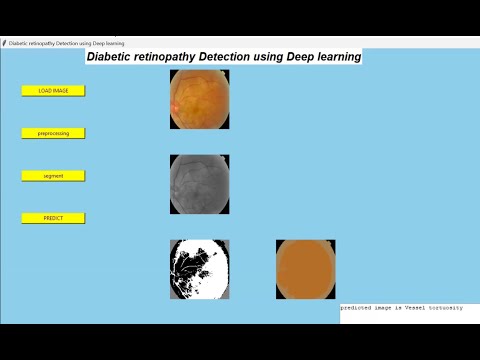
Ensemble Approach Using Deep Learning And Transfer Learning In Classifying Diabetic Retinopathy

Category: Mini Projects

Price: ₹ 2800 ₹ 8000 65% OFF

Abstract

Deep learning (DL) enables the creation of computational models comprising multiple processing layers that learn data representations at multiple levels of abstraction. In the recent past, the use of deep learning has been proliferating, yielding promising results in applications across agrowing number of fields, most notably in image processing, medical image analysis, data analysis, and bioinformatics. DL algorithms have also had a significant positive impact through yielding improvements in screening, recognition, segmentation, prediction, and classification applications across different domains of healthcare, such as those concerning the abdomen, cardiac, pathology, andretina. Given the extensive body of recent scientific contributions in this discipline, a comprehensivereview of deep learning developments in the domain of diabeticretinopathy (DR) analysis, viz.,screening, segmentation, prediction, classification, and validation, is presented here. A criticalanalysis of the relevant reported techniques is carried out, and the associated advantages andlimitations highlighted, culminating in the identification of research gaps and future challenges thathelp to inform the research community to develop more efficient, robust, and accurate DL models for the various challenges in the monitoring and diagnosis of DR.

keyword:
Dataset of retinal images,
CNN

Objective:

The objective of using an ensemble approach with deep learning and transfer learning in classifying diabetic retinopathy is to enhance the overall performance and robustness of the classification model. Diabetic retinopathy is a medical condition that affects the eyes of individuals with diabetes, and early detection is crucial for timely intervention and treatment. Here's a breakdown of the objectives for employing this ensemble approach:
Deep learning models, especially convolutional neural networks (CNNs), have shown excellent performance in image classification tasks. Transfer learning, which involves leveraging pre-trained models, can further enhance performance by utilizing knowledge gained from large datasets in related domains.
Ensemble methods combine multiple models to achieve better predictive performance than individual models. By combining the strengths of deep learning and transfer learning, the ensemble can potentially achieve higher accuracy, sensitivity, and specificity in classifying diabetic retinopathy.

Deep learning models can be sensitive to variations in input data. Transfer learning helps in addressing this by utilizing knowledge from diverse datasets, making the model more robust to variations in image characteristics.

Ensemble methods inherently improve robustness by reducing overfitting and handling noise in the data. By combining multiple models trained on different subsets or representations of the data, the ensemble is better equipped to generalize well to new and unseen cases.

block-diagram

• Demo Video
• Complete project
• Full project report
• Source code
• Complete project support by online
• Life time access
• Execution Guidelines
• Immediate (Download)

Software Requirements:

1. Python 3.7 and Above
2. NumPy
3. OpenCV
4. Scikit-learn
5. TensorFlow
6. Keras

Hardware Requirements:

1. PC or Laptop
2. 500GB HDD with 1 GB above RAM
3. Keyboard and mouse
4. Basic Graphis card

1. Immediate Download Online

Leave a Review

Only logged-in users can leave a review.

Customer Reviews