ABSTRACT
Direct Torque Control is a control technique used inAC drive systems to obtain high performance torque control. Inthis paper, Proportional-Integral (PI) controller has beenpresented to improve the system performance which gives bettertorque and flux response and also reduces the undesirabletorque ripple. The conventional DTC controller approach forinduction machines, based on an improved torque and statorflux estimator, is modified with the torque reference is generated with speed control loop. The speed control of IM is achieved with reduced torque ripple and the simulation work is carried out using MATLAB/Simulink software.
INTRODUCTION
The concept of Direct Torque Control (DTC) has become apowerful control scheme for the control of induction motordrives and it considered as an alternative to the field orientedcontrol (FOC) strategy .The scheme of DTC has gooddynamic performance, precise and quick control of stator fluxand electromagnetic torque, robustness against the motorparameter variations, and the simplicity of the algorithm. The performance ofDTC depends on the error band set between the desired andmeasured torque and stator flux values. The variation inspeed and according to flux and torque controllers hysteresisbandwidth, the inverter switching frequency is changed.The DTC aims to choose the best voltage vector in order tocontrol both stator flux and electromagnetic torque ofmachine simultaneously. Similar to hysteresis band(HB)current control, there will be ripple in current ,flux ,andtorque .The current ripple will give additional harmonic loss,and torque ripple will try to induce speed ripple in a lowinertia system and possible problem during starting .Toimprove the performance of DTC, the torque ripple must beeducedVarious methods are proposed by many researchers toaddress these problems of conventional DTC. Many of themuse space vector modulation (SVM) to get continuous voltagevector, which can adjust the torque and flux more accuratelyand moderately, hence the torque and flux ripples werereduced while obtaining fixed switching frequency. Toproduce the commanding voltage vector, such methods asincluding deadbeat control, sliding mode control, PIcontroller, etc. are proposed.The space vector modulation technique is more popularthan classical technique because of the higher efficiency,lower base band harmonics than regular pulse widthmodulation (PWM) or other sine based modulation methodsand more output voltage can be obtained without distorting waveform.
PROBLEM STATEMENT
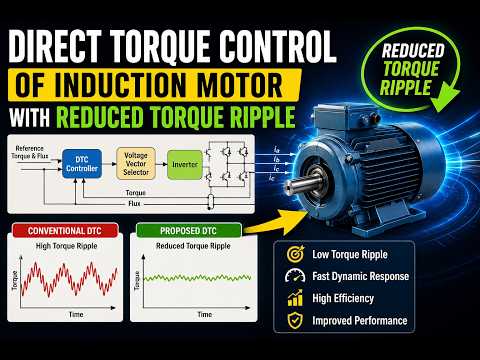
A three-phase voltage source inverter fed DTC motordrive produces eight switching state , comprising two zerostates(0 and 7) and six active states(1-6) to generate thespace vector PWM . The direct torque control (DTC) is the main interest and the torque, flux and sector is estimated and provided for the PI controllers, so that the flux, torque are compared with reference torque and flux and the change in torque and flux is provided along with sector to the switching table from which the pulses will be generated and provided to VSI for IM control. In this the torque reference is generated using speed control loop.
LITERATURE SURVEY
GVojkanKostic, MilutinPetronijevic, NebojsaMitrovic, BojanBankovicproposed “Experimental verification of direct torque control methods for electric drive application” .In this paper, a modified switching algorithm for open-end winding induction motor drive with less number of switching states is implemented. The open-end winding induction motor requires two voltage sources operating in dual mode. With the help of two inverters, it generates 18 active voltage space vectors and three-level output voltage. The proposed algorithm is implemented to operate the induction motor drive only with two level output voltage. Hence, the proposed algorithm is implemented only with 6 active voltage vectors and 2 null vectors. By using the proposed algorithm the induction motor drive is operated with two-level voltage and requires 8 switching states, so it provides higher switching states redundancy. The effectiveness of proposed algorithm verified experimentally with DSpace DS-1104 and it is interfaced through MATLAB/Simulink RTI-model.
A. Alwadie,“High Performance Predictive Direct Torque Control Of Induction Motor Drives System”,This paper presents a practical implementation for direct torque control of induction motor drive. Control system experiment is proposed using Digital Signal Processor. This control scheme directly determines the switching states of the inverter and gives optimal characteristics for stator flux and torque control. A simple switching pattern for direct torque control algorithm for induction motor drives has been presented. The main results with the simple approach are greatly reduced torque pulsations, constant and controlled switching frequency. Results show that the simulation meets the experimental results.
SandaVictorinne PATURCA, Aurelian SARCA, Mircea COVRIG “A simple method of torque ripple reduction for direct torque control of PWM inverter fed induction machine drives”.In conventional Direct Torque Control (DTC), a single stator voltage vector of the inverter standard topology is selected every control sampling period, and it is maintained for the whole period. This makes the torque and stator flux reference values to be reached quickly, with a small number of inverter switchings, resulting in a very good dynamic response. However, by this switching technique, based on hysteresis, large and small torque and flux errors are not distinguished, which cause an extra torque ripple in motor steady state operation. To overcome this problem, this paper proposes a simple solution, which consists in the modulation of the nonzero voltage vector duration over a sampling period, according to the instant values of the torque and stator flux errors. The introduced duty ratio is calculated using a relation containtaining terms proportional to these errors. The presented results show the torque, flux and current ripple reduction obtained by using the proposed method. Its main advantage is that it requires an insignificant additional computation, preserving the simplicity of the conventional DTC.
SebtiBelkacem, FaridNaceri, RachidAbdessemed ,“Reduction of torque ripple in DTC for induction motor using input-output feedback linearization”.Direct torque control (DTC) is known to produce fast responses and robust control in AC adjustable-speed drives. However, in the steady-state operation, notable torque, flux, and current pulsations occur. In this paper, nonlinear DTC of induction motor drives is presented based on a space vector pulse-width modulation scheme combined with the input-output feedback linearization technique. The variation of stator and rotor resistance due to changes in temperature or frequency deteriorates the performance of the DTC controller by introducing errors in the estimated flux linkage and the electromagnetic torque. This approach will not be suitable for high power drives such as those used in tractions, as they require good torque control performance at a considerably lower frequency. Finally, extensive simulation results are presented to validate the proposed technique. The system is tested at different speeds and a very satisfactory performance is achieved.
YongchangZhang , and Jianguo Zhu , “Direct Torque Control of Permanent Magnet Synchronous Motor With Reduced Torque Ripple and Commutation Frequency” .In conventional direct torque controlled (DTC) permanent magnet synchronous motor drive, there is usually undesired torque and flux ripple. The existing literature have proposed some methods to reduce torque and flux ripple by optimizing the duty ratio of the active vector. However, these methods are usually complicated and parameter dependent. This paper first compares the performances of three duty determination methods in detail and then proposes a very simple but effective method to obtain the duty ratio. The novel method is superior to the existing methods in terms of simplicity and robustness. By appropriately arranging the sequence of the vectors, the commutation frequency is reduced effectively without performance degradation. To further improve the performance of system, a low-pass filter-based voltage model with compensations of amplitude and phase is employed to acquire accurate stator flux estimation. The proposed scheme is able to reduce the torque and flux ripple significantly while maintaining the simplicity and robustness of conventional DTC at the most. Simulations and presented experimental results validate the effectiveness of the proposed schemes in this paper.
M. Harsha Vardhan Reddy, V. Jegathesan. “Open Loop V/f Control of Induction Motor based on hybrid PWM With reduced torque ripple”.Voltage source inverter (VSI) fed induction motors are widely used in variable speed applications. Space Vector Pulse Width Modulation (SVPWM) has become the successful techniques to construct three phase sine wave Voltage Source Inverter (VSI) parallel to control three-phase induction motor using v/f control. Because of the low maintenance and robustness induction motors have many applications in the industries. The speed control of induction motor is more important to achieve maximum torque and efficiency. VSI fed induction motor produces a pulsating torque due to the application of non sinusoidal voltages. Among the various modulation strategies Space Vector pulse width Modulation Technique is the efficient one because it has better spectral performance and output voltage is more closed to sinusoidal. Torque pulsation is strongly influenced by PWM technique used. This paper compares the torque ripples of convectional space vector PWM with hybrid PWM techniques. In hybrid PWM both continuous PWM and discontinuous PWM techniques are employed. The open loop V/f control of induction motor with hybrid PWM shows better reduction in torque ripples when compared with conventional space vector PWM technique. The simulated design is tested using MATLAB 7.8.
Okoro, O.I., "Dynamic and thermal modeling of induction machine with non-linear effects".This paper describes a modular simulation system developed by the authors to study analyze the electromagnetic and thermal response of an induction motor. This system considers the influence of skin effect in the rotor parameters. A linear thermal model with lumped parameters is assumed. The model is validated with the results from the paper of McCoy, Martiny and Margolis
K. L. SHI, T.F. CHAN, Y. K.WONG and S.L.HO,“Modelling and Simulation of three-phase induction motor using simulink” .This paper describes a generalized simulation model of the three-phase induction motor using the SIMULINK software package of MATLAB. The model is based on two-axis theory of revolving frame transformation. The model takes power source and load torque as inputs and gives speed and electromagnetic torque as outputs. Internal resistance of the power supply and magnetic saturation of the motor may also be accounted for.
M.SunilKumar ,A.V.NareshBabu , “Implementation of Direct Torque Control based on space vector modulation for induction motor”.The basic concept of direct torque control of induction machines is investigated in order to emphasize the effects produced by a given voltage vector on stator flux and torque variations. The low number of voltage vectors which can be applied to the machine using the basic DTC scheme may cause undesired torque and current ripple. An improvement of the drive performance can be obtained using a new DTC algorithm based on the application of the space vector modulation (SVM) for prefixed time intervals. In this way a sort of discrete space vector modulation (DSVM) is introduced. Numerical simulations and experimental tests have been carried out to validate the proposed method.
Block Diagram