ABSTRACT
The rapid growth of medical data across geographically distributed healthcare institutions has created a critical need for collaborative learning frameworks that preserve data privacy while enabling accurate and efficient model training. Traditional centralized machine learning approaches require sensitive patient data to be transferred to a central server, raising serious concerns related to data leakage, regulatory compliance, and ethical governance. To address these challenges, this project presents a privacy-preserving federated learning framework for medical image classification using CKKS homomorphic encryption. The proposed system enables multiple medical clients, such as hospitals, to collaboratively train a global machine learning model without sharing raw patient data or unencrypted model parameters. Each client locally trains a neural network on its private dataset and encrypts the learned model weights using the CKKS scheme implemented through the TenSEAL library. These encrypted weights are transmitted to a central server built using the Flower federated learning framework, where secure aggregation is performed directly on encrypted parameters without exposing sensitive information. The server decrypts and averages the received weights using a secure context, re-encrypts the aggregated global model, and redistributes it to participating clients for subsequent training rounds. Global model performance is evaluated after each round by aggregating loss and accuracy metrics reported by clients, and the best-performing model is preserved for deployment. To ensure computational efficiency and reduce communication overhead, dimensionality reduction techniques such as standard scaling and principal component analysis are employed before model training. A lightweight multilayer perceptron classifier is used for classification, balancing performance and encryption compatibility. Furthermore, the system includes a graphical user interface for secure image-based prediction, enabling end-users to select medical images and receive classification results without exposing internal model parameters. Experimental evaluation demonstrates that the proposed approach achieves reliable classification accuracy while maintaining strong privacy guarantees, making it suitable for real-world healthcare environments where data confidentiality is paramount. This project highlights the practical feasibility of integrating federated learning with homomorphic encryption to build secure, scalable, and privacy-aware medical decision-support systems.
INTRODUCTION
The digital transformation of the healthcare sector has resulted in the exponential growth of medical data generated from diverse sources such as hospitals, diagnostic centers, wearable devices, and medical imaging systems. Advances in machine learning and deep learning have demonstrated significant potential in extracting meaningful insights from such large-scale medical data, particularly in disease diagnosis, prognosis, and treatment planning. Medical image classification, in particular, has emerged as a critical application area where automated systems can assist clinicians in identifying pathological patterns with high accuracy and consistency. However, despite the promising performance of machine learning models, the adoption of centralized learning paradigms in healthcare environments remains limited due to stringent privacy regulations, ethical concerns, and the sensitive nature of patient data. Laws such as HIPAA and GDPR impose strict restrictions on the sharing and centralization of personal health information, making traditional data aggregation approaches impractical or legally infeasible. Consequently, there is an urgent need for learning frameworks that can leverage distributed medical data while ensuring strong privacy protection and data confidentiality.
Federated learning has emerged as a powerful paradigm that addresses the limitations of centralized machine learning by enabling collaborative model training across multiple decentralized clients without requiring the exchange of raw data. In a federated learning environment, each participating client, such as a hospital or medical institution, trains a local model using its own private dataset and shares only model updates with a coordinating server. The server aggregates these updates to construct a global model, which is then redistributed to clients for further refinement. This decentralized approach significantly reduces the risk of direct data exposure and allows institutions to benefit from collective learning while retaining full control over their local data. Federated learning is particularly well suited for healthcare applications, where data is naturally distributed across institutions and privacy preservation is of paramount importance. However, despite its advantages, federated learning is not inherently secure against information leakage, as model updates themselves may reveal sensitive information through inference attacks, gradient leakage, or malicious adversarial analysis.
To enhance the privacy guarantees of federated learning systems, cryptographic techniques have been increasingly integrated into the federated learning pipeline. Among these techniques, homomorphic encryption has gained significant attention due to its ability to perform mathematical operations directly on encrypted data without requiring decryption. This property enables secure computation in untrusted environments, ensuring that sensitive information remains protected throughout the learning process. The CKKS homomorphic encryption scheme, in particular, is well suited for machine learning applications as it supports approximate arithmetic on real-valued numbers, which are commonly used in neural network weights and gradients. By encrypting model parameters using CKKS, federated learning systems can prevent the central server from accessing plaintext model updates, thereby mitigating the risk of information leakage and enhancing trust among participating clients. Integrating homomorphic encryption into federated learning, however, introduces additional challenges related to computational overhead, communication efficiency, and system scalability, which must be carefully addressed in practical implementations.
This project presents a secure and privacy-preserving federated learning framework for medical image classification that integrates CKKS homomorphic encryption with the Flower federated learning platform. The proposed system is designed to enable multiple healthcare clients to collaboratively train a global classification model without sharing raw medical images or unencrypted model parameters. Each client locally trains a neural network model using its private dataset and encrypts the resulting model weights using the CKKS encryption scheme implemented through the TenSEAL library. These encrypted weights are transmitted to a central federated server, which performs secure aggregation by decrypting, averaging, and re-encrypting the model parameters within a protected cryptographic context. By ensuring that sensitive information is never exposed in plaintext during transmission or aggregation, the system provides a robust privacy-preserving learning environment suitable for real-world healthcare applications.
OBJECTIVES
The primary objective of this project is to design and implement a secure and privacy-preserving federated learning framework for medical image classification that enables collaborative model training across multiple distributed healthcare institutions without sharing raw patient data. The system aims to overcome the limitations of centralized machine learning approaches by allowing each participating client to retain full ownership and control over its local dataset while still benefiting from a globally trained model. By leveraging federated learning principles, the project seeks to facilitate cooperative intelligence among independent medical entities, thereby improving model generalization and diagnostic accuracy while adhering to strict data privacy requirements and regulatory constraints. Another key objective of this project is to enhance the privacy guarantees of federated learning by integrating homomorphic encryption into the model aggregation process. Standard federated learning systems expose model updates in plaintext to the central server, which can lead to indirect leakage of sensitive information. To address this vulnerability, the project aims to employ the CKKS homomorphic encryption scheme to encrypt model parameters before transmission, ensuring that sensitive information remains protected throughout the learning lifecycle. The use of TenSEAL for implementing CKKS encryption enables secure mathematical operations on encrypted weights, allowing the central server to perform aggregation without accessing plaintext parameters. This objective directly contributes to building trust among participating institutions and strengthens the overall security of the collaborative learning framework.
Block Diagram
SYSTEM REQUIREMENTS
Hardware Requirements
• A personal computer or workstation with a minimum Intel Core i5 or equivalent processor is required to ensure efficient execution of federated learning and encryption operations.
• A minimum of 8 GB RAM is recommended to handle model training, encrypted computations, and data preprocessing tasks without performance degradation.
• At least 256 GB of hard disk or solid-state storage is required to store datasets, trained models, encryption contexts, and project files.
• A GPU (NVIDIA CUDA-enabled) is optional but recommended to accelerate neural network training and inference processes.
• Stable network connectivity is required to support communication between federated clients and the central server during training rounds.
• Standard input devices such as a keyboard and mouse are required for system interaction and configuration.
• A display monitor with minimum HD resolution is necessary for visualization of results and GUI-based prediction output.
• Power supply with uninterrupted operation is recommended to avoid interruptions during federated learning rounds.
Software Requirements
• Operating System: Windows 10 / Linux (Ubuntu 20.04 or higher) for compatibility with Python-based machine learning libraries.
• Programming Language: Python 3.8 or higher for implementing federated learning, encryption, and neural network models.
• Federated Learning Framework: Flower (flwr) for managing client-server communication and model aggregation.
• Encryption Library: TenSEAL for implementing CKKS homomorphic encryption and secure model aggregation.
• Machine Learning Framework: PyTorch for building, training, and deploying the neural network model.
• Scientific Computing Libraries: NumPy and SciPy for numerical computations and matrix operations.
• Data Processing Libraries: Scikit-learn for feature scaling, dimensionality reduction, and evaluation metrics.
• Image Processing Library: Pillow (PIL) for image loading and preprocessing operations.
• Visualization Library: Matplotlib for plotting global loss and accuracy metrics.
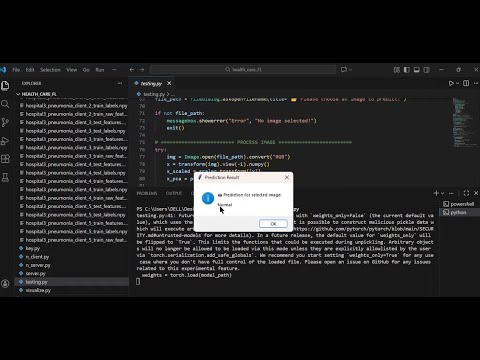
• GUI Library: Tkinter for implementing the graphical user interface for image-based prediction.
• Development Environment: Visual Studio Code or any Python-supported IDE for development and debugging.
• Package Manager: pip or conda for installing and managing Python dependencies.