ABSTRACT
Agriculture is a fundamental sector that supports human survival and economic development. However, one of the major challenges faced by farmers is the uncontrolled growth of weeds among crops. Weeds compete with crops for essential resources such as nutrients, water, sunlight, and space, leading to a significant reduction in crop yield and quality. Traditional weed control methods, including manual removal and chemical herbicides, are either labor-intensive, time-consuming, or harmful to the environment. Therefore, there is a need for an efficient, automated, and eco-friendly solution to address this issue.
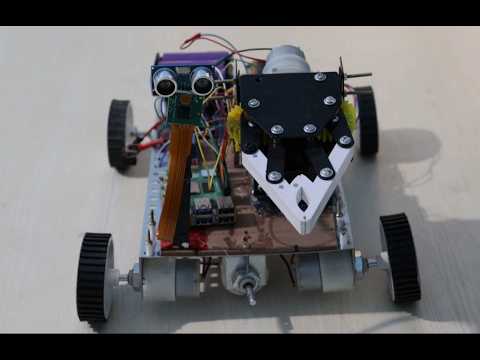
This project presents a Deep Learning Based Crop Detection and Weed Plucking system that utilizes modern technologies such as computer vision, embedded systems, and robotics. The system is designed using a Raspberry Pi as the main processing unit, along with a Raspberry Pi camera for capturing real-time images of the field. A YOLO (You Only Look Once) object detection model is implemented to accurately identify and classify plants as either crops or weeds.
Once the image is captured, it is processed by the YOLO model, which detects objects in real time and provides classification results with high accuracy. Based on the detection output, the system makes intelligent decisions. If a crop is detected, no action is taken, ensuring that the plant remains undisturbed. However, if a weed is identified, the system activates a cutter mechanism and a robotic arm to remove the unwanted plant effectively.
An ultrasonic sensor is incorporated to measure the distance between the device and the target plant, enabling precise positioning for cutting and plucking operations. Additionally, an LCD display is used to provide real-time feedback to the user, such as detection results and system status messages. This enhances the usability and monitoring capability of the system.
The proposed system offers several advantages, including reduced human effort, improved accuracy in weed detection, and minimal environmental impact due to reduced reliance on chemical herbicides. It also supports real-time operation, making it suitable for practical agricultural applications. The integration of deep learning with hardware components ensures efficient and intelligent functioning.
INTRODUCTION
Agriculture is the backbone of many economies and plays a crucial role in ensuring food security for the growing global population. With the continuous increase in population, the demand for higher agricultural productivity has also increased significantly. However, farmers face several challenges such as climate change, labor shortages, pest infestations, and weed growth, which directly affect crop yield and quality. Among these challenges, weed infestation is one of the most critical issues that must be addressed efficiently.
Weeds are unwanted plants that grow alongside crops and compete for essential resources such as nutrients, water, sunlight, and space. This competition leads to reduced crop growth, lower yields, and poor quality produce. In severe cases, weeds can completely destroy crop productivity if not controlled properly. Traditionally, farmers rely on manual labor to remove weeds or use chemical herbicides to control their growth. Manual weeding is time-consuming, labor-intensive, and not feasible for large-scale farming. On the other hand, chemical methods, although effective, can harm the environment, degrade soil quality, and pose health risks to humans and animals.
In recent years, advancements in technology have introduced new possibilities for improving agricultural practices. The integration of Artificial Intelligence (AI), Machine Learning (ML), and Deep Learning (DL) has enabled the development of smart farming systems that can automate various agricultural tasks. Among these technologies, computer vision has gained significant attention for its ability to analyze images and identify objects with high accuracy. This capability can be effectively used in agriculture for tasks such as crop monitoring, disease detection, and weed identification.
Deep learning, a subset of machine learning, uses neural networks with multiple layers to learn complex patterns from data. Convolutional Neural Networks (CNNs) are particularly effective in image processing tasks. One of the most popular object detection algorithms based on deep learning is YOLO (You Only Look Once). YOLO is known for its high speed and accuracy in real-time object detection, making it suitable for applications where quick decision-making is required. In this project, the YOLO model is used to detect and classify plants as either crops or weeds.
The proposed system utilizes a Raspberry Pi, which is a compact and cost-effective single-board computer, as the main processing unit. The Raspberry Pi is connected to a camera module that captures real-time images of the agricultural field. These images are then processed using the YOLO model to identify the type of plant present. Based on the detection results, the system takes appropriate action.
To automate the weed removal process, the system is equipped with a cutter mechanism and a robotic arm. When a weed is detected, the cutter is activated to remove the unwanted plant, and the robotic arm assists in plucking it from the soil. This ensures precise and efficient weed removal without affecting nearby crops. Additionally, an ultrasonic sensor is used to measure the distance between the system and the plant, enabling accurate positioning and operation of the cutter and robotic arm.
An LCD display is integrated into the system to provide real-time feedback to the user. It displays information such as whether a crop or weed is detected, system status, and operation messages. This improves user interaction and allows easy monitoring of the system's performance.
The combination of deep learning, embedded systems, and robotics makes this project a powerful solution for modern agriculture. It reduces dependency on manual labor, minimizes the use of harmful chemicals, and increases overall efficiency. The system is particularly useful for small and medium-scale farmers who require cost-effective solutions for improving productivity.
Furthermore, this project contributes to the concept of precision agriculture, where resources are used efficiently, and farming operations are optimized using advanced technologies. By accurately identifying and removing weeds, the system helps in maintaining healthy crop growth and improving yield quality.
In conclusion, the integration of AI-based detection systems with automated mechanical components provides a smart and sustainable approach to weed management. This project demonstrates how modern technologies can be applied to solve real-world agricultural problems effectively. It opens the door for future enhancements such as integrating IoT for remote monitoring, GPS for navigation in large fields, and advanced models for improved detection accuracy.
OBJECTIVE
The primary objective of this project is to design and develop an intelligent and automated system for crop detection and weed removal using deep learning and embedded system technologies. The system aims to improve agricultural productivity by reducing manual labor and minimizing the use of harmful chemical herbicides. By integrating computer vision, machine learning, and robotics, the proposed solution provides a smart approach to precision farming.
One of the key objectives is to implement a real-time object detection system using the YOLO (You Only Look Once) model. This model is trained to accurately distinguish between crops and weeds based on image data captured from the field. The use of deep learning ensures high accuracy and fast processing, making it suitable for real-time agricultural applications.
Another important objective is to utilize a Raspberry Pi as the central processing unit for handling image processing, decision-making, and hardware control. The Raspberry Pi camera module is used to capture real-time images, which are then analyzed by the YOLO model. Based on the detection results, the system makes intelligent decisions regarding whether to remove the detected plant or not.
The project also aims to automate the weed removal process using a cutter mechanism and a robotic arm. When a weed is identified, the system activates the cutter to remove it and uses the robotic arm to pluck it from the soil. This ensures precise and efficient weed removal without damaging nearby crops. The inclusion of an ultrasonic sensor further enhances the system by providing accurate distance measurement for proper positioning and operation.
Additionally, the system includes an LCD display to provide real-time feedback to the user. It displays information such as detection results, system status, and operation messages, improving usability and monitoring. The project also aims to develop a cost-effective and energy-efficient solution that can be easily deployed in small and medium-scale farms.
Overall, the objective of this project is to create a reliable, efficient, and eco-friendly system that leverages modern technologies to address the challenges of weed management in agriculture. It contributes to the advancement of smart farming techniques and supports sustainable agricultural practices.
Block Diagram