ABSTRACT
In recent years, the demand for secure, reliable, and cost-effective access control systems has increased significantly due to rising concerns over safety and unauthorized access. Traditional mechanical locking systems suffer from several limitations such as key loss, duplication, and lack of monitoring capabilities. To overcome these issues, this project presents the design and implementation of a Multi-Level Secure Door Lock System using Raspberry Pi, which provides enhanced security through electronic authentication mechanisms.
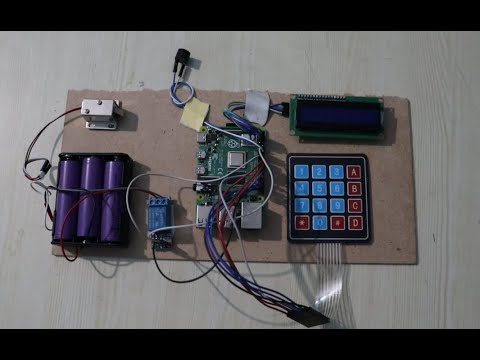
The proposed system utilizes a Raspberry Pi as the central processing unit to control and coordinate all system operations. A keypad is employed to allow users to enter a predefined password for authentication, while an OLED display provides real-time system feedback such as access prompts, authentication status, and error messages. A relay module is used to interface the Raspberry Pi with a door locking mechanism, enabling secure control of the lock based on authentication results.
When a user enters the correct password through the keypad, the Raspberry Pi validates the input and activates the relay to unlock the door for a specific duration. If an incorrect password is entered, access is denied and the system displays an alert message on the OLED screen. This multi-level verification approach significantly improves security and minimizes unauthorized access.
The system is designed to be compact, energy-efficient, and scalable, making it suitable for real-world applications such as homes, offices, laboratories, lockers, and restricted access areas. The use of Raspberry Pi allows easy integration with future enhancements such as biometric authentication, mobile application control, cloud monitoring, and Internet of Things (IoT) connectivity.
Overall, this project demonstrates a practical, affordable, and efficient electronic door locking solution that enhances security while maintaining ease of use. The proposed system effectively replaces traditional locking mechanisms and contributes to the development of smart and intelligent security systems.
INTRODUCTION
In the modern world, security has become one of the most critical concerns for individuals, organizations, and institutions. With rapid urbanization, increasing population, and the growth of shared spaces such as offices, hostels, laboratories, banks, and apartments, the need for reliable and efficient access control systems has significantly increased. Traditional locking mechanisms such as mechanical locks and keys have been widely used for decades; however, they suffer from several drawbacks including key loss, unauthorized duplication, lack of monitoring, and limited flexibility. These limitations highlight the necessity for smarter and more secure alternatives.
The advancement of embedded systems and low-cost computing platforms has enabled the development of intelligent security solutions that are more robust, flexible, and user-friendly. Among these platforms, the Raspberry Pi has emerged as a powerful and affordable single-board computer capable of performing complex processing tasks while interfacing with various hardware components. Its ability to support programming languages such as Python and to communicate with sensors and actuators makes it an ideal choice for designing smart security systems.
Electronic door lock systems provide enhanced security by replacing conventional keys with digital authentication methods such as passwords, access codes, or biometric verification. Password-based authentication using a keypad is one of the most widely adopted and cost-effective methods due to its simplicity and reliability. By combining keypad-based authentication with a processing unit like the Raspberry Pi, it is possible to design a secure access control system that prevents unauthorized entry while allowing easy access for authorized users.
In this project, a Multi-Level Secure Door Lock System using Raspberry Pi is proposed to address the limitations of traditional locking systems. The system uses a keypad for password entry, an OLED display for real-time user interaction, a relay module for controlling the locking mechanism, and an electronic door lock to physically secure the door. The Raspberry Pi acts as the central controller, managing authentication logic and controlling the hardware components based on user input.
The OLED display plays an important role in improving user experience by providing clear and immediate feedback. Messages such as “Enter Password,” “Access Granted,” and “Access Denied” are displayed, making the system intuitive and easy to use. This eliminates confusion and enhances usability, especially in environments where multiple users interact with the system. The relay module serves as an interface between the low-power Raspberry Pi and the high-power door lock, ensuring safe and reliable operation.
Security is further enhanced by implementing controlled access logic within the Raspberry Pi. Only when the correct password is entered does the system activate the relay to unlock the door for a predefined time interval. In the case of incorrect password attempts, access is denied, and the door remains locked. This approach significantly reduces the risk of unauthorized access and improves overall safety.
The proposed system is designed to be scalable and adaptable. Additional features such as alarm systems, camera-based surveillance, biometric authentication, or Internet of Things (IoT) integration can be easily incorporated in the future. This flexibility makes the system suitable for a wide range of applications, including residential security, office access control, laboratory protection, electronic lockers, and smart building systems.
Another important advantage of this project is its cost-effectiveness. By using readily available components such as Raspberry Pi, keypad, and OLED display, the system can be implemented at a relatively low cost compared to commercial security solutions. Despite its affordability, the system provides a high level of security and reliability, making it practical for real-world deployment.
From an educational perspective, this project offers hands-on experience in embedded systems, hardware interfacing, and software development. It helps students understand concepts such as GPIO programming, digital input/output control, real-time system feedback, and basic security logic. The project also demonstrates how software and hardware can work together to solve real-life problems.
In conclusion, the Multi-Level Secure Door Lock System using Raspberry Pi represents a modern approach to access control by combining embedded computing with electronic authentication. The system effectively overcomes the limitations of traditional locks and provides a secure, user-friendly, and expandable solution.
OBJECTIVES OF THE PROJECT
1. To design and develop a secure electronic door lock system using Raspberry Pi.
2. To replace traditional mechanical locking systems with a digital and automated access control mechanism.
3. To implement password-based authentication using a keypad for authorized access.
4. To provide real-time user interaction and system status display using an OLED screen.
5. To control the door locking and unlocking mechanism through a relay module.
6. To ensure enhanced security by allowing access only after successful authentication.
7. To minimize unauthorized access and improve safety in restricted areas.
8. To design a reliable and user-friendly interface for easy operation.
9. To integrate hardware and software components effectively using embedded system concepts.
10. To develop a cost-effective and energy-efficient security solution suitable for real-world applications.
11. To provide a scalable system architecture that supports future enhancements.
12. To improve system reliability by implementing controlled access logic.
13. To demonstrate the practical application of Raspberry Pi in security-based systems.
14. To enhance learning and understanding of GPIO interfacing and Python programming.
15. To implement a smart access control system applicable to homes, offices, lockers, and laboratories.
Block Diagram