ABSTRACT:
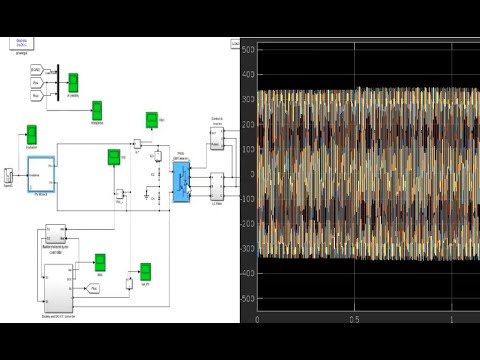
In this, a bidirectional DC-DC converter is designed and integrated with PV standalone inverter for continuous supply to the loads. A switching control strategy (SCS) for a bidirectional DC/DC converter is proposed with the aim of managing the power that the battery has to deliver or absorb following a requirement of loads and availability of the PV source. For that purpose, the converter is modelled as a switched linear system. Based on hysteresis and logic switching, a switching rule is designed. Necessary and sufficient conditions for the existence of the switching rule are established. The transient changes in the sources are used to test the converter from one scenario to another under different conditions. The proposed system is simulated in MATLAB/Simulink software.
INTRODUCTION
With the increasing integration of the distributed renewable energy resources (RESs) like wind turbine and photovoltaic (PV) array to the grid, the trend moves away from the large centralized to distributed power generation. However, due to the intermittence characteristic of the renewable energy, energy storage devices such as battery are usually used to buffer the weather dependent unstable power generation. Micro grids have emerged as a promising way of organizing and coordinating the operation of distributed energy resources (DER). The organization of DERs to a micro grid before connecting to the existing grid has several advantages. First, using the different energy sources can mitigate the uncertainties of the renewable energy, e.g., wind and solar energy is complementary with each other. Second, the power management within a micro grid makes it a better generation power profile than a standalone renewable energy system. To manage power flow in the micro grid as well as the energy sources, power converters are desired to absorb the surplus power generated by RESs or supply deficient power to the micro grid. Generally, there are mainly two ways to integrate multiple energy sources to the grid. One is to use multiple converters, e.g., an independent converter for each source; the other is to use an integrated converter with capability of interfacing multiple sources, namely a multiport converter. Compared to the former method, using a dc-dc converter can achieve more compact structure and higher power density since some components can be shared. Besides, it does not require board-to-board communications and power flow can be managed by a centralized controller. Therefore, the latter solution is preferable. Most of existing converters which interface an energy source, battery, and the load (or DC-link) are three-port. A lot of DC-DC converters with different topologies were reported, including interleaved buck-boost and boost topologies, dual active bridge, full bridges, Z-source converter, the three-phase structure, and LLC resonant configuration. However, these converters cannot be directly used for interfacing more than three sources and an extra port needs to be extended. In addition, the majority of three-port converter (TPC) cannot be simply extended for bidirectional application, only few four-port topologies can be derived from the TPC without adding too many components. Moreover, in most of bidirectional TPC, only battery has the bidirectional port, and the battery can be charged by the RES only. Compared to the TPC, less research work has been done for the bidirectional converter. Many papers contribute to the design of a bidirectional converters to connect storage. The bidirectional port in most of existing converters is only designed for the battery, i.e., the battery is charged by the RES and discharged to the DC-link. Furthermore, the polarity of the battery current is changed within a switching period, e.g., the current is fluctuated at the high frequency. Such a high-frequency charge/discharge has a negative effect on the battery lifetime. Due to the lack of the bidirectional port at the DC-Link, the energy in the micro grid cannot be stored in the battery. The ‘use or waste’ issue cannot be solved when the micro grid works in the island mode. Therefore, these converters are suitable for the standalone applications, e.g., satellite application, electric vehicle, PV-battery system, hybrid renewable energy system. When the micro grid works in the island mode, both battery and DC-link are desired to be bidirectional ports to solve the ‘use or waste’ issue at the system level. Some units generate more renewable energy and their battery are fully charged, while some units generate less power and the state of the charge (SOC) of the battery is low, the surplus power in the micro grid then can be stored in the battery with the reversed power flow. In the past decade, several four-port converters with two bidirectional ports are proposed. These topologies may lead to battery current fluctuation and an increase in circuit complexity or component ratings.
PROBLEM STATEMENT
In this, the BBBCs are analysed as the BBBC is in broad area of renewable energy systems where BBBC is used to charge the battery when the load is running smoothly from source. When transients and overload condition occur across PV source and loads, BBBC starts working in forward mode to discharge the battery to the load. As the load is AC load, DC-AC converter is connected between BBBC and the load. A control structure is formulated for both forward and reverse power flow methods for charging the battery and regulating the dc bus voltage.
Block Diagram





















.png)