ABSTRACT
The proposed IoT-Based Smart Irrigation System Using Machine Learning for Weather Prediction and Automated Water Management is designed to improve agricultural water management through the integration of Internet of Things (IoT) technology, machine learning techniques, and automated irrigation control. Conventional irrigation practices often depend on manual monitoring and fixed watering schedules, which may result in excessive water consumption, inefficient resource utilization, and inadequate consideration of changing environmental conditions. To address these limitations, the proposed system continuously monitors essential agricultural parameters, including temperature, atmospheric humidity, and soil moisture, through connected sensor devices. The collected sensor readings are transmitted to a Flask-based web application through an IoT application programming interface (API), enabling real-time data acquisition, processing, visualization, and irrigation management. Machine learning techniques are incorporated to analyse the environmental parameters and predict the possibility of rainfall, thereby supporting intelligent irrigation decisions based on prevailing weather conditions. The model development process involves dataset preprocessing, removal of invalid records, feature extraction, and the division of the prepared dataset into training and testing subsets. Temporal features such as hour, day of the week, and month are also extracted from timestamp information to improve the model's ability to identify variations in environmental patterns. Four machine learning classification algorithms, namely Random Forest, Extra Trees, Gradient Boosting, and Histogram-based Gradient Boosting, are evaluated using stratified cross-validation. The most suitable model is selected based on its mean validation F1-score and subsequently saved for integration into the application. During system operation, the predicted rainfall condition is combined with the measured soil moisture level to determine the appropriate irrigation action. The implemented control mechanism considers rainfall predictions and soil moisture thresholds to determine whether the water pump should be activated or deactivated. When rainfall is expected, the system prevents unnecessary irrigation by keeping the pump switched off. Under dry soil conditions without expected rainfall, the pump is activated through a remote API-based control mechanism, while sufficient soil moisture results in the pump being deactivated. The application is developed using the Flask framework and incorporates a SQLite database to maintain user information and sensor history records. Authentication facilities, including user registration, login, session management, and protected application access, are provided to ensure controlled access to the system. Additionally, the application supports live sensor monitoring, irrigation status updates, historical data management, and forecast-related information. By combining real-time environmental monitoring, machine learning-based rainfall prediction, and automated pump control, the proposed system aims to minimize unnecessary water usage, reduce manual intervention, and improve the efficiency of irrigation operations. Overall, the system provides an intelligent and integrated approach to agricultural water management by utilizing data-driven predictions and IoT-based automation to support more efficient and sustainable irrigation practices.
INTRODUCTION
Agriculture is one of the most important sectors contributing to economic development, food production, and the livelihood of a large proportion of the global population. The productivity of agricultural activities is strongly influenced by the availability and effective utilization of natural resources, particularly water. Irrigation plays a significant role in maintaining soil moisture and providing crops with the required amount of water for healthy growth and development. However, conventional irrigation practices generally depend on manual observation, fixed watering schedules, and the experience of farmers. These methods may not accurately consider variations in soil moisture, atmospheric humidity, temperature, and changing weather conditions. As a result, water may be supplied even when the soil already contains sufficient moisture or when rainfall is expected. Such practices can lead to unnecessary water consumption, inefficient irrigation management, and increased agricultural operating costs. Therefore, the development of an intelligent irrigation system capable of monitoring environmental conditions and making automated irrigation decisions has become an important requirement for improving agricultural efficiency and promoting sustainable water utilization.
The Internet of Things (IoT) provides an effective technological approach for monitoring agricultural environments through interconnected sensors and communication systems. IoT-based agricultural applications enable the collection and transmission of real-time information from different locations without requiring continuous manual intervention. In a smart irrigation environment, sensors can be used to measure important parameters such as soil moisture, temperature, and atmospheric humidity. Soil moisture indicates the amount of water available in the soil, while temperature and humidity provide additional information about the surrounding environmental conditions. These parameters are useful for understanding the irrigation requirements of agricultural fields and supporting appropriate water management decisions. By integrating sensor devices with a web-based monitoring platform, the collected information can be accessed, processed, and analysed systematically. This approach improves the availability of agricultural information and provides a foundation for implementing automated irrigation operations based on actual environmental conditions.
The proposed IoT-Based Smart Irrigation System Using Machine Learning for Weather Prediction and Automated Water Management integrates IoT technology, machine learning algorithms, and a web-based application to improve the efficiency of irrigation operations. The system collects temperature, humidity, and soil moisture measurements from connected sensor devices and retrieves the information through an application programming interface (API). The acquired sensor readings are processed by a Flask-based web application, which acts as the central platform for monitoring environmental conditions and controlling the irrigation mechanism. The system uses the collected information to analyse the current agricultural environment and determine whether irrigation is required. Instead of relying exclusively on soil moisture measurements, the proposed approach also considers the possibility of rainfall so that irrigation decisions can account for changing weather conditions. This combination of environmental monitoring and predictive analysis provides a more informed approach to automated water management.
Machine learning is an important component of the proposed system because it enables the identification of patterns in environmental data and the prediction of rainfall-related conditions. Weather variations directly influence the water requirements of agricultural crops, making rainfall prediction a useful factor in irrigation planning. The proposed model is developed using historical environmental data containing parameters such as temperature, humidity, and soil moisture. The target variable, represented by rain_expected, is used to train the classification models to identify whether rainfall is expected. During dataset preparation, invalid records are handled, relevant input features are selected, and optional temporal information is extracted from timestamp values. These temporal features include the hour, day of the week, and month, along with their corresponding cyclical representations. Such features help the model consider variations associated with different times and periods when analysing environmental conditions. The prepared dataset is divided into training and testing subsets using an 80:20 ratio, while stratified cross-validation is applied to support a systematic comparison of different classification algorithms.
The machine learning development process evaluates four classification algorithms, namely Random Forest, Extra Trees, Gradient Boosting, and Histogram-based Gradient Boosting. These algorithms are selected to compare their ability to identify rainfall-related patterns from the available environmental parameters. Random Forest and Extra Trees use multiple decision trees to generate classification results, whereas Gradient Boosting methods develop an ensemble of models by progressively improving prediction performance. The training process applies stratified four-fold cross-validation, and the models are compared using their mean validation F1-scores. Additional evaluation measures, including accuracy, precision, recall, F1-score, and ROC-AUC, are considered to assess the classification performance. Based on the validation comparison, the most suitable model is selected and saved as a serialized model file for integration into the Flask application. The trained model and its associated metadata provide the information required for performing predictions during system operation. This model comparison procedure helps identify an appropriate classification approach for the rainfall prediction task rather than depending on a single algorithm without evaluation.
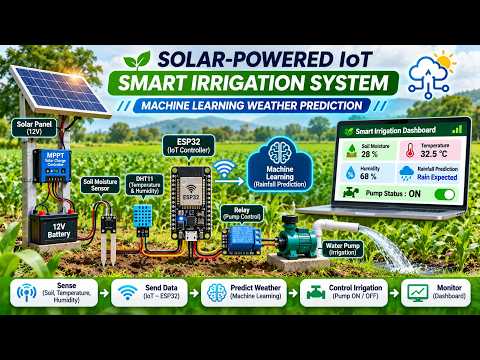
In the proposed system, the trained machine learning model analyses the environmental sensor readings and generates a prediction regarding the possibility of rainfall. The prediction is further considered along with humidity-based conditions to support the weather classification process. The application identifies whether rainfall is expected and distinguishes between different rainfall conditions based on the prediction probability and humidity thresholds implemented in the system. This information is subsequently combined with the measured soil moisture level to determine the appropriate irrigation action. Soil moisture is an important factor in deciding whether additional water should be supplied to the agricultural field. When rainfall is expected, the system keeps the water pump switched off to avoid unnecessary irrigation. When rainfall is not expected and the soil moisture level indicates a requirement for watering, the application activates the pump through the connected control API. When the soil moisture reaches a sufficient level, the pump is switched off. In the implemented application, the pump control logic uses soil moisture thresholds to distinguish between dry, irrigation-required, and sufficiently moist conditions. Consequently, the irrigation decision is based on both the current soil condition and the predicted weather condition.
The web application is developed using the Python Flask framework, which provides the necessary structure for integrating sensor communication, machine learning prediction, database operations, and irrigation control. Flask processes incoming requests, retrieves sensor information from the configured IoT API, executes the prediction process, and communicates the required pump command to the remote control API. The application also incorporates SQLite as its database management system for maintaining user information and historical sensor records. The database stores details such as temperature, humidity, soil moisture, pump status, and sensor timestamps. These stored records support the examination of previously collected environmental readings and irrigation activities. Duplicate sensor entries are handled using available API identifiers, timestamps, and sensor values to maintain more consistent historical records. The application also provides user registration, login, logout, and session-based access control. Passwords are stored using secure password-hashing techniques, and protected application routes are accessible only to authenticated users. These facilities establish a structured environment for accessing and managing the smart irrigation application.
Real-time monitoring is another important aspect of the proposed system. The application provides a mechanism for enabling or disabling the live sensor data-fetching process, allowing the monitoring activity to be controlled through the web interface. When live monitoring is active, the application retrieves the latest available sensor readings, processes the information, performs rainfall prediction, determines the irrigation requirement, and sends the corresponding pump command through the configured API. The resulting sensor measurements and pump status are stored in the database for future reference. The historical data management facility allows previously recorded sensor information to be accessed and maintained, while the forecast-related section provides access to stored records and model information. Through these integrated facilities, the application connects sensor-level data collection with machine learning analysis and remote irrigation control. This reduces the need for continuous manual observation and provides a centralized platform for monitoring the operation of the irrigation system.
The major objective of the proposed system is to improve irrigation management by combining real-time environmental monitoring with machine learning-based rainfall prediction. The integration of these technologies supports more appropriate irrigation decisions by considering both the moisture condition of the soil and the possibility of rainfall. Automated pump control helps prevent unnecessary water supply when the soil already contains sufficient moisture or rainfall is expected. Furthermore, the use of historical sensor records provides an opportunity to examine previous environmental conditions and irrigation activities. The machine learning component introduces a data-driven approach to weather classification, while the IoT infrastructure enables the application to obtain current sensor information and communicate with the irrigation control mechanism. Together, these components establish an integrated system for monitoring, prediction, and automated operation.
Overall, the proposed IoT-Based Smart Irrigation System provides a technology-oriented approach to improving agricultural water management through the effective integration of IoT, machine learning, and web application development. By analysing temperature, humidity, and soil moisture measurements, the system supports rainfall prediction and determines suitable irrigation actions through an automated control mechanism. The Flask application provides a centralized interface for user authentication, live monitoring, prediction processing, historical data storage, and pump operation. The use of machine learning algorithms for rainfall classification further enhances the decision-making process by incorporating environmental patterns into irrigation management. The proposed system is intended to reduce unnecessary water usage, minimize manual intervention, and improve the systematic utilization of available agricultural resources. Thus, the integration of intelligent prediction and automated irrigation control offers a practical foundation for developing more efficient and sustainable agricultural water management solutions.
Block Diagram