ABSTRACT
Solar photovoltaic (PV) systems are among the most widely deployed renewable energy technologies; however, their efficiency is significantly limited due to operating temperature rise and thermal losses. A considerable share of incident solar radiation is dissipated as heat, which reduces the power conversion efficiency of PV modules. This work investigates the analysis of a 320 W polycrystalline solar PV module consisting of 72 cells (Voc =40 V, Isc =9 A) and explores the integration of a thermoelectric generator (TEG, model TEC-12706) attached on the rear surface to harvest excess heat. The electrical behaviour of both PV and TEG is modelled using standard equations, and performance parameters are evaluated. Since the output of TEG modules is in the millivolt and microampere range, a boost converter is proposed to enhance the voltage for practical use. The combined PV–TEG approach demonstrates the potential for improved system efficiency by recovering excess heat in addition to conventional PV output. Since TEGs typically generate very low output voltages, a boost converter is developed and simulated using MATLAB/Simulink to elevate the voltage from as low as 2V to usable levels, reaching up to 48V for standard load applications. [20]
Index Terms—Solar photovoltaic (PV), Thermoelectric generator (TEG), Hybrid system, Boost converter, Energy efficiency, Excess heat utilisation.
INTRODUCTION
The increasing global demand for clean and sustainable energy has placed solar power at the forefront of the renewable energy revolution. Photovoltaic (PV) systems, which convert sunlight directly into electricity, have become one of the most widely adopted solutions for addressing the world's energy needs while reducing carbon emissions. With advancements in manufacturing and policy support, PV installations have grown rapidly across residential, commercial, and utility-scale sectors. However, maximizing the energy yield and reliability of PV systems requires a deep understanding of how environmental and operational factors influence their performance.
A single solar cell is a semiconductor device that converts sunlight into electrical energy through the photovoltaic effect. It is primarily composed of silicon and structured in multiple functional layers. At the top, a front contact made of fine conductive fingers collects and transmits the flow of electrons generated within the cell. Just beneath it lies an anti-reflective coating, which minimizes the reflection of sunlight and ensures that more light enters the cell for maximum efficiency. The core of the solar cell consists of two silicon layers with different doping: an n-type silicon layer, enriched with electrons, and a p-type silicon layer (note: the image incorrectly labels this as n-type), which has an abundance of holes or positive charge carriers. [2], [8]
The interface between these layers forms a p–n junction, creating an internal electric field. When photons from sunlight strike the cell, they energize electrons, creating electron–hole pairs. The electric field at the p–n junction drives these carriers apart, causing electrons to flow through an external circuit—producing electric current—before returning to the cell via the back contact. This layered design enables the solar cell to convert solar energy into usable direct current (DC) electricity efficiently. [2], [8]
A single solar cell is a semiconductor device that converts sunlight into electrical energy through the photovoltaic effect. It is primarily composed of silicon and structured in multiple functional layers. At the top, a front contact made of fine conductive fingers collects and transmits the flow of electrons generated within the cell. Just beneath it lies an anti-reflective coating, which minimizes the reflection of sunlight and ensures that more light enters the cell for maximum efficiency. The core of the solar cell consists of two silicon layers with different doping: an n-type silicon layer, enriched with electrons, and a p-type silicon layer (note: the image incorrectly labels this as n-type), which has an abundance of holes or positive charge carriers. [2], [8]
The interface between these layers forms a p–n junction, creating an internal electric field. When photons from sunlight strike the cell, they energize electrons, creating electron–hole pairs. The electric field at the p–n junction drives these carriers apart, causing electrons to flow through an external circuit—producing electric current—before returning to the cell via the back contact. This layered design enables the solar cell to convert solar energy into usable direct current (DC) electricity efficiently. [2], [8]
A single solar cell is a semiconductor device that converts sunlight into electrical energy through the photovoltaic effect. It is primarily composed of silicon and structured in multiple functional layers. At the top, a front contact made of fine conductive fingers collects and transmits the flow of electrons generated within the cell. Just beneath it lies an anti-reflective coating, which minimizes the reflection of sunlight and ensures that more light enters the cell for maximum efficiency. [2], [8]
The core of the solar cell consists of two silicon layers with different doping: an n-type silicon layer, enriched with electrons, and a p-type silicon layer (note: the image incorrectly labels this as n-type), which has an abundance of holes or positive charge carriers. The interface between these layers forms a p–n junction, creating an internal electric field. When photons from sunlight strike the cell, they energize electrons, creating electron–hole pairs. The electric field at the p–n junction drives these carriers apart, causing electrons to flow through an external circuit—producing electric current—before returning to the cell via the back contact. This layered design enables the solar cell to convert solar energy into usable direct current (DC) electricity efficiently. [2], [8]
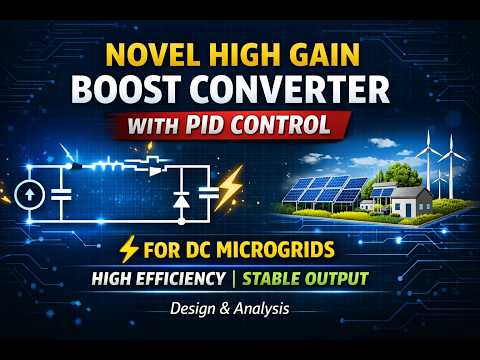
The high-gain DC-DC boost converters are essential in converting small input direct current (DC) voltage ranging from a few volts to substantially higher DC voltage levels. These DC-DC converters must have a constant input current and step-up capabilities. Such converters are used in various applications like solar photovoltaic (PV) systems, robotics, high-voltage DC systems, and electric vehicles. The energy produced by sources like fuel cells or solar photovoltaic is quite low and the required output voltage is relatively high for various household and industrial applications. These pressing concerns enable the researchers to focus more on the development of high-step-up DC-DC converters. DC-DC converters consist of various arrangements of inductors, capacitors, diodes, and switches. These components are interconnected to enable energy exchange between inductors and capacitors. The process begins with the exchange of stored energy in the inductors. Subsequently, this stored energy is transferred to the capacitors, resulting in the achievement of a higher voltage level. In a DC microgrid, a high-gain DC-DC converter regulates the DC voltage to a specified level. Modern DC microgrids employ a combination of supercapacitors and a high-gain DC-DC converter. In the islanded mode operation of a DC microgrid, it is common practice to pair an inverter with a high-gain DC-DC converter to supply alternating current (AC) loads. High-gain DC-DC converters have increasingly become a popular alternative to traditional boost converters and their derivatives. The conventional DC-DC boost converter has some drawbacks. These include high voltage stress, upswing electromagnetic interference (EMI), intolerable input current ripples, and low efficiency at light load conditions and therefore it is unsuitable in practical applications where the duty ratio exceeds a predetermined threshold value. DC-DC converters serve as a bridge between the source and the load. These converters are generally categorized into isolated and non-isolated types. Conventional boost converters must operate at higher duty ratio values when integrated with microgrids. This results in a significant amount of current and voltage stress on the converter. As the duty ratio increases, the parasitic resistance (ESR) of the capacitor and inductor experiences a substantial rise, resulting in a significant loss in voltage gain and efficiency of the boost converter. Non-isolated converters are further classified as coupled inductor and noncoupled inductor-based configurations. An isolated converter creates electrical isolation between the input power supply and load. It effectively divides the circuit into two distinct sections to prevent the direct flow of current by incorporating a high-frequency transformer. However, it leads to an increase in both the size and expense of the converter. Isolated configurations are preferred in high-power applications that require a shared ground between the source and load. The coupled inductor configurations can achieve notably high voltage gain at a lower duty ratio but at a higher duty, it causes issues like switch voltage stress, conduction loss, low efficiency, and leakage inductance. This research article exclusively looks at non-isolated non-coupled inductor topologies. Non-isolated converters are preferred when there is no need for isolating the input from the output. To solve these challenges, various DC-DC converter topologies have been proposed in this article. The study proposed shows a comparative review of several non-isolated high step-up DC-DC converters. Several topologies of quadratic boost converter (QBC) have been introduced. These topologies are designed to produce significantly high voltage at lower duty cycles by effectively minimizing the stress on the switching devices, but at a higher duty ratio, the inductor core is more likely to saturate. A novel quadratic boost converter shown is designed to minimize the inductor current ripples and reduce the stress on the switches. The study proposed shows a quasi-z-source converter. This converter replaces the inductor with an impedance network belonging to the high-gain boost converter topology but they operate within a constrained duty cycle range. An interleaved boost converter presented enhances both output voltage and efficiency with fewer switches. A study proposed shows an interleaved high-gain boost converter carried out by combining two boost converters. The converter requires a large number of capacitors and diodes to achieve a higher voltage conversion ratio. A multiphase interleaved converter combined with a z-source network to achieve a high gain with a low input current ripple and eliminates the need for an input filter. However, a voltage boost circuit is required at the end of the converter to further enhance the converter gain. A quadratic boost converter is introduced by implementing the voltage lift technique. A high-gain hybrid converter uses a voltage multiplier cell and switched capacitor cells to mitigate the issues related to the stress on the power device. The study proposed shows a converter with different voltage stress levels on two switches. It employs both the diode voltage capacitor multiplier and switched inductor voltage multiplier techniques to attain high gain. The study proposed shows a non-isolated coupled inductor-based high step-up DC-DC converter with ultra-high voltage gain facilitated by an active switched inductor. The three-winding coupled inductor ensures a wide output voltage range for various applications. Its broad voltage gain range offers versatility, low semiconductor spikes to enhance reliability, and a simple gate driver control system to make it user-friendly. [1-6] [10]–[17]
Block Diagram