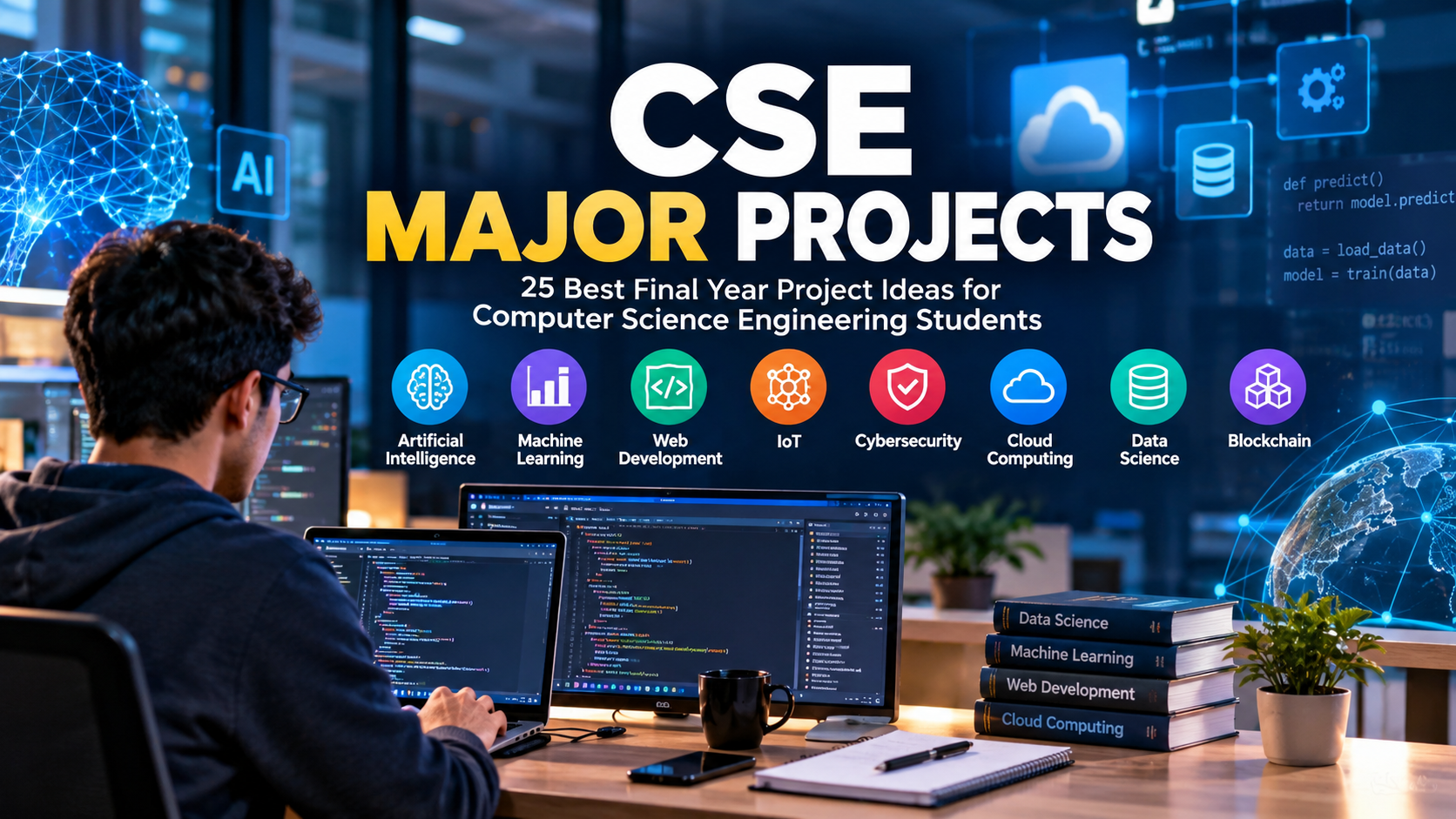
IEEE Final Year Projects for CSE in Bangalore – 25 Latest Research Project Ideas
Are you searching for IEEE final year projects for Computer Science and Engineering (CSE) in Bangalore? Aislyn Technologies helps students explore research-oriented project ideas in Artificial Intelligence, Machine Learning, Deep Learning, Cybersecurity, Blockchain, Cloud Computing, Natural Language Processing, and Data Science.
IEEE publications cover a wide range of emerging computer science technologies and research methods. Students can use relevant IEEE papers as references to understand existing approaches, identify research gaps, define project objectives, and develop their own implementations.
A strong final year CSE project should address a clear problem, explain the proposed methodology, use appropriate datasets or test environments, and evaluate results using measurable criteria. Students should verify paper details and publication status through IEEE Xplore or other authoritative research sources before selecting a reference paper.
25 IEEE-Inspired Final Year Projects for CSE
1. AI-Based Fake News Detection Using Deep Learning
Develop a text classification system that analyses news articles and identifies potentially misleading content using Natural Language Processing and deep learning techniques.
Build a cybersecurity prototype that analyses network traffic datasets and classifies potentially suspicious activities using supervised or unsupervised learning algorithms.
3. Blockchain-Based Secure Electronic Voting System
Develop a voting prototype that explores tamper-evident record keeping, identity verification, and transparent vote auditing using blockchain technology.
4. Deep Learning-Based Medical Image Classification
Train a deep learning model to classify selected medical images using a suitable labelled dataset and evaluate its performance using appropriate metrics.
5. AI-Powered Question Answering System Using RAG
Build a document-based question-answering application using retrieval-augmented generation, semantic search, embeddings, and a language model.
6. Federated Learning for Privacy-Preserving Machine Learning
Develop a simulation in which multiple clients train a shared model without directly centralising their raw training data. Evaluate model performance and communication overhead.
7. Cloud-Based Secure File Storage System
Create an application that demonstrates secure file storage, access control, encryption, and authenticated file retrieval using a cloud or local test environment.
8. Explainable AI for Machine Learning Predictions
Build a prediction system that uses explainability techniques to illustrate which features influence model outputs.
9. AI-Based Phishing Website Detection
Develop a machine learning model that classifies potentially phishing URLs or webpages using extracted features and a suitable labelled dataset.
10. Privacy-Aware Face Recognition Research Prototype
Explore face detection and identity matching using a consent-based dataset, while evaluating accuracy, bias, privacy risks, and access controls.
11. Sentiment Analysis Using Transformer Models
Build a sentiment classification system using transformer-based NLP models and compare its results with traditional machine learning approaches.
Develop a research prototype that estimates credit risk using suitable historical data and evaluates fairness, classification metrics, and model limitations.
13. AI-Based Traffic Congestion Prediction
Analyse historical traffic or sensor data to estimate congestion patterns using machine learning and time-series forecasting techniques.
14. Blockchain-Based Supply Chain Tracking
Create a prototype that records product movement and transaction events to demonstrate traceability and tamper-evident record management.
15. Deep Learning-Based Human Activity Recognition
Classify selected human activities using labelled wearable sensor data or video datasets and compare different classification approaches.
16. IoT-Based Anomaly Detection Using Machine Learning
Develop a system that analyses connected-device sensor readings to identify unusual patterns and generate alerts.
17. AI-Based Software Bug Classification
Use machine learning and Natural Language Processing to categorise software bug reports based on their descriptions and historical labels.
18. Recommendation System Using Collaborative Filtering
Build a recommendation engine that suggests relevant products, courses, books, or movies based on user interaction data.
19. Secure Authentication Using Multi-Factor Verification
Develop a web application that combines password authentication with additional verification mechanisms and secure session management.
20. AI-Based Code Review and Vulnerability Classification
Create a research prototype that analyses source code or labelled vulnerability datasets to identify potential security issues and classify findings.
21. Machine Learning-Based Energy Consumption Forecasting
Develop forecasting models that estimate energy usage from historical consumption data and compare their prediction errors.
22. Graph Neural Networks for Fraud Pattern Detection
Explore graph-based learning methods to identify suspicious relationships and potential fraud patterns in suitable transaction or network datasets.
23. Cloud Resource Allocation Using Reinforcement Learning
Simulate a cloud resource management environment and investigate reinforcement learning strategies for allocating computing resources.
24. Multimodal Emotion Recognition Research Prototype
Explore the combination of text, audio, or visual features to classify predefined emotion categories using appropriately labelled datasets.
25. AI-Based Document Summarisation and Classification
Develop an application that summarises documents and categorises them using NLP techniques, transformer models, and text-processing pipelines.
Technologies Used in IEEE-Inspired CSE Projects
Depending on the research topic, students can explore Python, Java, TensorFlow, PyTorch, Scikit-learn, OpenCV, Hugging Face libraries, SQL databases, cloud platforms, blockchain frameworks, and web development tools.
These are research-oriented project concepts inspired by common computer science research areas, not claims that each title is an exact published IEEE paper. Before choosing a project, identify a relevant published reference paper, study its methodology, and define a clear extension or implementation objective. Follow your college's rules for citations, academic integrity, and research documentation.
Key Features & Benefits
Applications of Research-Oriented CSE Projects
Research-oriented Computer Science projects help students explore practical applications of algorithms, software systems, data analysis, and emerging technologies.
Artificial Intelligence and Machine Learning: Develop prediction, classification, recommendation, and decision-support prototypes.
Healthcare Research: Investigate medical image classification, healthcare data analysis, and machine learning evaluation using suitable research datasets.
Blockchain Technology: Demonstrate tamper-evident record keeping, transaction traceability, and decentralised application concepts.
Cloud Computing: Develop scalable application prototypes, resource allocation simulations, and secure data storage systems.
Natural Language Processing: Build sentiment analysis, document classification, summarisation, and question-answering applications.
Smart Transportation: Analyse traffic patterns, predict congestion, and explore intelligent transport management.
Financial Analytics: Investigate credit risk classification, anomaly detection, and fraud pattern analysis using suitable datasets.
Software Engineering: Apply AI and data-driven techniques to bug classification, code analysis, and software quality improvement.
Internet of Things: Combine connected devices, sensor data, machine learning, and anomaly detection for monitoring applications.
Students can use these application areas to define a project problem, select an appropriate research methodology, and evaluate their proposed solution against a baseline or existing approach.
Implementation Guide
Who Can Benefit from IEEE Final Year Projects for CSE?
IEEE-inspired CSE projects can benefit students who want to explore research methods and develop practical software engineering skills.
BE and BTech CSE Students: Final-year students preparing academic projects, research-based prototypes, technical reports, and project presentations.
IT Students: Learners interested in software development, data science, databases, cloud computing, and intelligent applications.
MTech Students and Research Scholars: Students investigating advanced algorithms, deep learning, cybersecurity, distributed systems, and emerging computer science research topics.
AI and ML Students: Learners exploring data preparation, model training, evaluation, deep learning, and explainable AI.
Cybersecurity Enthusiasts: Students interested in network security, phishing detection, intrusion detection, authentication, and vulnerability analysis.
Students Preparing for Technical Careers: Learners who want to demonstrate programming, analytical thinking, system design, experimentation, and problem-solving skills.
Major IEEE-Inspired CSE Project Domains
Artificial Intelligence and Machine Learning
Deep Learning and Neural Networks
Natural Language Processing and Generative AI
Cybersecurity and Network Intrusion Detection
Blockchain and Distributed Systems
Cloud Computing and Edge Computing
Data Science and Predictive Analytics
Computer Vision and Image Processing
Software Engineering and Code Analysis
Internet of Things and Intelligent Monitoring
Federated Learning and Privacy-Preserving AI
Graph Neural Networks and Data Mining
Recommendation Systems
Intelligent Transportation Systems
Secure Web Applications and Authentication
Select a domain according to your interests, academic requirements, dataset availability, implementation timeline, and technical resources. A research-oriented project should explain the problem statement, reference literature, methodology, proposed contribution, experimental setup, results, limitations, and future scope.
Technical Specifications
Why Choose Aislyn Technologies for IEEE Final Year Projects in Bangalore?
Aislyn Technologies helps students explore research-oriented project ideas across Computer Science and Engineering, Artificial Intelligence, Machine Learning, Cybersecurity, Cloud Computing, and related domains.
Research Topic Exploration: Identify suitable project areas based on current computer science technologies and your academic interests.
Reference Paper Selection: Learn how to search for relevant publications, understand existing methods, and identify potential research gaps. Verify paper metadata and publication status using authoritative sources.
Technology Selection: Explore appropriate programming languages, machine learning frameworks, databases, development tools, and deployment approaches.
Conclusion & Next Steps
Contact Aislyn Technologies for IEEE Final Year CSE Projects in Bangalore
Looking for IEEE-inspired final year projects for CSE in Bangalore? Contact Aislyn Technologies to explore project ideas in Artificial Intelligence, Machine Learning, Deep Learning, Cybersecurity, Blockchain, Cloud Computing, Natural Language Processing, and Data Science.
Whether you are preparing a BE or BTech final-year project, an MTech research prototype, or a research-oriented software application, selecting a suitable problem and methodology is an important first step.
Discuss your project topic, reference paper requirements, technology stack, dataset availability, implementation scope, and academic guidelines with our team.
Company: Aislyn Technologies, Bangalore
Phone: +91 97395 94609
Email: info@aislyntech.com
Website: https://aislyn.in
Explore research-oriented CSE projects and develop practical skills in programming, experimentation, model evaluation, software development, and technical documentation.
Contact Aislyn Technologies today to discuss your IEEE-inspired CSE project in Bangalore and get started with suitable project guidance for your academic goals.