ABSTRACT
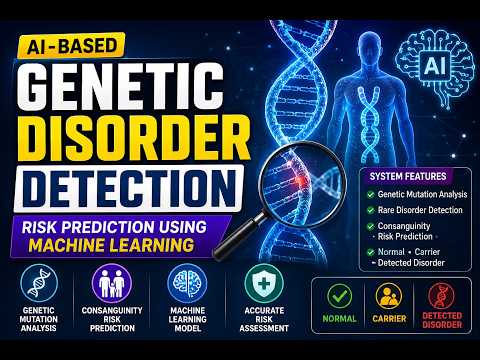
Rare genetic disorders are a significant challenge in modern healthcare because they are often difficult to identify at an early stage due to their complex and hidden nature. These disorders are mainly caused by mutations in genes, which may not show immediate symptoms but can affect individuals over time. The risk of such disorders becomes higher in cases of consanguineous relationships, where genetically related individuals have children, increasing the chances of inheriting recessive genetic conditions. Early detection and proper interpretation of genetic mutations can play an important role in improving awareness, prevention, and decision-making in healthcare. This project proposes a hybrid system for rare genetic disorder detection and consanguinity risk prediction using a combination of rule-based mutation analysis and machine learning techniques. The system takes genetic mutation data as input in a simple CSV format and performs preprocessing to remove missing values and inconsistencies. After preprocessing, the mutation data is compared with a reference dataset of known disease-causing mutations to identify possible genetic disorders. If a match is found, the system detects the associated disorder and provides basic interpretation. In addition to rule-based detection, a machine learning model such as a Random Forest classifier is used to analyze mutation patterns and predict the overall genetic risk category. The system classifies the results into Normal, Carrier, or Detected Disorder, making it easy to understand. Furthermore, the project includes consanguinity risk assessment by checking for homozygous mutations and recessive inheritance patterns, which indicate a higher probability of inherited disorders. The final results are displayed through a user-friendly interface built using Flask, allowing users to upload data and view predictions easily. This project is designed as an academic and decision-support tool to simplify genetic data analysis and improve understanding of inherited risks. It reduces the complexity of manual interpretation and provides faster and more structured results. Although the system does not replace clinical diagnosis, it serves as a useful preliminary screening tool for research and educational purposes. Overall, the proposed system demonstrates how simple data processing and machine learning techniques can be effectively applied to genetic disorder detection and risk prediction.
INTRODUCTION
Rare genetic disorders represent one of the most complex and challenging areas in modern healthcare due to their low prevalence, diverse symptoms, and difficulty in early diagnosis. These disorders are primarily caused by mutations or alterations in the DNA sequence of an individual, which can disrupt normal gene function and lead to various inherited conditions. In many cases, these mutations remain undetected for long periods because their symptoms may not appear immediately or may resemble other common diseases. As a result, patients often experience delays in diagnosis, which can affect timely treatment, disease management, and genetic counseling. The growing importance of early detection has led to increased interest in computational approaches that can assist in identifying genetic disorders using data-driven techniques.
Genetic mutations can occur in different forms, such as single nucleotide changes, insertions, deletions, or structural variations. While some mutations are harmless, others are pathogenic and directly associated with disease conditions. Scientists and medical researchers have identified numerous gene mutations that are linked to specific rare genetic disorders, and this information is stored in specialized databases. By comparing an individual’s genetic mutation data with these known mutation databases, it becomes possible to detect whether a person may be affected by a particular disorder or may act as a carrier. However, manual analysis of such genetic data is complex and requires expert knowledge, making it difficult to apply in a simplified academic or preliminary screening environment. One of the critical factors influencing the occurrence of rare genetic disorders is consanguinity, which refers to reproduction between biologically related individuals. In consanguineous marriages, there is a higher probability that both parents carry the same recessive gene mutation. When such mutations are inherited from both parents, the likelihood of the offspring developing a genetic disorder increases significantly. This makes consanguinity an important aspect to consider in genetic risk analysis, especially in populations where such relationships are more common. Despite its importance, many existing systems focus only on mutation detection and do not provide integrated analysis for consanguinity-related risk, creating a gap in comprehensive genetic screening.
Traditional methods for diagnosing genetic disorders involve laboratory testing, clinical evaluations, and expert interpretation. Although these methods are accurate, they are often time-consuming, expensive, and not easily accessible in all settings. Additionally, the increasing volume of genetic data generated through modern sequencing technologies has made manual analysis even more challenging. There is a need for computational systems that can process large amounts of genetic data efficiently and provide meaningful insights in a structured manner. Such systems can support healthcare professionals and researchers by reducing analysis time and improving understanding of genetic risks.
With the advancement of artificial intelligence and machine learning, new opportunities have emerged in the field of bioinformatics and genetic data analysis. Machine learning algorithms are capable of identifying patterns and relationships within large datasets, making them suitable for predicting disease risk based on genetic information. In the context of genetic disorder detection, machine learning can be used to classify individuals into categories such as normal, carrier, or affected based on their mutation profiles. However, relying solely on machine learning may not always provide reliable results, especially when known disease-causing mutations need to be identified with high accuracy.
To overcome this limitation, a hybrid approach that combines rule-based systems with machine learning techniques can be more effective. Rule-based mutation analysis involves directly comparing patient mutation data with a reference dataset of known pathogenic mutations. This ensures accurate identification of diseases associated with specific genetic variants. On the other hand, machine learning adds predictive capability by analyzing overall mutation patterns and estimating the risk level. The integration of these two approaches provides both reliability and adaptability, making the system more suitable for real-world and academic applications.
The proposed project focuses on developing a hybrid intelligent system for rare genetic disorder detection and consanguinity risk prediction. The system is designed to accept genetic mutation data in a simple CSV format, making it easy to use and implement. The first step in the system involves data preprocessing, where missing values, duplicate entries, and inconsistencies are removed to ensure data quality. After preprocessing, the mutation data is analyzed using a rule-based approach to identify matches with known disease-causing mutations. If a match is found, the system detects the corresponding disorder and provides basic interpretation.
Objectives
1. To develop a hybrid system that combines rule-based mutation analysis and machine learning techniques for rare genetic disorder detection.
2. To collect and preprocess genetic mutation data in CSV format by handling missing values and inconsistencies.
3. To identify disease-causing mutations by comparing patient data with known genetic disorder datasets such as ClinVar.
4. To detect possible rare genetic disorders based on mutation matching with reference databases.
5. To build a machine learning model (e.g., Random Forest) to classify genetic risk into Normal, Carrier, and Detected Disorder.
6. To analyze mutation patterns and improve prediction accuracy using data-driven techniques.
7. To assess consanguinity risk by identifying homozygous mutations and recessive inheritance patterns.
8. To provide a simple and understandable interpretation of genetic risk for users.
9. To design a user-friendly web interface using Flask for uploading data and displaying results.
10. To automate the genetic data analysis process and reduce manual effort.
11. To support early screening and awareness of rare genetic disorders for academic and research purposes.
12. To create a scalable system that can be extended with larger datasets and advanced models in the future.
Block Diagram
SOFTWARE REQUIREMENTS
1. Operating System
Windows 10 or above (recommended for smooth development and execution)
2. Programming Language
Python (used for data processing, machine learning, and backend logic)
3. Development Environment (IDE)
Visual Studio Code (for coding and debugging)
4. Web Framework
Flask (used to build the web-based interface and handle user requests)
5. Data Handling Libraries
o Pandas (for reading, processing, and analyzing CSV data)
o NumPy (for numerical computations)
6. Machine Learning Library
Scikit-learn (for building and training the Random Forest model)
7. Data Visualization Libraries
o Matplotlib (for plotting graphs if needed)
o Seaborn (for advanced visualizations)
8. Database / Storage
o CSV files (for storing mutation and dataset information)
o SQLite (optional, for structured data storage)
9. Frontend Technologies
HTML (structure of web pages)
CSS (styling and design)
JavaScript (basic interactivity)
10. Web Browser
Google Chrome / Microsoft Edge (for running and testing the Flask application)
11. Python Packages / Tools
• Joblib (for saving and loading ML models)
• Idle or Vs code (optional, for model development and testing)
Hardware Requirements
1. Processor (CPU)
Minimum: Intel Core i3 or equivalent
Recommended: Intel Core i5 or higher for faster processing
2. RAM (Memory)
Minimum: 4 GB
Recommended: 8 GB or above for smooth execution of machine learning tasks
3. Storage (Hard Disk / SSD)
Minimum: 256 GB HDD
Recommended: 512 GB SSD for better speed and performance
4. System Type
64-bit system architecture (required for modern Python libraries and tools)
5. Display Monitor
Standard monitor with minimum resolution of 1366 × 768
6. Input Devices
Keyboard and Mouse (for user interaction and system operation)
7. Internet Connection
Required for downloading datasets, libraries, and updates
8. Graphics (Optional)
Integrated graphics is sufficient (no need for high-end GPU)
9. Peripheral Devices (Optional)
USB drive or external storage for data transfer and backup