ABSTRACT
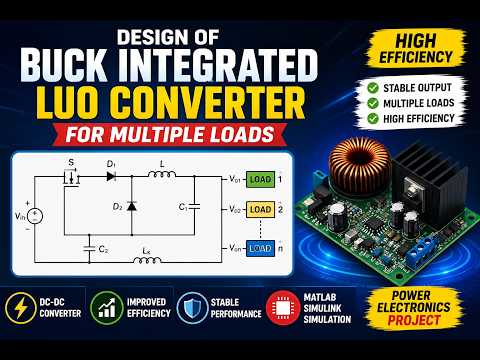
Electric Vehicles (EVs) rely heavily on DC–DC converters. In modern EVs, a separate DC–DC converter is used to charge both the low-voltage and high-voltage batteries. Because of these factors, the same converter produced enormous output voltage ripples, high ON-OFF losses, and diode conduction losses, resulting in lower EV efficiency. This article proposes a multi-port DC–DC converter charging circuit for EVs to address these issues. The developed circuit has a single input dual output (SIDO) structure, which consists of a negative output super lift luo converter (NOSLLC) and the integration of a step-down converter (NOSLLCSDC). The NOELLC generates high voltage, while the Step-Down Converter generates low voltage. The NOELLC is a fundamental topology of SUPER LIFT LUO CONVERTERs. Over conventional converters, the developed converter has small output voltage ripples, good voltage transfer gain, less turn ON/turn OFF losses and conduction losses, and a compact structure design. Changing the duty cycle of the NOSLLCSDC results in different output voltage ranges
INTRODUCTION:
Luo converters are DC-DC Switching Mode Boost converters. A boost converter (step-up converter) is a power converter with an output dc voltage greater than its input dc voltage. Luo converters are a class of converters providing a high gain with relatively lesser number of components. Although Luo converters provide a high gain, when cascaded, the gain increases stage by stage only in Arithmetic Progression i.e. these converters uses the voltage lift (VL) technique. In order to solve this discrepancy in the Classical Luo Converters, another class of converters called Super-lift Luo Converters were developed. While the positive aspects of the Classical Luo Converters are retained in Super-lift converters, Super-lift converters also have the advantage that the gain in this converter increases in geometric progression, stage by stage. Electric vehicles (EVs) are important in transportation today because they are non-polluting. An EV’s primary components include the battery, DC–DC converters, inverter, electrical machinery, battery management system (BMS), and control unit. The DC–DC converter is in charge of charging EV batteries and increasing the high voltage from renewable energy sources (Habib et al., 2020; Alahyari et al., 2014). However, in existing EVs, a single DC–DC converter was used to charge both the low-voltage and high-voltage batteries, resulting in higher switching losses, higher output voltage ripples, massive conduction losses, and a decrease in system efficiency. These issues hampered the EVs’ performance. This article introduces a Single-Input and MultiOutput (SIMO) DC–DC converter charging circuit for EVs to address these concerns. A SIMO converter for study in this article is a Negative Output Super Lift Luo Converter (NOSLLC) with integration of a Step-Down Converter (SDC) in Continuous Conduction Mode (CCM) with various duty cycles. NOSLLC is used for high voltage in this article, while SDC is used for low voltage. In terms of voltage transfer gain, tenacity, and ripple voltage, the designed converter outperforms existing EV battery charging DC–DC converters (Lin, 2020; Luo and Ye, 2016). Multi-Input and Multi-Output (MIMO) DC–DC converters are currently hot topics in EVs. One SIMO transformerbased DC–DC converter with a variety of output voltages is well presented (Chen et al., 2020). However, this converter had several flaws, including a large transformer size, a higher cost/number of power switches, higher switching losses, and a complex control/driver circuit that can reduce efficiency. The SIMO with coupled inductors was then presented (KhademiAstaneh et al., 2019). In Li et al. (2019), a soft-switching SIMO converter has been recorded. As a result of this article, the coupled inductor has resulted in increased leakage current/switching losses and more complex design steps. The modified buck-boost DC–DC converter has been well addressed (Shen et al., 2011). No design of NOSLLCSDC with duty cycle control for EV battery charging application has been reported in the literature, according to the review. As a result, this article’s goal is to design the NOSLLCSDC for EV applications. The entire model is validated using the MATLAB/Simulink software platform and an experimental model under various operating conditions.
Block Diagram