ABSTRACT
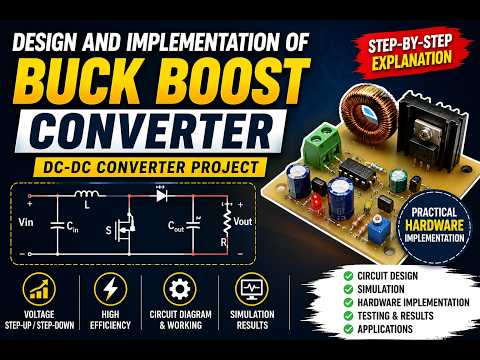
In this work, the design and simulation of buck boost converters is performed with ANFIS control structure to achieve load voltage control.. It contains the theoretical derivations and parameters equations with design. The performance of the converter with PI controller and ANFIS controller is noted and compared. The output graphs for all the converters are well fitted. The proposed system is simulated in MATLAB/Simulink software.
INTRODUCTION
For the control of electric power or power conditioning, the conversion of electric power from one form to another is necessary and the switching characteristics of the power devices permit these conversions [1-3]. The static power converters perform these functions of power conversions. A converter may be considered as a switching matrix. As the portable electronics industry progressed over the years, different requirements evolved such as increased the battery lifetime, small and cheap systems, brighter, full color displays and a demand for increased talk time in cellular phones. A continually increasing demand from power systems has placed power consumption at a premium. To carry on with these demands engineers have worked towards developing efficient conversion techniques and also have resulted in the subsequent formal growth of an interdisciplinary field of Power Electronics. However it comes as no surprise that this new field has offered challenges owing to the unique combination of two major disciplines of electrical engineering: electronics and power. Commonly speaking the use of a swift or switches for the rationale of power conversion can be regarded as an SMPS (Switch Mode Power Supply). A dc-dc converter can be considered as dc equivalent to an ac transformer with a continuously variable duty ratio. In many industrial applications [4,5], it is required to convert a fixed-voltage dc source into a variable-voltage dc source. A dc-dc converter converts directly from dc to dc and is simply known as a dc converter. A dc converter can be considered as dc equivalent to an ac transformer with a continuously turns ratio. Like a transformer, it can be used to step down or step up a dc voltage source. The dc-dc converters are widely used for traction motor control in electronic automobiles, trolley cars, marine hoists, forklift trucks, and mine haulers. They provide smooth acceleration control, high efficiency, and fast dynamic response [9,10]. DC-DC converters can be used in regenerative braking of dc motors to return energy back into the supply, than this feature results in energy savings for transportation systems with frequent stops. DC converters are used in dc voltage regulators[6] and also are used in conjunction with an inductor, to generate a dc current source, especially for the current source inverter. The dc converters can be used as switching mode regulators to convert a dc voltage, usually unregulated, to a regulated dc output voltage. The regulation is normally achieved by PWM at a fixed frequency and the switching driver is normally BJT, MOSFET, or IGBT. The power regulator can be inductor based, switch-mode power converter, a switch capacitor charge pump or a linear regulator. Each regulator has its own advantages and disadvantages, but it is the particular application requirements that determine which type of power regulator is best suited[8].
Block Diagram