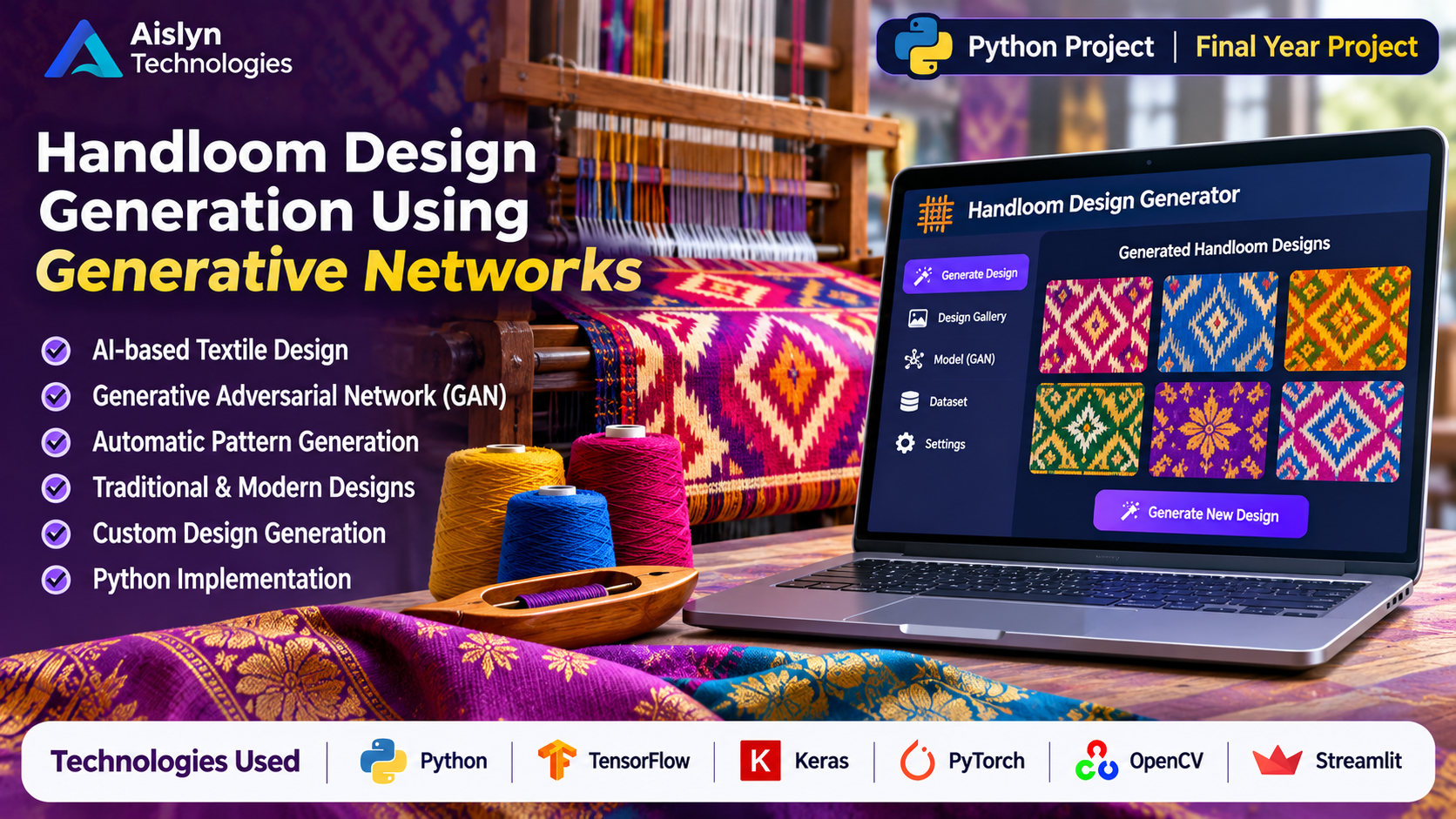
The Handloom Design Generation Using Generative Networks project is an Artificial Intelligence and Deep Learning-based application that explores the automatic creation of innovative textile patterns using generative models. Handloom weaving is an important part of traditional textile manufacturing, with unique patterns, colors, textures, and cultural designs.
Traditionally, creating new handloom patterns requires manual creativity, artistic knowledge, and considerable time. With advancements in Generative AI, deep learning models can learn visual characteristics from existing textile patterns and generate new design variations.
This project focuses on applying Generative Adversarial Networks (GANs) to generate creative handloom textile designs. By training a generative model with a collection of textile pattern images, the system learns design structures, color combinations, and visual arrangements to produce new patterns.
Developed using Python and deep learning technologies, this project demonstrates how Artificial Intelligence can support traditional textile design innovation. It is suitable for final-year students interested in Python, Deep Learning, Computer Vision, Generative AI, and image generation applications.
Key Features & Benefits
Project Overview and Objectives
The main objective of this project is to develop an AI-powered platform that generates new handloom design patterns using generative neural networks.
Generative Adversarial Networks consist of two major components: a Generator and a Discriminator. The Generator creates synthetic textile pattern images, while the Discriminator evaluates whether the generated images resemble real training samples.
Through repeated training, both networks improve their performance. The Generator gradually learns to produce more realistic and visually meaningful textile patterns.
Key Project Objectives:
Collect and prepare handloom textile pattern images.
Build a dataset suitable for deep learning model training.
Apply image preprocessing and normalization techniques.
Train a generative network to learn textile design characteristics.
Generate new handloom patterns using trained model weights.
Explore different colors, textures, and pattern arrangements.
Develop an interface for generating and viewing AI-created designs.
Demonstrate the potential of Generative AI in textile design.
Implementation Guide
Major Features and Modules
The project can be organized into several modules to support the complete handloom design generation workflow.
1. Dataset Collection Module
Collects textile images containing different handloom patterns, geometric arrangements, traditional motifs, and color combinations. A diverse dataset helps the model learn different visual characteristics.
2. Image Preprocessing Module
Prepares the collected images before model training. Operations may include image resizing, normalization, format conversion, and dataset organization.
3. Generative Network Module
Implements a Generative Adversarial Network consisting of a Generator and Discriminator. The Generator creates new textile patterns, while the Discriminator learns to distinguish generated images from real dataset images.
4. Model Training Module
Trains the generative architecture using the prepared textile dataset. During training, the Generator and Discriminator compete to improve the quality of generated patterns.
5. Handloom Pattern Generation Module
Uses the trained Generator to produce new textile designs from random latent vectors. Different input vectors can produce different pattern variations.
6. Design Preview Module
Displays generated textile patterns through a user-friendly interface. Users can explore multiple generated outputs and identify designs that match their creative requirements.
7. Design Download Module
Can provide an option to save generated textile pattern images for further examination, editing, or design development.
8. Model Evaluation Module
Evaluates generated image quality using visual inspection and suitable generative image evaluation metrics. Metrics such as Fréchet Inception Distance (FID) can be considered when the evaluation setup supports them.
Technical Specifications
Technologies Used and System Implementation
The Handloom Design Generation project combines Python programming, deep learning architectures, and image processing technologies.
Programming Language
Python – Implements the complete machine learning and image generation workflow.
Deep Neural Networks – Learns complex visual features from textile images.
Convolutional Neural Networks (CNN) – Extracts spatial and visual features from images.
Deep Learning Frameworks
TensorFlow / Keras – Can be used to build and train the generative network.
PyTorch – An alternative framework for implementing GAN architectures.
Image Processing
OpenCV – Supports image loading, resizing, and preprocessing.
Pillow – Handles image manipulation and format conversion.
NumPy – Performs numerical operations on image arrays.
Frontend and Visualization
Streamlit – Can provide an interactive interface for design generation.
HTML and CSS – Can be used for a customized web interface.
Matplotlib – Visualizes generated patterns and training results.
System Implementation Workflow
First, handloom textile images are collected and organized into a dataset. The images are resized and normalized to ensure consistency during training.
Next, the GAN architecture is implemented using Python and a deep learning framework. The Generator learns to create textile pattern images, while the Discriminator evaluates the generated outputs against real training samples.
After completing the training process, the trained Generator is saved for future use. When a user requests a new design, the system supplies a random latent vector to the Generator and produces a new handloom pattern.
Finally, the generated image is displayed through the application interface, where users can preview and save the output.
Conclusion & Next Steps
Advantages, Applications and Future Enhancements
Advantages of the Project
Automates the exploration of new textile pattern ideas.
Reduces the time required for manually creating initial design variations.
Supports creative experimentation with colors and motifs.
Demonstrates practical applications of Generative AI.
Helps explore traditional and modern textile design combinations.
Provides an opportunity to integrate AI into textile design workflows.
Real-World Applications
The concepts demonstrated in this project can be explored in several industries:
Handloom and traditional textile manufacturing.
Fashion and apparel design.
Digital textile printing.
AI-assisted pattern creation.
Interior decoration and furnishing design.
Textile research and design education.
Future Enhancements
The project can be expanded with advanced Generative AI capabilities.
Conditional GANs for generating patterns based on selected design categories.
User-controlled color palette selection.
Traditional motif-based pattern generation.
High-resolution textile image generation.
AI-powered design recommendations.
Image-to-image textile pattern transformation.
Integration with digital textile printing systems.
Diffusion models for exploring alternative generative architectures.
Conclusion
Handloom Design Generation Using Generative Networks demonstrates how Artificial Intelligence and Deep Learning can support innovation in traditional textile design. By applying Generative Adversarial Networks, the system learns visual characteristics from existing handloom patterns and generates new design variations.
The project combines Python, CNN architectures, GAN models, and image processing techniques to explore the possibilities of AI-powered textile design.
It is an excellent final-year Python and Deep Learning project for students interested in Generative AI, Computer Vision, image synthesis, and smart textile applications.
Frequently Asked Questions
1. What is Handloom Design Generation Using Generative Networks?
It is an AI-based approach that uses generative neural networks to learn textile patterns and create new handloom design variations.
2. Which AI model is used in this project?
Generative Adversarial Networks (GANs) can be used to generate synthetic textile pattern images.
3. Which programming language is used?
Python is commonly used with TensorFlow, Keras, or PyTorch for implementing generative models.
4. What is the role of the Generator and Discriminator?
The Generator creates synthetic textile images, while the Discriminator evaluates whether those images resemble real training samples.
5. Can Generative AI be used in the textile industry?
Yes. Generative AI can support textile pattern exploration, fashion design concepts, digital printing, and creative design workflows.
Contact Details
Aislyn Technologies, Bangalore
Phone: +91 97395 94609
Email: info@aislyntech.com
Website: https://aislyn.in
Contact us today to start building your AI, Machine Learning, Deep Learning, and Embedded Projects in Bangalore with our expert support!