ABSTRACT:
TrueHue is an intelligent beauty-technology system developed to accurately detect an individual’s skin tone and automatically prepare a customized liquid foundation that matches the user’s natural complexion. The project addresses one of the most common challenges in the cosmetics industry: selecting a foundation shade that blends seamlessly with diverse skin tones, particularly the warm, olive, and deep undertones widely found in Indian skin. Consumers often purchase multiple shades before finding a suitable match, resulting in unnecessary expense, product wastage, and dissatisfaction.
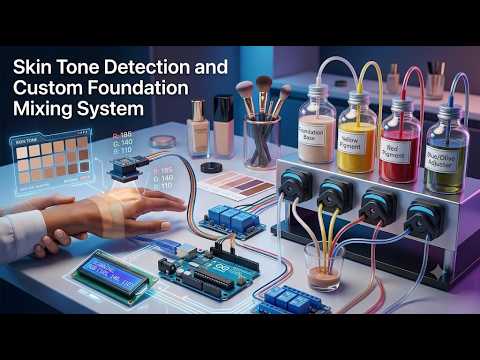
The proposed system combines color sensing, embedded processing, and automated dispensing into a single prototype. A color sensor, such as the TCS3200, is used to measure the Red, Green, and Blue (RGB) values of the user’s skin by scanning the face or forearm. These RGB values are processed by an Arduino microcontroller, which compares the measured data with a predefined calibration database containing reference skin-tone values and their corresponding pigment formulations.
Each entry in the calibration database stores the RGB values of a known skin tone and the required percentages of four liquid components: foundation base, yellow pigment, red pigment, and blue or olive adjuster. Once the closest match is identified, the system retrieves the associated formulation and displays the detected skin tone and pigment percentages on a 16×2 LCD screen. The Arduino then converts these percentage values into time-based control signals and activates four peristaltic pumps through a 4-channel relay module. Each relay switches a pump ON for a specific duration, dispensing the exact quantity of each liquid component into a mixing container to create the final customized foundation.
For example, if the measured skin tone corresponds to RGB values of (120, 98, 85), the calibration table may return a formulation of 45% foundation base, 30% yellow pigment, 15% red pigment, and 10% blue adjuster. The system displays these values on the LCD and activates each pump for a duration proportional to the required percentage. After dispensing is complete, the mixed foundation closely matches the user’s skin tone and is ready for use.
TrueHue demonstrates the practical application of color science, embedded systems, and automation in personalized cosmetics. The system eliminates the trial-and-error process involved in shade selection and offers a cost-effective, scalable solution for beauty retailers, salons, dermatology clinics, and home users. In addition to improving customer satisfaction, the project reduces cosmetic waste and product returns, contributing to more sustainable consumption practices.
By transforming skin-tone detection into a data-driven and automated process, TrueHue provides an inclusive and innovative approach to custom cosmetic formulation, ensuring that every user can obtain a foundation shade precisely tailored to their unique complexion.
INTROUDCTIONS:
The cosmetics industry has experienced rapid growth in recent years, driven by increasing consumer demand for products that are personalized, inclusive, and convenient. Among all cosmetic products, foundation plays a critical role in achieving a natural and even skin appearance. However, selecting a foundation shade that accurately matches an individual’s skin tone remains a significant challenge for many consumers. Differences in skin undertones, seasonal tanning, lighting conditions, and the limited shade ranges offered by many brands often result in products that appear too light, too dark, too orange, or too gray when applied.
This problem is particularly relevant in countries such as India, where skin tones vary widely across regions and individuals. Indian complexions frequently include warm, golden, olive, and deep undertones that are not always represented effectively in commercially available products. As a result, consumers often purchase multiple shades before finding a suitable match, leading to increased expenses, dissatisfaction, and considerable cosmetic waste. Online shoppers face an even greater challenge because they cannot test products physically before purchasing.
TrueHue is proposed as an intelligent skin-tone detection and customized foundation dispensing system that addresses this issue using embedded technology and color science. The system is designed to measure the user’s skin tone using a color sensor, process the measured Red, Green, and Blue (RGB) values using an Arduino microcontroller, and compare the values with a predefined calibration database. Based on the closest match, the system determines the exact proportions of foundation base and color-adjusting pigments required to produce a customized foundation shade.
The formulation process is fully automated. The calculated pigment percentages are displayed on a liquid crystal display (LCD), and four peristaltic pumps are activated through a relay module to dispense the required amounts of foundation base, yellow pigment, red pigment, and blue or olive adjuster. These liquids are combined to create a foundation shade that closely matches the user’s natural complexion. This approach removes the guesswork involved in foundation selection and ensures consistent and repeatable results.
The TrueHue project integrates several disciplines, including embedded systems, color sensing, automation, and cosmetic formulation. It demonstrates how low-cost hardware components and a calibration-based algorithm can be used to build a practical prototype for personalized beauty applications. Beyond its technical significance, the system has strong commercial potential for use in cosmetic stores, beauty salons, dermatology clinics, and e-commerce platforms.
In addition to improving customer experience, TrueHue contributes to sustainability by reducing the number of mismatched products that are discarded and minimizing return rates in the cosmetics industry. The project also promotes inclusivity by addressing the diverse skin tones and undertones that are often underserved by conventional beauty products.
Overall, TrueHue represents an innovative and scalable solution that transforms foundation shade matching from a subjective trial-and-error process into a precise, scientific, and automated system capable of delivering personalized cosmetic products with greater accuracy and efficiency.
OBJECTIVES:
To design and develop an intelligent skin-tone detection and automated foundation mixing system that accurately measures a user’s skin color and prepares a customized liquid foundation formulation using color sensing, embedded processing, and automated dispensing technology.
Specific Objectives
1. To measure the user’s skin tone using a color sensor.
The system will use a TCS3200 color sensor to capture the Red, Green, and Blue (RGB) values from the user’s skin under controlled conditions.
2. To process RGB values using an Arduino microcontroller.
The measured RGB values will be analyzed and compared with a predefined calibration database stored in the Arduino program.
3. To classify the detected skin tone.
The system will identify the closest matching skin tone and display the tone name (such as Fair, Wheatish, Warm Brown, or Deep Brown) on the LCD.
4. To store a calibration database of foundation formulations.
A reference table containing skin-tone RGB values and corresponding pigment percentages will be created and used for formula selection.
5. To determine the required pigment composition.
The system will retrieve the percentage of foundation base, yellow, red, and blue/olive pigments needed to reproduce the detected skin tone.
6. To display formulation details on the LCD.
The detected skin tone and the calculated pigment percentages will be shown on a 16×2 LCD display.
7. To automate foundation dispensing.
Four peristaltic pumps will be controlled through a 4-channel relay module to dispense the required quantities of each liquid component.
8. To produce a customized foundation shade.
The dispensed pigments will be mixed to create a foundation that closely matches the user’s natural complexion.
9. To reduce cosmetic waste and incorrect purchases.
The project aims to minimize the trial-and-error process involved in selecting foundation shades and reduce product returns.
10. To provide a scalable prototype for personalized beauty applications.
The developed system can be expanded for use in cosmetic stores, salons, e-commerce platforms, and home-use beauty devices.
Block Diagram