ABSTRACT
The Smart Environment Monitoring System using Raspberry Pi with WhatsApp Alerts is an advanced IoT-based solution designed to monitor environmental conditions in real time and provide immediate notifications during abnormal situations. This system focuses on improving safety, awareness, and response time by continuously tracking key environmental parameters such as temperature, humidity, air quality, and gas leakage. The rapid growth of industrialization and urbanization has increased the need for intelligent monitoring systems that can ensure a safe and healthy environment.
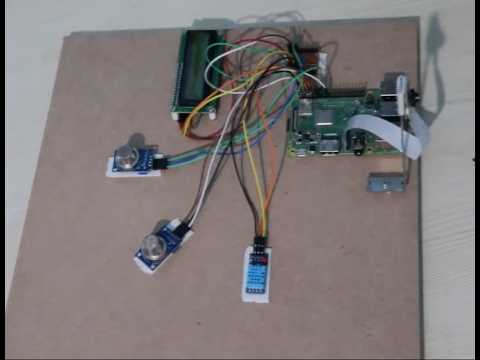
The proposed system utilizes a Raspberry Pi as the central processing unit, which collects data from multiple sensors including DHT22 for temperature and humidity measurement, MQ135 for air quality detection, and MQ2 or MQ5 sensors for identifying hazardous gas leaks such as LPG or smoke. These sensors provide continuous input data, which is processed using Python-based scripts running on the Raspberry Pi. The system is designed to compare real-time sensor readings with predefined threshold values to determine abnormal environmental conditions.
Whenever any parameter exceeds its safe limit, the system immediately triggers an alert mechanism. As part of the alert process, a camera module connected to the Raspberry Pi captures an image of the surrounding environment. This feature enhances situational awareness by providing visual evidence of the detected anomaly. The captured image, along with sensor data, is then transmitted to the user via WhatsApp using the Twilio API, ensuring instant and reliable communication.
The integration of WhatsApp alerts makes the system highly practical and user-friendly, as it eliminates the need for dedicated applications or complex interfaces. Users can receive real-time updates directly on their mobile devices, allowing them to take necessary actions promptly. Additionally, the system can be extended to include cloud storage for data logging and analysis, making it suitable for long-term environmental monitoring and research purposes.
An advanced feature of this system includes the integration of artificial intelligence using models such as YOLOv8 for detecting fire, smoke, and human presence.
INTRODUCTION
The rapid advancement of technology in recent years has significantly influenced the way environmental monitoring systems are designed and implemented. With the increasing concerns related to pollution, climate change, and industrial hazards, there is a growing need for intelligent systems that can continuously monitor environmental conditions and provide timely alerts. Traditional monitoring methods often rely on manual observation or standalone devices, which are not efficient for real-time analysis and quick response. To overcome these limitations, the integration of Internet of Things (IoT) technology with embedded systems has emerged as an effective solution.
A Smart Environment Monitoring System is an innovative approach that combines sensors, computing devices, and communication technologies to observe environmental parameters in real time. This project focuses on designing and developing such a system using a Raspberry Pi, which acts as the central processing unit. The system is capable of monitoring essential environmental factors such as temperature, humidity, air quality, and the presence of harmful gases. These parameters play a crucial role in maintaining a safe and healthy environment in residential, industrial, and public spaces.
Temperature and humidity are fundamental environmental factors that influence human comfort, agricultural productivity, and industrial processes. Monitoring these parameters helps in maintaining optimal conditions and preventing potential risks. Similarly, air quality monitoring has become increasingly important due to the rise in air pollution caused by urbanization and industrial emissions. Harmful gases such as carbon monoxide, methane, and LPG can pose serious health risks and even lead to life-threatening situations if not detected early. Therefore, integrating gas sensors into the system enhances its ability to ensure safety and prevent accidents.
The Raspberry Pi platform is widely used in IoT applications due to its compact size, low cost, and powerful processing capabilities. It supports various programming languages, with Python being the most preferred due to its simplicity and extensive library support. In this system, the Raspberry Pi collects data from multiple sensors and processes it using Python scripts. The data is continuously compared with predefined threshold values to identify abnormal conditions. This real-time processing capability makes the system highly efficient and reliable.
One of the key features of this project is the integration of an alert mechanism using WhatsApp. In today’s digital era, instant communication is essential for quick decision-making. By using the Twilio API for WhatsApp, the system can send real-time alerts directly to the user’s mobile device. This eliminates the need for additional applications and ensures that the user is immediately notified in case of any abnormal environmental condition. The alert message includes sensor readings, which helps the user understand the severity of the situation.
In addition to sending alerts, the system is equipped with a camera module that captures images whenever an abnormal condition is detected. This feature provides visual confirmation of the event, making the system more reliable and informative. For example, in the case of a gas leak or fire, the captured image can help the user assess the situation and take appropriate action. This combination of sensor data and visual evidence enhances the overall effectiveness of the monitoring system.
Furthermore, the project can be extended by integrating advanced technologies such as artificial intelligence and cloud computing. The use of AI models like YOLOv8 enables the system to detect objects such as fire, smoke, or human presence in real time. This adds an additional layer of intelligence to the system, allowing it to make more accurate decisions and reduce false alarms. Cloud integration can be used for storing historical data, analyzing trends, and generating reports for long-term monitoring.
The Smart Environment Monitoring System is designed to be scalable and adaptable to different environments. It can be deployed in homes to ensure safety and comfort, in industries to monitor hazardous conditions, and in public areas to maintain environmental standards. The system not only improves safety but also contributes to energy efficiency and environmental sustainability by enabling better resource management.
In conclusion, the integration of IoT, Raspberry Pi, sensors, and communication technologies provides a powerful platform for developing intelligent environmental monitoring systems. This project demonstrates how modern technology can be used to address real-world problems effectively. By providing real-time monitoring, instant alerts, and visual evidence, the system ensures a safer and smarter environment for users.
Block Diagram
SOFTWARE & HARDWARE REQUIREMENTS
HARDWARE REQUIREMENTS
The proposed Smart Environment Monitoring System requires a set of hardware components that work together to collect environmental data, process it, and generate alerts. The central component of the system is the Raspberry Pi, which acts as the main controller. A Raspberry Pi 4 or Raspberry Pi 5 is preferred due to its higher processing power, better connectivity options, and ability to handle multiple tasks simultaneously. It serves as the brain of the system, interfacing with sensors, processing data, and executing alert mechanisms.
To monitor temperature and humidity, a DHT22 sensor is used. This sensor provides accurate digital output and is suitable for environmental monitoring applications. It helps in maintaining optimal environmental conditions and detecting abnormal temperature or humidity levels.
For air quality monitoring, the MQ135 gas sensor is used. This sensor detects various harmful gases such as ammonia, benzene, smoke, and carbon dioxide. It plays a crucial role in identifying pollution levels and ensuring air quality safety. Additionally, MQ2 or MQ5 sensors are used for detecting gas leakage, including LPG, methane, and smoke. These sensors are highly sensitive and are essential for preventing fire hazards and gas-related accidents.
Since MQ sensors produce analog signals and the Raspberry Pi does not support analog input directly, an Analog-to-Digital Converter (ADC) such as MCP3008 is required. This component converts analog signals into digital form so that the Raspberry Pi can process the sensor data effectively.
A camera module is also included in the system, which can be either a Raspberry Pi Camera Module or a USB webcam. This component is used to capture images whenever an abnormal condition is detected. The captured images provide visual confirmation of the situation, enhancing the reliability of the system.
Additional hardware components include a breadboard and jumper wires, which are used for making connections between sensors and the Raspberry Pi. A stable power supply is also required to ensure continuous operation of the system. Optionally, sensors such as BMP280 for pressure measurement and PMS5003 for advanced air quality monitoring (PM2.5) can be added to enhance system functionality.
SOFTWARE REQUIREMENTS
The software component of the system plays a vital role in data processing, analysis, and communication. The primary programming language used in this project is Python 3, which is widely preferred due to its simplicity, flexibility, and extensive support for libraries related to IoT and hardware interfacing.
The system uses several Python libraries to interact with hardware components and perform required operations. The Adafruit_DHT library is used to read temperature and humidity data from the DHT22 sensor. This library simplifies sensor interfacing and ensures accurate data acquisition.
For image capture and processing, the OpenCV (opencv-python) library is used. It enables the system to access the camera module, capture images, and store them for further use. OpenCV also provides additional capabilities for image processing, which can be extended for advanced features such as object detection.
The gpiozero library is used for handling GPIO operations on the Raspberry Pi. It provides an easy-to-use interface for controlling and reading from pins, making hardware interaction more efficient. For interfacing with the MCP3008 ADC, the spidev library is used, which allows communication over the SPI protocol. This ensures that analog sensor data can be read and processed accurately.
For sending alerts, the system uses the Twilio API for WhatsApp communication. This API enables the system to send real-time messages to users over WhatsApp. It requires credentials such as Account SID, Auth Token, and a registered WhatsApp number. This method is reliable and widely used for instant communication. Alternatively, the pywhatkit library can be used for sending WhatsApp messages, but it is less reliable compared to the Twilio API.
The operating system used for the Raspberry Pi is typically Raspberry Pi OS, which supports all required libraries and provides a stable environment for development and execution. The Python script runs continuously on the system, collecting sensor data, checking conditions, and triggering alerts when necessary.
Optionally, cloud platforms such as ThingSpeak, Firebase, or AWS can be used for storing sensor data and performing analysis. These platforms allow users to visualize data trends, generate reports, and monitor the system remotely. Additionally, advanced AI models like YOLOv8 can be integrated into the system for detecting fire, smoke, or human presence in captured images.