Abstract
Respiratory diseases, particularly tuberculosis (TB), remain a major public health challenge, especially in regions with limited access to medical infrastructure. Early detection of cough patterns and abnormal physiological signals can significantly improve diagnosis and preventive care. This project presents an AI-enabled Cough Detection and TB Screening System that integrates deep learning, audio analysis, and real-time vital monitoring into a unified Flask-based web platform.
The system utilizes a 1D Convolutional Neural Network (CNN) trained using MFCC audio features extracted from cough and normal breathing samples. Noise reduction is applied using spectral gating (noisereduce) to improve the clarity of input signals. The trained model is deployed within a Flask application that records audio through a microphone, extracts features, and performs real-time classification.
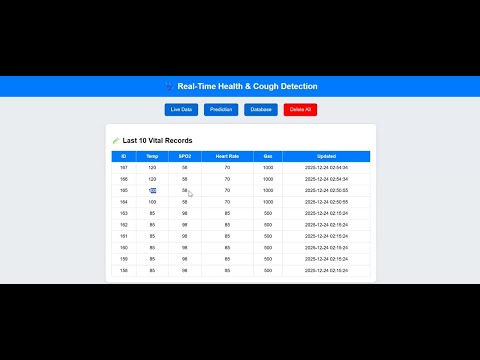
In parallel, the system retrieves live vital signs—temperature, SpO₂, heart rate, and gas levels—from an IoT-based cloud API and stores them in a local SQLite database. A decision-fusion algorithm combines cough detection with vital status to determine whether the user is “Normal”, “Cough”, or potentially exhibiting symptoms consistent with TB risk. The proposed framework provides a low-cost, automated, and accessible solution for preliminary respiratory screening, making it suitable for rural clinics, remote health monitoring, and mobile diagnostic platforms.
Keywords
Cough Detection, Tuberculosis (TB) Screening, MFCC Features, Convolutional Neural Network (CNN), Audio Classification, Noise Reduction, Vital Monitoring, Flask Web Application, IoT-Based Health System, Machine Learning in Healthcare.
Introduction
Respiratory diseases continue to pose a significant burden on global healthcare systems, with tuberculosis remaining one of the most challenging infectious diseases to control. According to global health reports, TB affects millions of individuals annually and disproportionately impacts populations in low-resource settings. Early detection plays a critical role in controlling disease spread and improving patient outcomes; however, timely diagnosis remains a major obstacle due to limited access to healthcare infrastructure, especially in rural and economically disadvantaged regions.
Traditional TB diagnostic techniques such as sputum smear microscopy, chest radiography, and molecular tests like GeneXpert provide accurate results but require specialized laboratory equipment, trained technicians, and significant processing time. These limitations often result in delayed diagnosis, during which infected individuals may unknowingly transmit the disease. Moreover, such diagnostic facilities are often unavailable in remote areas, further widening the healthcare accessibility gap.
Cough is a primary symptom of TB and is often present long before severe complications arise. Human cough sounds contain rich temporal and spectral information that reflects the condition of the respiratory system. Advances in machine learning and audio signal processing have shown that these acoustic patterns can be automatically analyzed to differentiate between healthy and pathological coughs. In particular, deep learning models such as Convolutional Neural Networks (CNNs) have demonstrated strong performance in extracting discriminative features from transformed audio representations.
Alongside cough analysis, physiological indicators such as fever, reduced oxygen saturation, abnormal heart rate, and exposure to polluted environments further strengthen the screening process. The integration of Internet of Things (IoT) technology enables continuous and remote monitoring of these vital parameters using low-cost sensors. When combined with intelligent data analysis, IoT-based health monitoring systems can support early intervention and preventive care.
This project aims to bridge the gap between audio-based respiratory screening and physiological monitoring by developing an integrated AI-driven framework. By combining cough sound classification with real-time vital monitoring in a unified system, the proposed approach enhances screening accuracy and provides a holistic assessment of TB risk. The system is designed to operate in real-world environments, offering an accessible and automated solution that complements existing clinical diagnostic workflows.
Objectives
The objectives of this project include:
• Designing a robust deep learning model for automatic cough detection
• Implementing effective noise reduction and MFCC feature extraction techniques
• Integrating real-time IoT-based monitoring of physiological parameters
• Developing a decision-fusion mechanism for TB risk assessment
• Deploying a user-friendly Flask-based web interface
• Ensuring scalability, portability, and cost-effectiveness
• Supporting early detection and preventive healthcare delivery
Block Diagram
Hardware Requirements
The proposed system requires minimal and cost-effective hardware components to ensure portability and scalability. A standard computer or laptop with at least an Intel Core i3 processor, 4 GB RAM, and sufficient storage is required to run the Flask application and deep learning inference smoothly. A high-quality microphone is used to capture cough audio signals with clarity for accurate feature extraction and classification.
IoT hardware components include a body temperature sensor (such as DS18B20 or MLX90614) for fever detection, a pulse oximeter and heart rate sensor (such as MAX30102) to measure oxygen saturation and pulse rate, and a gas sensor module (such as MQ135 or MQ2) to monitor environmental air quality. These sensors are interfaced with a microcontroller such as ESP8266 or ESP32, which collects sensor readings and transmits them to a cloud API over Wi-Fi. A stable internet connection is required for real-time sensor data retrieval, while the core audio classification operates locally.
Software Requirements
The software implementation is based on Python due to its extensive support for machine learning, audio processing, and web development. TensorFlow and Keras are used to design, train, and deploy the 1D CNN model for cough classification. Librosa is employed for audio loading and MFCC feature extraction, while the noisereduce library is used to perform noise reduction on real-world audio recordings. NumPy supports numerical computation and data handling throughout the processing pipeline.
Flask is used to develop the web-based interface that manages audio recording, model inference, API communication, and result visualization. SQLite is used as a lightweight local database to store vital-sign readings, prediction results, and timestamps. Additional libraries such as Scikit-learn are used for label encoding and model support functions. The system runs on standard operating systems such as Windows or Linux, making it suitable for deployment in diverse environments.