ABSTRACT:
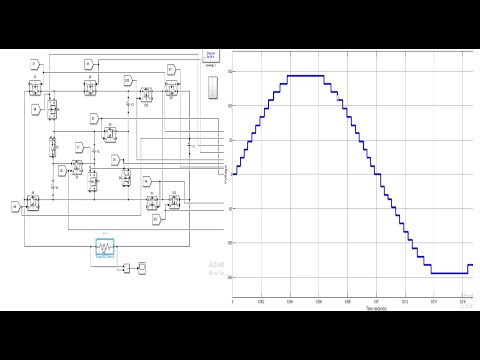
Asymmetrical voltage sources based multilevel inverters have received a great deal of interest that increases the output voltage levels depending on the voltage ratio between the dc voltage sources and improves the power quality. In this, a 25-level Asymmetrical MLI using reduced number of switches and four dc sources. The voltage ratio between the sources are in the order of 1:2:4:6. A comparative assessment with recently developed 25-level MLIs in terms of the number of components, gain, stress, and cost factor elucidates the advantages of the proposed MLI. After a detailed circuit analysis, simulations are performed to verify the balancing of voltage levels of the proposed MLI. The simulation is to be carried out in MATLAB/Simulink software.
INTRODUCTION
Development of multilevel inverters (MLIs) has been a recent trend for a variety of low-, medium-, and high power applications. This is due to the competence of MLI in generating a sinusoidal like output using the combination of switches and dc sources. Diodes and capacitors are the additional components used in the MLI to strengthen structural flexibility. MLIs are used in different applications that include photovoltaic (PV) systems, electric vehicles, STATCOM, traction drives, high-frequency power distribution, etc. to enhance the power quality, efficiency, and reliability. Popular MLI topologies are the neutral-point clamped (NMLI), flying-capacitor MLI (FMLI), and cascaded H-bridge MLI (CMLI). Both the NMLI and FMLI are subjected to voltage balancing problems and collapsing of the whole module due to the series connection of switches. CMLI, on the other hand omits the requirement of additional clamping diodes/capacitors. However, the requirement of large number of semiconductor devices remains a concern in these MLIs for generating higher voltage levels at the output. Based on the requirement and application, CMLI can be operated using equal (symmetrical), unequal (asymmetrical), and varying dc sources. Symmetrical MLIs have simpler control while the asymmetrical structures can increase the voltage levels using less number of dc sources. The CMLI structure is equipped with capacitors in one of the modules to reduce the number of dc sources. Even though this circuit creates five levels at the output, the boosting factor (ratio of the output voltage to input voltage) is still one. The voltage boosting is elemental in PV systems to match the output voltage with the grid/load requirement. Several structural modifications have been done in recent years to reduce the number of switches, dc sources, and control complexity. These structures can be broadly classified into two types, i.e., reduced source switched-capacitor (SC)- based boost type topologies and multi-dc non boosting MLIs. The switched-source and switched-diode MLIs without the inherent boosting feature are esteemed as the non boosting type MLIs. Toward an attempt to reduce the number of dc sources, structures are developed. The input voltage is equally distributed among the capacitors, which appear across the load and consequently lack the ability to boost the output. The circuit proposed for the renewable energy application uses series diodes in the conduction path. Thus, their operation in highly inductive loads is unfeasible. However, the voltage level enhancement integrating a floating capacitor is an additional advantage of the circuit proposed. An additional switch can eliminate the voltage spike appearing due to the inductive loads only in the first voltage step. The MLI presented is suitable for PV systems. However, the circuit requires multiple input sources identical to the conventional CMLI. The above-discussed structures embody a back-end H-bridge for generating the negative levels. Excluding the full bridge, potential non boosting structures are disclosed, which reduce the voltage stress significantly. Apart from this, significant research interest is growing in recent years to develop SC MLIs with inherent boosting ability. Voltage balancing of SCs without auxiliary sensors and voltage boosting without additional inductor/transformers makes the SC MLIs suitable for the PV applications and high-frequency ac power distribution. The MLI topologies presented use the same basic unit to generate high output voltage levels using reduced number of components. The basic unit consisting of one dc source and a capacitor can create a two-step twofold boosted output. The charging of the capacitor in parallel and discharging in series with the source enables self-voltage balancing. Single-phase extension of these circuits requires more number of dc sources. On the other hand, this offers an opportunity to increase the voltage levels (17-level, 25- level, 49-level, 81-level) by operating the MLI in symmetrical as well as asymmetrical modes. A novel basic module proposed synthesizes nine-level twofold boost output using a single dc source. However, the extended version of this structure requires multiple dc sources. SC MLI introduced requires a number of series-connected dc sources to obtain the desired output. The basic module of the disclosed structure can produce threefold three-step output. However, the switch count and the number of dc sources increase when high-quality voltage is intended to be produced at the output. Most recent research also involves the design of SC MLIs with single input even in the extended forms. Charging spike in SCs is addressed by developing such MLI with a quasi-resonant front-end structure integrated with a back-end full bridge. All the capacitors are equally charged and the input voltage is divided among the capacitors. Consequently, this topology lacks in boosting the voltage. The MLI circuits proposed reduce the voltage stress satisfyingly at the cost of a large number of circuit components. Research effort is also made to develop a single-dc hybrid NMLI-based structure to reduce the stress on the switches while generating 7-level, 9-level, and 11-level output. However, the voltage gain in 11-level inverter is limited to 2.5 times the input voltage. Recently configured MLIs attain high voltage gain (six times, four times, and three times) using lower number of components. Conventional H-bridge is not required in these circuits to generate the ac voltage output.
PROBLEM STATEMENT
A new multi level inverter with asymmetrical sources of voltage ratio 1:2:4:6 is designed to obtain 25 voltage levels without increasing the number of switches. The peak output voltage level is of two times of the V4 which provides the maximum voltage among the input voltage sources. The switching table is provided and the modes of operation of the proposed inverter are analysed. The %THD of the proposed inverter is compared with the previous works. The voltage sources (V1, V2 and V3) are replaced with the capacitors and the switching time periods of each voltage level is adjusted in such a manner that the capacitor voltage is balanced and the same number of output voltage level (25 levels) is achieved with single source.
Block Diagram