ABSTRACT
Rapid and reliable fire detection plays a crucial role in preventing large-scale accidents, minimizing property damage, and ensuring human safety. Traditional smoke and fire alarm systems depend on heat sensors or physical detectors, which often respond only after a fire has significantly progressed. To overcome these limitations, this project proposes an intelligent real-time fire and smoke detection system using a Convolutional Neural Network (CNN) integrated with a live video feed. The system is trained on a custom dataset containing fire, smoke, and normal scene images, enabling the CNN to learn deep visual patterns and classify frames accurately. A three-class model was developed using a sequential CNN architecture with convolution, pooling, activation, and dropout layers, achieving efficient feature extraction with reduced overfitting. The trained model is deployed in a Flask web application where users can register, log in, and initiate live detection through a webcam. Each frame captured from the camera is processed, classified, and annotated with bounding-box visual cues for fire or smoke detection. Detected frames are automatically stored and displayed on the web interface, providing options for deleting individual or all saved images. A SQLite database is used for secure user authentication and session management, ensuring controlled access to the prediction module. The system offers low latency, high classification accuracy, and a user-friendly dashboard accessible through any browser. This work demonstrates a practical, cost-effective, and scalable solution suitable for smart buildings, surveillance systems, and industrial environments. By combining machine learning with real-time video analytics, the proposed system enhances early fire detection capabilities and provides a foundation for future integrations such as alarms, IoT notifications, and automatic emergency response systems.
INTRODUCTION
Fire is one of the most destructive hazards encountered in both urban and industrial environments. Every year, thousands of incidents worldwide result in severe property loss, environmental damage, and human casualties. Traditional fire prevention systems rely heavily on smoke detectors, heat sensors, or human monitoring. Although these conventional systems are widely deployed, they suffer from delayed response, limited detection range, and high false-alarm rates in dynamic environments. With rapid advancements in computer vision and artificial intelligence, real-time video-based fire and smoke detection has emerged as a promising, efficient, and intelligent alternative to conventional solutions. This project focuses on developing a Convolutional Neural Network (CNN)–based real-time fire and smoke detection system using live video input, offering faster response times and greater situational awareness.
In modern surveillance infrastructures, CCTV cameras are already installed across public spaces, industries, commercial buildings, and residential complexes. Despite having continuous video coverage, most systems depend purely on human operators to interpret and respond to visual information. Human monitoring is prone to fatigue, distraction, and delayed reactions, especially when viewing multiple camera feeds. Integrating machine learning techniques into existing video surveillance systems transforms them into smart, automated fire detection units capable of identifying fire or smoke patterns instantly and consistently. Unlike conventional sensors that depend on physical phenomena such as heat or gas density, computer vision–based systems detect fire at the visual stage, allowing intervention before a fire fully develops.
This project aligns with the growing adoption of artificial intelligence across safety-critical applications. CNNs, a subcategory of deep learning algorithms, have proven exceptionally effective at learning image-based patterns such as colors, shapes, textures, and gradients. Fire and smoke each possess unique visual features—flames exhibit irregular motion, bright yellowish tones, and high-frequency edges, whereas smoke shows diffused texture, semi-transparent patterns, and varying grayish intensity. A CNN is capable of automatically learning these complex patterns without manual feature engineering. This makes CNN-driven systems far more robust and adaptable than rule-based or classical computer vision approaches, which often fail when lighting conditions, backgrounds, or camera angles change.
The primary objective of this project’s introduction is to establish a clear foundation for the need, significance, and methodology of real-time fire detection using a trained CNN model. Unlike offline classification tasks, real-time detection demands continuous frame processing, rapid prediction, and efficient memory management. To address this, the project incorporates a lightweight yet powerful CNN architecture trained on a curated dataset containing three classes: Fire, Smoke, and Normal scenarios. The dataset includes diverse environmental conditions indoor, outdoor, high light, low light, thick smoke, light smoke, and various types of flames to ensure that the model generalizes well in real-world deployments. Once trained, the model is integrated into a real-time pipeline using OpenCV, enabling frame-by-frame analysis of live video streams. To enhance usability, maintainability, and accessibility, the entire system is deployed as a web-based application using Flask, providing a user-friendly interface where users can register, log in, and initiate live fire detection. Flask efficiently handles client-server communication, integrates seamlessly with machine learning backends, and renders interactive web pages with HTML templates. Additionally, a SQLite database is used for storing user credentials and managing secure access to the detection module. This ensures that only authenticated users can initiate camera-based predictions, which is crucial in deployment environments like control rooms, monitoring stations, or industrial safety units.
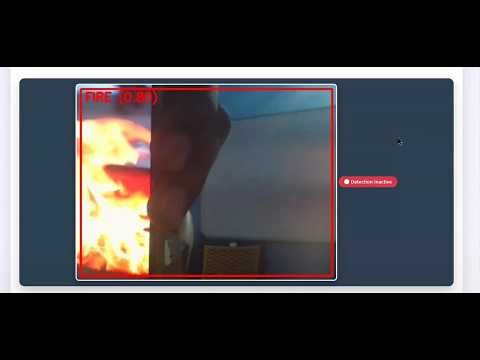
Another significant aspect of this project is the system’s ability to save detected frames automatically with labels such as Fire or Smoke. These saved images can be used not only for audit and analysis but also for model retraining, performance evaluation, or providing evidence during incident investigations. The graphical interface includes an option to view stored images, delete individual frames, or clear the entire saved dataset. This functionality extends the system beyond real-time detection, transforming it into a powerful monitoring and documentation tool. The real-time detection module incorporates visual warning cues by drawing colored bounding boxes around the frame whenever fire or smoke is detected. This enhances situational awareness, allowing users to instantly identify the severity and type of threat. Fire predictions are highlighted in red, smoke predictions in yellow, and normal conditions are displayed without boxes. This visual differentiation helps users interpret results more quickly and reduces cognitive load.
OBJECTIVES
The primary objective of this project is to design and implement a real-time, intelligent fire and smoke detection system that leverages deep learning and computer vision to provide faster, more reliable, and more user-friendly hazard identification compared to traditional sensor-based systems. The system aims to detect the earliest visual signs of fire or smoke by analyzing continuous video streams through a trained Convolutional Neural Network (CNN), enabling rapid alert generation before physical detectors respond. A core objective is to achieve high detection accuracy across diverse environments, including indoor settings, outdoor spaces, low-light areas, and situations with complex backgrounds. This requires building a robust CNN model capable of distinguishing between fire, smoke, and normal scenes with minimal false positives. Another major objective is to create a complete end-to-end pipeline rather than just a research model. This includes preprocessing raw camera frames, performing real-time inference, annotating predictions with color-coded bounding boxes, and displaying them on a web-based dashboard. The system is also designed with the objective of being lightweight enough to function smoothly on standard CPU hardware without the need for GPUs, making it widely deployable in homes, industries, or institutional settings.
In addition to accurate detection, a significant objective of this work is to ensure system usability by providing a browser-accessible interface through a Flask web application, allowing users to monitor live video streams and interact with the detection system easily. The interface must support intuitive controls, such as Start Live and Stop Live buttons, to give users direct command over the camera-based detection engine. The system must also include automatic storage of detected fire and smoke frames, enabling proper documentation, review, or post-incident investigation. This objective extends to providing users with tools to manage saved detections, including the ability to delete individual images or clear the entire set. Secure user authentication forms another key objective, implemented using SQLite to ensure that only authorized individuals can access the detection module, safeguarding the system from unauthorized use. Beyond real-time detection, the project also aims to support maintainability and scalability. Therefore, modular design principles are adopted so that the detection engine, user interface, and database operate independently but seamlessly integrate as one system.
Block Diagram