ABSTRACT
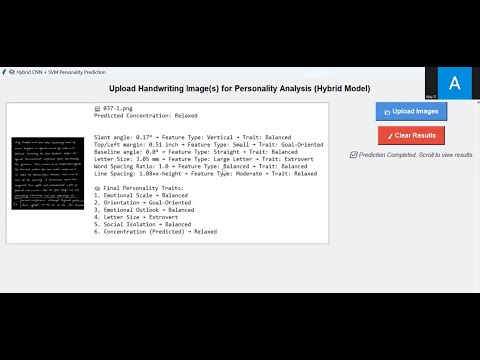
Handwriting is a complex neuromuscular activity that reflects an individual’s cognitive state, emotional tendencies, behavioral patterns, and personality traits. Traditional graphology relies on subjective human interpretation, which lacks consistency and scientific reproducibility. To overcome these limitations, this project proposes a hybrid AI-based personality prediction framework that integrates handcrafted graphology features with deep visual handwriting embeddings. Handwritten samples are processed through a Multi-Output Random Forest model for multi-trait prediction, while handwriting images are analyzed using a ResNet50-based CNN to extract stroke-level visual patterns. These numerical graphology features and CNN embeddings are fused and classified using an SVM to achieve highly accurate concentration prediction. A Tkinter GUI is developed to allow multi-image uploads, real-time processing, and clear visualization of all predicted traits. The system successfully transforms traditional subjective handwriting analysis into a data-driven, automated, and reliable method for personality assessment.
Keywords: Handwriting Analysis, Graphology, Personality Prediction, Random Forest, CNN, ResNet50, Hybrid Model, SVM, Machine Learning, Deep Learning.
OBJECTIVES
• To develop an automated AI-based handwriting personality prediction system that eliminates the subjectivity of traditional graphology.
• To extract and analyze core graphology features such as slant, margins, spacing, baseline alignment, and letter size from the handcrafted CSV dataset.
• To build a Multi-Output Random Forest model capable of predicting multiple personality traits simultaneously using structured handwritten features.
• To design a deep learning model using ResNet50 for extracting high-level visual handwriting embeddings from images.
• To combine CNN-based visual features with handcrafted graphology features through a hybrid feature fusion approach.
• To implement an SVM classifier over the fused features to achieve highly accurate concentration prediction.
• To ensure robust preprocessing, including cleaning, encoding, scaling, and augmentation, for improved model stability.
• To develop a Tkinter-based GUI that supports multi-image upload and displays all predicted traits in real time.
• To evaluate the performance of machine learning, deep learning, and hybrid models using accuracy, F1-score, and confusion matrices.
• To create a scalable and extendable personality analysis system that can accommodate additional traits or advanced AI models in future work.
Block Diagram
Requirement Specification
Pc
Software Requirement
The very Basics of Python
There are a few features of python which are different than other programming languages, and which should be mentioned early on so that subsequent examples don’t seem confusing. Further information on all of these features will be provided later, when the topics are covered in depth. Python statements do not need to end with a special character – the python interpreter knows that you are done with an individual statement by the presence of a newline, which will be generated when you press the “Return” key of your keyboard. If a statement spans more than one line, the safest course of action is to use a backslash (\) at the end of the line to let python know that you are going to continue the statement on the next line; you can continue using backslashes on additional continuation lines. (There are situations where the backslashes are not needed which will be discussed later.) Python provides you with a certain level of freedom when composing a program, but there are some rules which must always be obeyed. One of these rules, which some people find very surprising, is that python uses indentation (that is, the amount of white space before the statement itself) to indicate the presence of loops, instead of using delimiters like curly braces ({}) or keywords (like “begin” and “end”) as in many other languages. The amount of indentation you use is not important, but it must be consistent within a given depth of a loop, and statements which are not indented must begin in the first column. Most python programmers prefer to use an editor like emacs, which automatically provides consistent indentation; you will probably find it easier to maintain your programs if you use consistent indentation in every loop, at all depths, and an intelligent editor is very useful in achieving this.