ABSTRACT
Communication is one of the most essential aspects of human life, enabling individuals to express thoughts, emotions, and needs effectively. However, mute and deaf individuals face significant challenges in communicating with normal people due to limitations in speech and hearing abilities. Sign language is commonly used by them, but it is not universally understood by everyone, which leads to a communication gap in society. To overcome this problem, an assistive communication system is required that can convert gestures into understandable text and speech in real time.
This project presents a Gesture Based Communication System for mute and deaf people using Raspberry Pi, flex sensors, ADS1115 analog-to-digital converter, Raspberry Pi camera, LCD display, and speaker. The main objective of the system is to convert hand gestures into meaningful messages and provide both visual and audio output for easy understanding. The system is designed to be low-cost, portable, and user-friendly, making it suitable for daily use.
The proposed system operates in two different modes. In the first mode, flex sensors attached to a glove are used to detect finger movements. These sensors produce analog signals based on finger bending, which are converted into digital signals using the ADS1115 converter. The Raspberry Pi processes these signals and identifies predefined gestures. Each gesture corresponds to a specific message such as basic needs like water, food, washroom, or help.
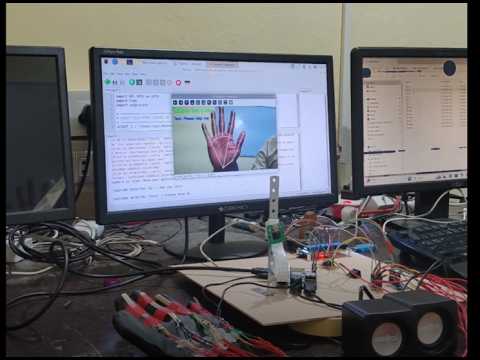
In the second mode, a Raspberry Pi camera is used to capture hand gestures. The system detects finger count and interprets it as predefined messages. This allows contactless gesture recognition and increases system flexibility. The recognized gestures are displayed on an LCD screen and simultaneously converted into speech using a speaker module.
Python programming language is used for implementing the system due to its simplicity and availability of libraries for hardware control and image processing. The Raspberry Pi acts as the central processing unit and manages all input and output operations. The system ensures real-time processing of gestures, providing quick response and accurate communication.
INTRODUCTION
Communication is a basic necessity in human life that allows individuals to share ideas, emotions, and information effectively. It plays a vital role in social interaction, education, healthcare, and professional environments. Humans communicate using speech, hearing, writing, and gestures. However, mute and deaf individuals face significant challenges in communicating with others due to their inability to speak and hear properly. This creates a communication barrier between specially abled people and normal individuals in society.
Sign language is the primary method of communication for deaf and mute individuals, but it is not widely understood by everyone. As a result, communication becomes slow, inefficient, and sometimes misunderstood. In many real-world situations such as hospitals, schools, offices, and public places, immediate communication is required, and dependency on interpreters is not always possible. Therefore, there is a strong need for an automated system that can convert gestures into understandable text and speech.
In recent years, advancements in embedded systems, microcontrollers, and sensor technologies have enabled the development of intelligent assistive devices. These systems help bridge the communication gap and improve accessibility for specially abled individuals. The use of Raspberry Pi as a processing unit allows real-time data processing and efficient system control. Flex sensors are widely used for detecting finger movements in gesture recognition systems due to their simplicity and accuracy.
The proposed Gesture Based Communication System is designed to convert hand gestures into meaningful messages. It uses flex sensors attached to a glove and a Raspberry Pi camera for detecting gestures. The system is designed to operate in two modes: flex sensor mode and camera-based mode. This dual-mode system increases flexibility and ensures better communication in different conditions.
In flex sensor mode, finger movements are detected using flex sensors, which generate analog signals based on bending angles. These signals are converted into digital values using the ADS1115 analog-to-digital converter. The Raspberry Pi processes these values and maps them to predefined gestures. Each gesture represents a specific message such as “I need water,” “I need food,” “I need washroom,” and “I need help.” The output is displayed on an LCD screen and converted into speech using a speaker.
In camera mode, the Raspberry Pi camera captures hand gestures and detects finger count. The system processes the image input and identifies gestures based on predefined logic. Each detected gesture is mapped to a corresponding message, and up to 13 different messages can be recognized. The system then displays the message on an LCD and provides audio output using a speaker. This contactless method improves usability and convenience.
Python programming language is used for developing the system due to its simplicity and strong support for hardware interfacing, image processing, and text-to-speech conversion. The Raspberry Pi acts as the central controller that manages all inputs and outputs. The system ensures real-time processing of gestures, providing fast and accurate communication between users.
The system is designed to be low-cost, portable, and user-friendly so that it can be used in everyday environments such as schools, hospitals, workplaces, and public service areas. It reduces dependency on human interpreters and improves independence for mute and deaf individuals. It also enhances social inclusion by enabling smoother communication between specially abled and normal people.
This project demonstrates the effective use of embedded systems and sensor technologies in solving real-world communication problems. It combines hardware components and software algorithms to create an intelligent assistive communication device. The integration of flex sensors and camera-based recognition makes the system more reliable and adaptable in different situations.
In conclusion, the Gesture Based Communication System plays an important role in improving communication accessibility for mute and deaf individuals. It provides a practical, efficient, and real-time solution to overcome communication barriers and supports inclusive development in society. Future improvements can further enhance its accuracy and expand its applications using advanced technologies such as machine learning and artificial intelligence.
OBJECTIVES
1. To design a gesture-based communication system for mute and deaf individuals using Raspberry Pi.
2. To capture hand gestures using flex sensors and a Raspberry Pi camera.
3. To convert finger movements into electrical signals using flex sensors.
4. To use ADS1115 ADC for accurate conversion of analog signals to digital data.
5. To process gesture data using Raspberry Pi as the main controller.
6. To recognize predefined gestures and map them to meaningful messages.
7. To display recognized messages on an LCD display in real time.
8. To convert text messages into speech using a speaker module.
9. To implement a dual-mode system using a switch for mode selection.
10. To improve communication between mute/deaf individuals and normal people.
11. To provide a low-cost and portable assistive communication device.
12. To ensure real-time processing of gestures with minimal delay.
13. To support both sensor-based and vision-based gesture recognition.
14. To reduce dependency on sign language interpreters.
15. To enhance social inclusion and accessibility for specially abled individuals.
Block Diagram