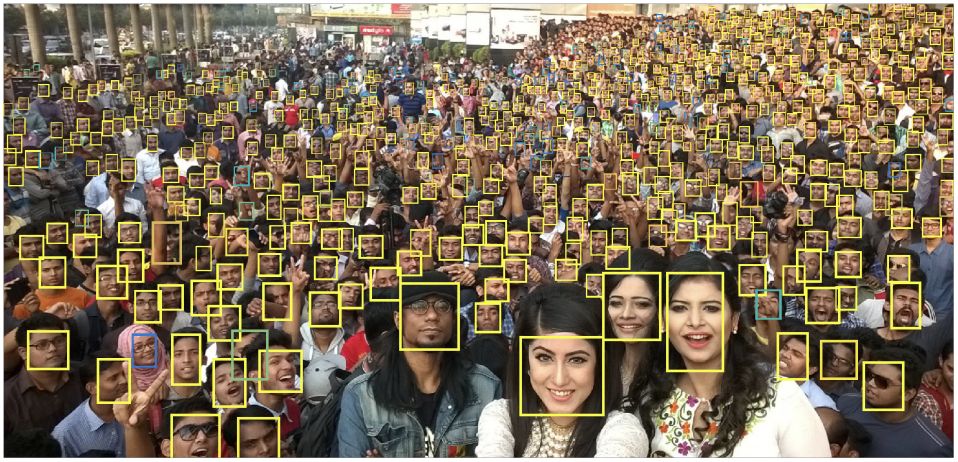
Finding missing individuals is an important challenge for families, communities and authorized public safety organizations. Searching through large collections of photographs and manually comparing facial appearances can require considerable time and effort. Artificial Intelligence (AI), computer vision and deep learning offer new approaches to support image-based search and comparison.
The Missing People Identification System Using Face Recognition and Deep Learning is an AI project designed to demonstrate how facial image analysis can assist in searching for potentially matching individuals within an authorized image database. The system uses deep learning techniques to detect faces, extract facial features and compare those features with reference images.
When a user submits an authorized reference photograph, the application processes the image and searches for visually similar face representations in its database. Potential matches can be displayed with similarity scores and relevant reference information for further human review.
The primary objective is to explore how automated image processing can support missing-person search workflows. The system is intended as a research and educational prototype. A similarity score is not proof of identity, and any real-world identification must be independently verified by authorized professionals.
Key Features & Benefits
Existing System and Its Challenges
Traditional missing-person searches often involve collecting photographs, reviewing reports, contacting relevant organizations and manually comparing available images. These activities are important but can become difficult when the number of reference photographs is large.
Some challenges include:
1. Time-Consuming Image Comparison: Manually reviewing large image collections can require significant time and effort.
2. Variations in Facial Appearance: Facial images may differ because of lighting, camera angle, image quality, facial expressions and changes in appearance over time.
3. Poor Image Quality: Blurred, low-resolution or partially obscured photographs can affect face detection and feature extraction.
4. Large Image Collections: Searching through many photographs manually can make it difficult to identify potentially relevant images quickly.
5. Inconsistent Image Organization: Missing or incomplete metadata can make photograph management and retrieval more challenging.
6. Risk of Incorrect Matches: Facial recognition systems can produce false matches. A visually similar result must never be treated as a confirmed identity without additional verification.
A deep learning-based system can help organize and retrieve candidate images, but its performance depends on image quality, dataset suitability, model evaluation and responsible human oversight.
Implementation Guide
Proposed System and Methodology
The proposed system combines face detection, deep learning-based feature extraction and similarity comparison to identify potentially matching photographs in an authorized database.
1. Authorized Image Collection
The system uses reference photographs and database images that have been lawfully collected with appropriate permissions. Image sources, access rights and retention policies should be documented.
2. Image Preprocessing
Uploaded images are prepared for analysis through resizing, normalization and quality checks. Images with insufficient resolution or unsuitable lighting can be flagged for review.
3. Face Detection
A face detection model identifies facial regions within the input photograph. Depending on the implementation, technologies such as MTCNN, RetinaFace or OpenCV-based detection methods may be evaluated.
4. Facial Feature Extraction
A deep learning model converts a detected face into a numerical feature representation, often called a face embedding. Models such as FaceNet or ArcFace can be explored for this stage, subject to their licensing and appropriate use.
5. Similarity Comparison
The extracted feature representation is compared with authorized reference embeddings in the database. Similarity measures such as cosine similarity or Euclidean distance can be used to rank candidate images.
6. Candidate Result Display
The application displays potential matches with reference image information and similarity scores. Results should be presented as candidates for review, not confirmed identities.
7. Human Verification and Record Management
An authorized reviewer examines candidate results and performs independent verification using appropriate procedures. Access to images and records should be restricted, logged and governed by clear retention policies.
Technical Specifications
Technologies, Features and Applications
The project can be developed using Python, deep learning frameworks, computer vision libraries and a database for managing authorized image records.
Technologies Used
Python – Main programming language.
OpenCV – Image processing and face-related operations.
TensorFlow or PyTorch – Deep learning model development and inference.
FaceNet or ArcFace – Facial feature embedding approaches.
MTCNN or RetinaFace – Face detection options.
NumPy – Numerical computation and feature handling.
Scikit-learn – Evaluation and comparison utilities.
Flask or Streamlit – Web interface and application backend.
MySQL or MongoDB – Authorized image metadata and record management.
Key Features
Authorized reference image upload.
Automatic face detection.
Deep learning-based facial feature extraction.
Similarity-based candidate retrieval.
Ranked candidate result display.
Image and record management.
Human review and verification workflow.
Access control and activity logging.
Privacy-conscious data handling.
Potential Applications
Academic research in face recognition.
Computer vision and deep learning demonstrations.
Authorized missing-person search support prototypes.
Image retrieval and similarity comparison research.
Digital image database management.
Development of human-reviewed investigative support tools.
Facial images and biometric representations are sensitive personal data. A real-world system must use appropriate legal authorization, informed consent where required, strong security, access restrictions, bias testing and clear retention and deletion policies. It should not be used for unrestricted public surveillance or automatic decisions about a person's identity
Conclusion & Next Steps
Conclusion
The Missing People Identification System Using Face Recognition and Deep Learning demonstrates how computer vision and artificial intelligence can support image retrieval and candidate matching in authorized missing-person search workflows. By combining face detection, deep learning-based feature extraction and similarity comparison, the project provides a practical foundation for studying AI-based image analysis.
This project is suitable for students interested in Python, deep learning, computer vision, face recognition and AI application development. Its development also highlights the importance of privacy, responsible biometric data handling and human verification.
Contact Details
Aislyn Technologies, Bangalore
Phone: +91 97395 94609
Email: info@aislyntech.com
Website: https://aislyn.in
Contact Aislyn Technologies for project development, implementation guidance and technical support. Our team can help you develop your AI final-year project with expert support.