ABSTRACT:
The increasing demand for smart farming solutions has led to the development of intelligent systems capable of monitoring plant health and supporting farmers in early disease detection. This project presents an IoT-enabled leaf disease detection robot with automated pesticide prediction using Raspberry Pi, designed to assist farmers in identifying plant diseases in real time and recommending appropriate pesticides. The system integrates a Raspberry Pi 4B+, Pi Camera, YOLOv5-based disease detection model, and a Blynk-controlled robotic platform to navigate through agricultural fields.
The robot captures continuous video of plant leaves using the Pi Camera and processes the frames using a trained deep-learning model to classify diseases such as leaf spot, blight, rust, mildew, and other common infections. Each classified disease is mapped to a predefined set of recommended pesticides, enabling quick and accurate pesticide suggestions. A L298N motor driver is used to control the four-wheel robotic movement, while the Blynk mobile application allows users to manually navigate the robot across the field. Additionally, the system incorporates Twilio SMS integration, enabling automatic alerts to farmers with the detected disease, its confidence level, and the suitable pesticide recommendations.
The proposed system offers a cost-effective and efficient alternative to manual crop inspection, reduces the risk of delayed diagnosis, and enhances crop productivity through timely treatment. By combining robotics, computer vision, and IoT communication, this solution demonstrates a scalable approach toward modern precision agriculture. The system can further be expanded with features like autonomous navigation, multi-disease datasets, Internet-based dashboards, and real-time pesticide spraying mechanisms, making it a valuable tool for future smart farming applications.
INTRODUCTION:
Agriculture remains one of the most essential sectors in the global economy, providing food, raw materials, and employment to a large portion of the population. However, traditional farming practices continue to face significant challenges, especially in the early detection and treatment of plant diseases. When plant diseases go unnoticed, they can spread rapidly across agricultural fields, resulting in reduced yield, poor crop quality, and major economic losses for farmers. Manual inspection of crops is often time-consuming, inaccurate, and labor-intensive, particularly for large farms. With the growth of smart technologies and the increasing adoption of automation, there is a strong need for intelligent systems that can help farmers monitor plant health more efficiently.
In recent years, Internet of Things (IoT) devices, robotics, and machine learning-based image analysis have emerged as powerful tools for modern agriculture. These technologies offer new opportunities to automate field monitoring, collect real-time data, and make informed decisions to protect crops from various diseases. Embedded systems like the Raspberry Pi have become highly popular due to their low cost, compact size, and ability to run advanced algorithms for image processing and communication with IoT platforms.
This project introduces an IoT-Enabled Leaf Disease Detection Robot with Automated Pesticide Prediction Using Raspberry Pi, a smart agricultural system designed to identify plant diseases in real-time and recommend appropriate pesticides instantly. The robot integrates multiple technologies—embedded hardware, computer vision, machine learning, IoT-based communication, and cloud-based notification services—to deliver a complete precision farming solution.
The system uses a Raspberry Pi 4B+ as the central processing unit, which captures live images using an attached Raspberry Pi Camera. These images are analyzed using a YOLOv5 deep learning model trained to recognize different types of leaf diseases. Once a disease is detected, the system automatically maps it to a corresponding pesticide using predefined datasets stored in the program. This eliminates guesswork and helps farmers apply the correct treatment at the right time.
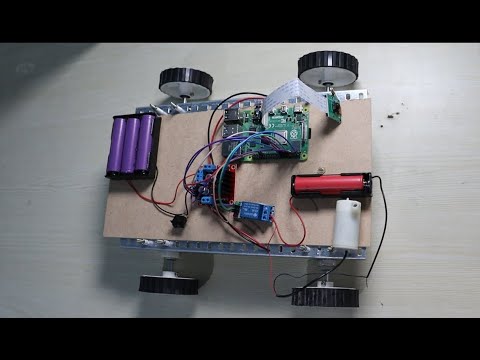
The robot’s movement is controlled remotely using the Blynk IoT mobile application, enabling the user to drive the robot across crop areas and monitor plants without physical effort. The locomotion is powered by a four-wheel robotic chassis connected to an L298N motor driver and 12V power supply, ensuring stable motion across different terrains. Furthermore, the system utilizes the Twilio communication API to send real-time alerts directly to the farmer’s mobile phone. These alerts include the detected disease, confidence level, and recommended pesticides, ensuring timely decision-making.
Overall, the project demonstrates how modern technologies can work together to improve agricultural productivity. By automating disease detection and pesticide recommendation, the system reduces manual workload, minimizes the chances of misdiagnosis, and enables farmers to maintain healthier crops. This IoT-driven robotic platform represents a step forward in the development of automated, intelligent, and sustainable agricultural systems designed to support the future of smart farming.
OBJECTIVES:
1. To design and develop an IoT-enabled mobile robotic platform for efficient agricultural field monitoring.
The primary objective of this project is to build a mobile robot capable of navigating through agricultural fields and capturing continuous visual data of plant leaves. The robot is designed using a four-wheel chassis driven by an L298N motor driver and controlled remotely through the Blynk IoT mobile application. This ensures that farmers or researchers can guide the robot across different sections of the field without physically walking long distances or manually inspecting plants. By enabling remote control and seamless mobility, the system supports enhanced field coverage, reduced human effort, and flexible operation under different environmental conditions.
2. To implement a Raspberry Pi–based real-time leaf disease detection system using advanced deep learning techniques.
Another major objective is to integrate a Raspberry Pi 4B+ with a high-resolution Pi Camera to capture live images and process them using a YOLOv5 object detection model. The aim is to perform disease detection directly on the live video feed, providing immediate identification of infected leaves. This eliminates the limitations of traditional manual inspection and ensures consistent accuracy even in varying lighting and field conditions. The ability to perform real-time detection allows the system to diagnose diseases while the robot is in motion, making it significantly more efficient than stationary or manual methods.
3. To develop an automated pesticide prediction mechanism linked with disease identification.
A critical objective is to ensure that once a disease is detected, the system automatically provides suitable pesticide recommendations without requiring farmer expertise. Each disease class identified by the YOLO model is mapped to a predefined pesticide list embedded in the Raspberry Pi program. This allows the system to instantly recommend chemical treatments such as Mancozeb, Neem Oil, or Copper Hydroxide, depending on the detected disease. By automating this decision-making process, the project aims to minimize incorrect pesticide usage, prevent crop damage, and promote responsible chemical application.
4. To integrate IoT-based notification and alert services for real-time communication with farmers.
The project aims to establish instant communication channels using IoT platforms like Blynk and Twilio SMS. When a disease is detected, the system automatically sends a detailed alert to the farmer’s mobile phone containing the disease name, model confidence, and recommended pesticides. This ensures that farmers receive timely information even when they are far away from the field or not actively monitoring the robot. Such instant notification is crucial for preventing the rapid spread of diseases and enabling immediate action on the ground.
5. To reduce manual labour, improve accuracy, and enhance efficiency in disease detection processes.
One of the major objectives of the project is to eliminate the dependency on slow and error-prone manual inspection methods. Human observation is limited by fatigue, inconsistent judgement, and the inability to cover large field areas in limited time. By automating disease detection using artificial intelligence and robotics, the system ensures consistent accuracy, faster monitoring, and the ability to detect early-stage infections that may be missed by the naked eye. This objective directly contributes to improving agricultural productivity and reducing crop loss.
6. To create an affordable, portable, and scalable solution suitable for modern precision farming.
The project aims to deliver a low-cost yet powerful agricultural tool by utilizing widely available components such as Raspberry Pi, standard DC motors, Blynk IoT services, and open-source AI models. The design and architecture are intentionally kept modular so the system can be easily expanded or replicated for different crops, disease types, or field sizes. The objective is to ensure that even small-scale farmers can adopt this technology without financial burden, thereby empowering rural communities and supporting sustainable agricultural practices.
Block Diagram