ABSTRACT
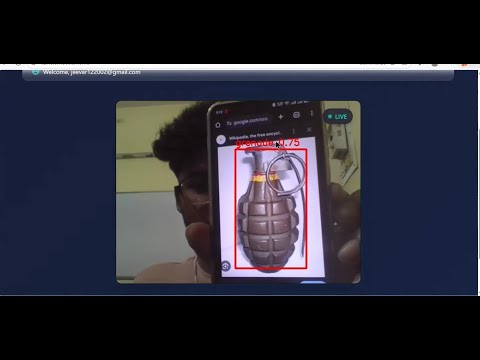
The rapid advancement of computer vision and deep learning technologies has enabled intelligent surveillance systems capable of performing real-time weapon detection with high accuracy. This project focuses on developing a secure and efficient real-time weapon detection system using the YOLOv5 deep learning model integrated with the Flask web framework. The proposed system is designed to detect specific objects such as weapons like guns, grenade, hammer, knife from live video streams and to record the detected instances for user analysis. The model employs YOLOv5, a state-of-the-art convolutional neural network architecture known for its speed and precision in object localization and classification tasks. By utilizing Python as the core programming language, the system ensures modularity, scalability, and easy integration with existing surveillance environments. The Flask framework serves as the backend for managing user authentication, detection data storage, and live video processing. A lightweight SQLite database is used to maintain user credentials and detection records securely, thereby ensuring efficient data management and retrieval. The application also provides a user-friendly web interface for registration, login, live detection visualization, and retrieval of previous detection events. The integration of OpenCV enables real-time frame acquisition and processing, while the PyTorch-based YOLOv5 model performs fast inference for detecting potential threats. Each detected frame is automatically stored in the local directory with timestamps for accountability and later review. The primary objective of this project is to develop a practical solution that enhances safety through intelligent monitoring while minimizing computational cost and false detection rates. The system is designed to be easily deployable in environments such as schools, public areas, and organizations where security is a priority. Experimental evaluation demonstrates that the system achieves high detection accuracy and stable frame rates even under varying lighting and background conditions. This approach effectively bridges the gap between machine learning-based visual analytics and web-enabled monitoring systems. The project showcases the potential of combining Flask’s lightweight web technology with YOLOv5’s deep learning capabilities to produce a reliable, real-time weapon detection platform. Overall, this work contributes to the growing field of intelligent video surveillance and paves the way for future enhancements involving cloud deployment, multi-camera integration, and mobile access.
OBJECTIVES
The primary objective of this project is to design and implement a real-time intelligent weapon detection system that integrates deep learning with web-based technologies for enhanced surveillance and monitoring. The system aims to automatically detect specific objects, such as grenade, guns, hammer, knife from live video streams and alert users by storing the detection results for review and analysis. By utilizing the YOLOv5 deep learning architecture, the project seeks to achieve high detection accuracy and processing speed, ensuring that real-time monitoring can be conducted efficiently and effectively without human intervention. The overarching goal is to develop a system that contributes to public safety by identifying potential threats early and minimizing the possibility of human oversight. One of the key objectives is to integrate a trained YOLOv5 model with a Flask-based web application, enabling users to interact with the detection system through a simple and accessible interface. This integration demonstrates the feasibility of deploying deep learning models on lightweight, platform-independent web frameworks, thereby bridging the gap between AI research and real-world usability. The project intends to make weapon detection technology more accessible to general users, security personnel, and organizations by offering a solution that does not require specialized hardware or complex installations. Another important objective is to enable real-time processing and visualization of detections through a connected camera. The system is designed to capture live video frames, process them using YOLOv5, and display the detection results instantly on the web interface. This objective ensures that the application not only performs offline recognition but also serves as an interactive real-time surveillance tool. The inclusion of OpenCV as the video processing library supports this functionality, allowing continuous frame capture and analysis with minimal latency.
A further objective of the project is to implement secure user management and data handling mechanisms. Through the use of the SQLite database, the system maintains individual user accounts, enabling secure registration, login, and session management. Each detection event is associated with the corresponding user and stored along with a timestamp for future retrieval. This feature promotes accountability and supports data-driven decision-making by maintaining a structured record of detections. It also ensures that multiple users can operate the system independently without data interference. The project also aims to develop a robust detection log and image storage module that records each detected frame for later inspection. This feature is particularly valuable in surveillance scenarios where maintaining a historical record is essential for investigations or audits. By storing images with relevant metadata, such as the detection time and object class, the system enables users to review and analyze detection patterns over extended periods. Another major objective is to optimize computational performance and system scalability. The application is built with a focus on efficiency, ensuring that it can run smoothly even on systems with limited hardware capabilities. The modular design of the Flask framework allows future integration of additional functionalities, such as multi-camera support, cloud-based monitoring, or real-time alert notifications. This flexibility aligns with modern software engineering principles, ensuring that the system can evolve according to user needs and technological advancements. The project also seeks to enhance user experience through a simple and intuitive interface. The goal is to design a web dashboard that provides easy access to live detection streams, historical detection images, and relevant data summaries. By simplifying interaction, the project ensures that users with minimal technical expertise can effectively utilize the application without extensive training.
From a research perspective, another objective is to demonstrate the real-world applicability of deep learning in computer vision tasks. The project emphasizes practical implementation rather than theoretical modeling, showcasing how pre-trained AI models can be integrated into web-based environments to solve real-time problems. It contributes to the broader field of intelligent surveillance and smart monitoring systems by offering an adaptable framework for similar detection-based applications. In summary, the objectives of this project revolve around the development of an intelligent, efficient, secure, and user-friendly real-time weapon detection system. The system aims to merge the power of deep learning with the accessibility of web technology to produce a comprehensive monitoring solution. It seeks to ensure rapid detection, reliable data management, and flexible deployment — all while maintaining scalability, accuracy, and ease of use. Through these objectives, the project aspires to provide a foundation for future innovations in AI-powered security systems and intelligent video analytics. In addition to the core objectives, this project also aims to bridge the technological gap between theoretical deep learning models and their practical deployment in everyday security applications. Many AI models remain underutilized because they lack real-world integration frameworks. This project overcomes that limitation by demonstrating how a high-performance detection model like YOLOv5 can be successfully integrated within a Flask web application to create a functional and deployable system. The emphasis is not only on model accuracy but also on usability, performance, and maintainability — ensuring that the system can operate seamlessly in dynamic, real-world environments. Another supplementary objective is to implement a data-driven approach for continuous improvement of the detection model. By systematically recording detections and maintaining logs in the database, the project enables future retraining and fine-tuning of the model using real-time data. This capability ensures that the system becomes progressively smarter and more adaptive to environmental variations, such as changes in lighting, background, or camera angles. Such adaptability is essential for ensuring that the detection model remains reliable over time. The project also aims to demonstrate modularity and code reusability in its software architecture. Each component — including the YOLOv5 model, database management system, video stream handler, and web interface — is designed as an independent yet interconnected module. This modular structure allows developers to modify, upgrade, or replace individual components without affecting the overall functionality of the application. This objective aligns with modern software engineering practices that prioritize maintainability and scalability. Furthermore, the project seeks to promote awareness about AI-driven safety solutions and encourage institutions to adopt intelligent surveillance systems. With the growing concerns around campus safety, public security, and industrial monitoring, this project highlights how cost-effective, open-source technologies can contribute to the development of advanced monitoring infrastructures. The proposed system offers an affordable yet efficient solution for organizations that may not have access to high-end commercial surveillance platforms.
Block Diagram
SYSTEM REQUIREMENTS
The proposed real-time weapon detection system is designed to integrate artificial intelligence, computer vision, and web-based technologies. Therefore, both hardware and software requirements must be carefully defined to ensure smooth execution, optimal performance, and system stability. The following specifications outline the recommended environment for developing and deploying this YOLOv5 and Flask-based weapons detection application.
1. Hardware Requirements
The hardware requirements are essential for ensuring the real-time performance of the system. Since the YOLOv5 model performs intensive mathematical operations involving deep neural network computations, it is necessary to have a capable machine that can process live video frames efficiently. The hardware specifications are listed below:
Processor (CPU):
A multi-core processor such as Intel Core i5, i7, or AMD Ryzen 5 and above is recommended. A higher clock speed enables faster processing of video frames and improves detection performance.
Graphics Processing Unit (GPU):
For faster inference, an NVIDIA GPU with CUDA support (such as GTX 1060, RTX 2060, or higher) is recommended. The GPU accelerates the YOLOv5 model and significantly reduces latency compared to CPU-only processing. However, the system can also operate in CPU mode with reduced speed.
Random Access Memory (RAM):
At least 8 GB RAM is required to handle simultaneous tasks such as model inference, web streaming, and database management. For optimal performance, 16 GB or higher is recommended, especially when working with high-resolution video feeds.
Storage:
A minimum of 100 GB of available disk space is recommended to store the model weights, dataset, dependencies, and detection images. SSD storage is preferred for faster data access and reduced loading time.
Camera Device:
A USB webcam or integrated laptop camera with a minimum resolution of 720p is necessary to capture live video input. For better results, a Full HD or IP-based camera can be used for clear and detailed detection.
Network Connectivity:
A stable internet or local network connection is recommended for smooth data transmission, web application hosting, and real-time video streaming over Flask.
Display Monitor:
A standard LED/LCD monitor with a resolution of at least 1366×768 pixels is sufficient to display live detection results and interface pages clearly.
2. Software Requirements
The software environment defines the development and execution framework for the YOLOv5 detection system. It consists of the operating system, programming tools, libraries, and dependencies that collectively support deep learning and web integration.
Operating System:
The system is compatible with major platforms such as Windows 10/11 (64-bit), Ubuntu 20.04, or macOS Monterey. Python-based environments make the system platform-independent.
Programming Language:
The application is primarily developed in Python 3.8 or higher, which provides the flexibility and extensive library support required for machine learning, computer vision, and web development.
Frameworks and Libraries:
• Flask: For web application development, routing, and live video streaming.
• PyTorch: For running the YOLOv5 deep learning model and managing neural network computations.
• OpenCV: For capturing video frames, drawing bounding boxes, and image preprocessing.
• NumPy: For efficient numerical and matrix operations.
• SQLite3: For lightweight database management to store user credentials and detection logs.
• Torchvision and Utils: For image transformation and YOLOv5 model support.
Model File:
The trained YOLOv5 weight file (best.pt) must be placed in the runs/train/exp/weights/ directory. This model is used for inference to detect weapons from the camera feed.
IDE / Code Editor:
Development and debugging can be done using environments like Visual Studio Code, PyCharm, or Jupyter Notebook, which support Python syntax highlighting and virtual environment management.
Browser:
The web interface can be accessed using modern browsers such as Google Chrome, Microsoft Edge, or Mozilla Firefox, ensuring smooth rendering of live streams and stored detections.