Introduction: The Evolution of Autonomous Mobile Robots (AMRs) in Smart Logistics
Autonomous Mobile Robots (AMRs) and Automated Guided Vehicles (AGVs) form the backbone of modern industrial automation, smart warehousing, and flexible manufacturing facilities. Traditional automated transport systems rely solely on static floor tracks. However, next-generation logistics demand vehicles capable of high-precision path tracking alongside real-time dynamic obstacle detection and intelligent re-routing.
The Line Follower and Obstacle Avoiding Robot Using Arduino with Smart Navigation System represents an ideal, cost-effective prototype for engineering students working on autonomous systems, IoT, and embedded robotics. By combining infrared (IR) line-tracking arrays with ultrasonic distance measuring sensors and servo-assisted scanning, this robot follows pre-designated paths while dynamically handling unexpected path blockages.
Key Features & Benefits
System Pipeline & Operational Workflow
Unlike end-to-end training where all network layers update simultaneously, layer-wise training optimizes individual network blocks or auto-encoder sub-networks incrementally before tuning the complete network.
The process begins with Input Frame Capture, where raw RGB driving footage is captured continuously via automotive camera sensors or benchmark datasets.
Next, during Layer One Feature Extraction, early encoder layers train independently to isolate fundamental low-level features such as spatial edges, contrast boundaries, and basic road surface colors.
This advances to Layer Two Mid-Level Feature Representation, where intermediate layers build on the initial edge representations to identify complex textures, road structures, and lane geometry.
Following this, Layer Three High-Level Contextual Features extract deep semantic maps that segment drivable paths from surrounding obstacles, vegetation, and sidewalks.
The network then enters Global Fine-Tuning & Decoder Reconstruction, where the complete encoder-decoder architecture undergoes lightweight joint fine-tuning paired with auxiliary loss functions.
Finally, the system outputs a Multi-Class Pixel Mask, generating high-resolution, color-coded segmentation masks for real-time decision-making in autonomous vehicle perception stacks.
Implementation Guide
Key Features & Essential Technologies
Implementing layer-wise training for road semantic segmentation balances real-time inference speed with pixel-level accuracy. Key features include lightweight embedded execution that cuts floating-point operations (FLOPs) for edge hardware, multi-class scene parsing for simultaneous road and obstacle labeling, faster convergence rates that reduce total training epochs, and strong environmental robustness against lighting and shadow changes.
The recommended software stack relies on Python 3.x or C++ paired with deep learning frameworks such as PyTorch, TensorFlow, or Keras. Computer vision processing is powered by OpenCV, Albumentations, and NumPy. Benchmark datasets commonly used for training include KITTI Vision, Cityscapes, BDD100K, and Freiburg Forest. Hardware deployment is typically executed on edge AI platforms like NVIDIA Jetson Orin/Nano, Raspberry Pi with AI accelerators, or dedicated CUDA GPUs.
Technical Specifications
Step-by-Step Implementation Guide for Students
Follow this structured step-by-step roadmap to assemble, wire, and program your project successfully:
Hardware Chassis Assembly & Power Management
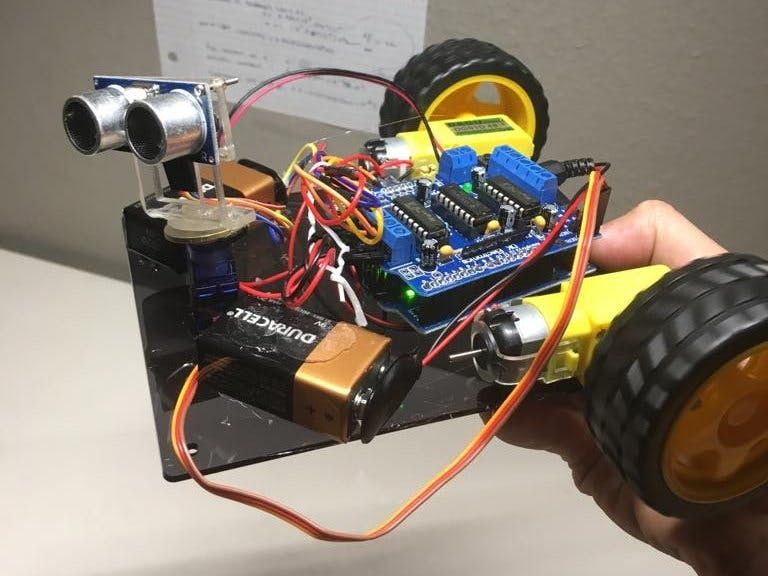
Action: Mount dual BO gear motors securely onto an acrylic robot chassis. Position the IR sensor array close to the ground (approximately 5 mm to 10 mm height) at the front base. Mount the HC-SR04 ultrasonic distance sensor directly onto the micro servo horn centered at the front top.
Verification: Spin both wheels manually to ensure smooth rotation without hitting the chassis frame, and check that the IR sensors maintain clear clearance above the floor.
Interfacing Sensors and Motor Drivers
Action: Wire motor driver inputs (IN1, IN2, IN3, IN4) directly to the digital pins of the Arduino board. Connect the enable pins (ENA and ENB) to PWM-capable pins for precise speed control. Connect the digital outputs of the IR sensors and the Echo/Trigger pins of the ultrasonic sensor to dedicated GPIO pins.
Verification: Power on the microcontroller board and verify that the status LEDs illuminate on both the IR sensor module and the motor driver board.
Algorithm Development & Calibration
Action: Calibrate the IR sensor threshold values for light versus dark surfaces using the built-in potentiometers or software calibration code loops. Write proportional control logic in Embedded C/C++ to enable smooth line-tracking movements.
Verification: Place the robot over a black line; the onboard IR indicator LEDs should toggle ON and OFF accurately as the sensor crosses over the dark edge.
Obstacle Bypass Logic & Field Testing
Action: Program conditional logic blocks for obstacle handling: set a safety threshold distance (e.g., 20 cm), bring motors to a halt upon detection, execute a servo sweep (45 degrees left, 45 degrees right), select the path vector with maximum clearance, bypass the obstacle, and sweep until the primary track line is re-acquired.
Verification: Place an object 15 cm in front of the moving robot; it should stop immediately, scan both sides, turn toward the open path, and resume line-following once the track is relocated.
Conclusion & Next Steps
Future Scope & Industrial Applications
Autonomous line-following and obstacle-avoiding mobile platforms provide foundation technology across numerous modern industries:
Smart Factory AGVs: Transporting raw materials and components along assembly lines in manufacturing plants.
Automated Warehouse Logistics: Navigating fulfillment centers (like Amazon robotics) while avoiding human workers and stationary equipment.
Hospital Medical Delivery: Carrying medications, linens, and lab samples safely along hospital hallways.
IoT & Fleet Management Integration: Adding Wi-Fi/Bluetooth modules (ESP32/Raspberry Pi) for real-time telemetry, battery level reporting, and centralized control over cloud dashboards.
Building a Line Follower and Obstacle Avoiding Robot Using Arduino with Smart Navigation System provides students with solid practical grounding in embedded programming, sensor fusion, motor control, and robotics systems design.
Contact Details
Aislyn Technologies, Bangalore
📞 Phone: +91 97395 94609
📧 Email: info@aislyntech.com
🌐 Website: https://aislyn.in
Contact us today to start building your Embedded project in Bangalore with our expert support!