ABSTRACT
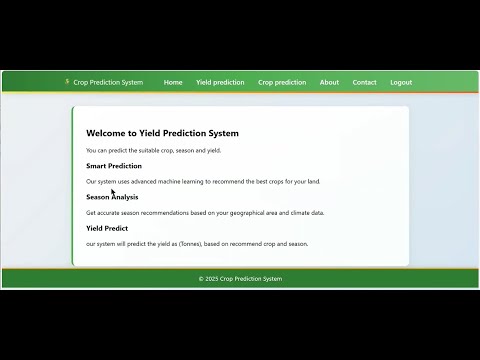
Agriculture is the backbone of the Indian economy, and accurate crop prediction plays a vital role in enhancing productivity and supporting farmers’ decision-making processes. Due to unpredictable climatic variations, improper crop selection often results in poor yield and economic losses. To address this challenge, this project presents a smart agricultural decision support system that predicts the most suitable crop and corresponding cultivation season based on environmental and soil parameters of the Karnataka region. The proposed system utilizes a Multi-Output Support Vector Machine (SVM) model for simultaneous prediction of crop type and season, while a separate machine learning-based crop recommendation model suggests the best crop based on soil nutrition values and weather conditions. The dataset is preprocessed by handling missing values, scaling numerical features, and encoding categorical variables for improved model efficiency. A web-based application using Flask is developed, enabling user authentication, input parameter submission, and real-time prediction visualization. The system also includes an innovative area-based matching technique, which retrieves the nearest crop and production information when exact field data is unavailable. Experimental results show that the approach delivers significant accuracy in practical prediction scenarios and supports data-driven agricultural planning. The developed system aims to assist farmers, researchers, and government sectors by providing timely insights to increase crop productivity and ensure sustainable agricultural development in Karnataka.
OBJECTIVES
🔹 Objective 1: To Apply Machine Learning for Crop and Season Prediction
The primary objective of this project is to utilize machine learning algorithms to analyze agricultural data and accurately predict the most suitable crop along with the correct season for cultivation. The system aims to learn the relationships between soil properties, environmental attributes, and cropping patterns using a large dataset from different districts of Karnataka. By identifying these hidden correlations, the model supports data-driven decision-making, helping farmers avoid manual guesswork. Machine learning enhances prediction accuracy by handling complex feature interactions which traditional farming knowledge may overlook. The developed model is trained to classify outputs efficiently with minimal error rate. This objective ensures that the system acts as a reliable tool to assist farmers in increasing yield. It also strengthens the use of advanced computational intelligence in agriculture. Overall, this objective promotes predictive analytics as an essential component in modern farming strategies.
🔹 Objective 2: To Design a Multi-Output SVM Model
The second objective is to develop a Multi-Output Support Vector Machine (SVM) classifier capable of predicting two target variables simultaneously, namely crop type and season. Unlike single-output models, multi-output learning maintains dependency between target variables, improving reliability in results. SVM is selected due to its excellent classification performance on complex datasets with high-dimensional features. By training the model to classify both outputs together, the system ensures consistency between crop suitability and seasonal requirements. This approach enhances classification stability across varying environmental conditions. The objective also emphasizes optimizing hyperparameters, scaling features, and encoding categorical variables for improved performance. Through this model, farmers receive a combined recommendation rather than separate and possibly conflicting predictions. The result is a more intelligent and context-aware prediction framework. This objective ultimately contributes to smarter agricultural planning and increased productivity.
🔹 Objective 3: To Develop a Crop Recommendation Model Using Soil and Weather Parameters
Another core objective is to implement an additional crop recommendation model that uses crucial inputs such as Nitrogen (N), Phosphorus (P), Potassium (K), temperature, humidity, pH level, and rainfall. By analyzing these key factors, the model predicts the most suitable crop for a given farmland condition. This objective ensures that the system remains practical even when farmers provide only soil and climate-related attributes. The model supports precision farming by reducing the risk of crop failure and promoting better resource utilization. The prediction mechanism aims to encourage sustainable agriculture by suggesting crops that match soil health and availability of natural resources. It also supports farmers in improving yield quantity and quality. The model leverages machine learning to provide fast and accurate insights in a user-friendly manner. Ultimately, this objective addresses essential field-level decisions for enhanced agricultural success.
Block Diagram