Abstract:
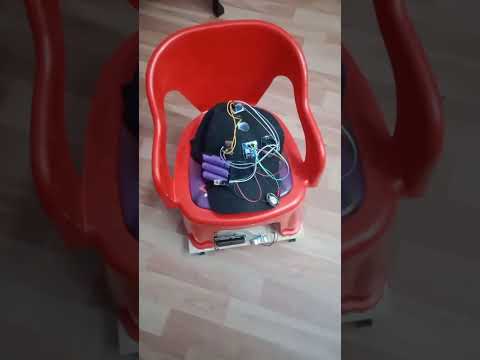
The proposed project, Head Gesture Movement Robot using IoT, focuses on designing an intelligent robotic system that can be controlled through human head movements and monitored remotely using the Internet of Things (IoT). The system integrates an ESP32 microcontroller, an RF transmitter and receiver, an LCD display, and various sensors including a temperature sensor, pulse sensor, and ADXL335 accelerometer to achieve responsive and accurate control.
The ADXL335 accelerometer detects the head gestures of the user, converting them into corresponding motion commands for the robot via the RF communication module. The ESP32 serves as the main controller, processing sensor data and transmitting it to the robot. Real-time health parameters such as body temperature and pulse rate are measured using the temperature and pulse sensors and displayed on the LCD screen. This integration provides not only gesture-based robotic control but also continuous health monitoring of the user.
This system has potential applications in assistive robotics for differently-abled individuals, and human-robot interaction, offering a novel approach to wireless robotic control combined with health monitoring. The use of IoT ensures efficient and user-friendly.
Introduction:
Robotics has become an integral part of modern technology, enabling automation and intelligent control in various fields. Among different control techniques, gesture-based control offers an intuitive and natural way for humans to interact with robots. The Head Gesture Movement Robot using IoT is designed to allow robot control through simple head movements, making it particularly useful for individuals with limited mobility or disabilities.
This project uses an ESP32 microcontroller as the central processing unit, which collects data from the ADXL335 accelerometer, temperature sensor, and pulse sensor. The accelerometer detects the user’s head gestures and translates them into motion commands, which are transmitted wirelessly to the robot using an RF transmitter and receiver module. Health parameters such as body temperature and pulse rate are measured and displayed on an LCD screen, providing additional functionality.
By combining gesture recognition with wireless control, this system offers a user-friendly and efficient method to operate robots. It has potential applications in assistive robotics and human-robot interaction, providing an innovative solution for controlling machines without physical contact.
Objectives:
1. To design a robotic system that can be controlled using head gestures detected by the ADXL335 accelerometer.
2. To implement wireless communication between the user and the robot using an RF transmitter and receiver.
3. To integrate an ESP32 microcontroller as the central processing unit for gesture recognition and robot control.
4. To monitor and display basic health parameters such as body temperature and pulse rate on an LCD screen.
5. To develop a user-friendly and efficient system suitable for assistive robotics and human-robot interaction.
6. To demonstrate the effectiveness of IoT-based robotic control for simple, intuitive operation.
• Demo Video
• Complete project
• Full project report
• Source code
• Complete project support by online
• Lifetime access
• Execution Guidelines
• Immediate (Download)
Software requirements:
1. Arduino IDE
2. Embedded C
Hardware Requirements:
1. Esp32 -2
2. RF transmitter and Receiver
3. Motor Driver
4. Accelerometer(adxl335)
5. Power supply
6. Robot
7. temperature sensor
8. pulse sensor
9.lcd display
Immediate Download:
1. Synopsis
2. Rough Report
3. Software code
4. Technical support
Hardware Kit Delivery:
1. Hardware kit will deliver 4-10 working days (based on state and city)
2. Packing and shipping changes applicable (based on kit size, state, city)
Only logged-in users can leave a review.