Abstract
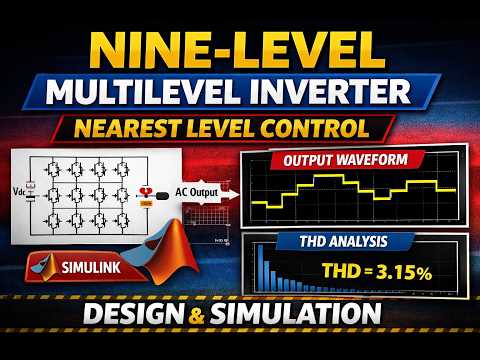
This research work explores a harmonic mitigation approach implemented through control strategies applied to multilevel inverter systems. In this approach, a low-frequency switching technique is utilized, where the most effective switching angles are pre-determined through the solution of a system of nonlinear transcendental equations. The study emphasizes the application of Nearest Level Control (NLC) for a 9-level Multilevel Inverter (MLI), aiming to minimize harmonic distortion in the output waveform. Extensive simulation studies have been conducted in the MATLAB/Simulink environment to evaluate the effectiveness of the proposed control methodology in minimizing Minimizing Reducing unwanted harmonic components and enhancing the fidelity of the output voltage waveform. A hardware prototype model is used to demonstrate the workings of the proposed multi level inverter.
Key words—Multi level inverters, Series-Connected , H-Bridge Multilevel Inverter (SC-HBMI) topology
INTRODUCTION
Multilevel inverters (MLIs) have gained significant traction in recent years due to their extensive use across various industrial and utility-scale applications, particularly in medium- to high-voltage power systems. The origin of multilevel inverter technology traces back to the early 1980s, introducing a novel concept where the output voltage waveform is composed of multiple discrete voltage levels—typically three or more. Multilevel inverter architectures are particularly advantageous Owing to their capability to generate output voltages of superior quality with minimized harmonic distortion, even when operating at comparatively low switching frequencies. This characteristic not only contributes to enhanced power quality but also results in reduced switching losses, minimized electromagnetic interference (EMI), and lower voltage stress on semiconductor devices. There are three predominant classical topologies of voltage source MLIs that have been developed and commercialized: the Common multilevel inverter configurations include the The primary multilevel inverter configurations include Common multilevel inverter configurations include the Cascaded H-Bridge (CHB), Neutral Point Clamped (NPC), and Flying Capacitor (FC) structures. Among these architectures, the CHB topology is often preferred for applications requiring Owing to its modular architecture, the system is capable of generating an increased resolution of output voltage levels. and scalability is frequently preferred for high-level voltage applications due to its modularity and scalability, owing to its scalable, modular structure and minimal device count, making It is particularly well-suited for high-power industrial applications due to its
ability to handle elevated voltage and current levels efficiently. Multilevel inverter control methodologies are typically divided into two primary categories based on the switching frequency: (a) low-frequency or fundamental switching strategies, and (b) high-frequency modulation techniques. Low-frequency switching techniques include approaches such as Selective Harmonic Elimination (SHE) and Space Vector Control (SVC), while high-frequency control strategies primarily employ different forms of Pulse Width Modulation (PWM).In low-frequency control schemes, each power switch operates only once or twice per output cycle, which substantially minimizes switching losses. Conversely, high-frequency control schemes require multiple switching operations per cycle, which can lead to increased thermal stress and EMI. Among the various low-frequency control techniques, the SHE method has emerged as a highly effective and widely adopted strategy, particularly For medium- and high-voltage systems, targeted harmonic suppression techniques are employed by accurately selecting switching instants to eliminate specific low-order harmonic components from the output voltage signal. By doing so, it not only enhances power quality but also reduces the complexity and size of the output filter. An important characteristic of the SHE technique is its dependence on pre-determined switching angles, These The calculation of switching angles involves solving intricate nonlinear transcendental expressions derived from the Fourier series expansion of the inverter’s output voltage. Numerous computational methods have been explored in the literature to solve the SHE equations. These solution approaches can be broadly grouped into two categories: (i) Iterative techniques, (ii) Algebraic methods based on Algebraic approaches based on polynomial resultant principles and nature-inspired optimization techniques are commonly utilized. Among numerical solvers, the Modified Newton Method is frequently employed for its rapid convergence. is extensively employed due to its straightforward implementation and rapid convergence near a solution. Nevertheless, the Newton-Raphson (NR) method is sensitive to the initial guess and may not converge reliably, especially as the number of voltage levels increases, potentially leading to divergence under specific conditions. A major challenge associated with SHE techniques is the escalating mathematical complexity encountered when designing for higher-level inverters, which necessitates more advanced or hybridized optimization algorithms. As multilevel inverters scale in voltage levels and application scope, developing robust and efficient solution strategies for SHE remains an area of active research and innovation. Evolutionary algorithms (EAs), including techniques Methods based on evolutionary computation, swarm-based heuristics, and data-driven neural network frameworks, have been employed to address the SHE problem by reformulating it as a constrained optimization taskGenetic Algorithm (GA) has been utilized to determine the optimal switching angles for SHE, while Particle Swarm Optimization (PSO), known for its robust performance in optimization tasks, has been extensively explored in the context of SHE by numerous researchers. In this work, a nine-level multilevel inverter is developed incorporating harmonic reduction techniques. Although increasing the number of levels in multilevel inverters effectively reduces harmonic content, it also leads to a rise in the number of components, system size, and overall cost. Hence harmonic mitigation strategies are formulated for reduction in harmonics. Nearest level control is used for switching the MLI with reduced harmonics.
Block Diagram