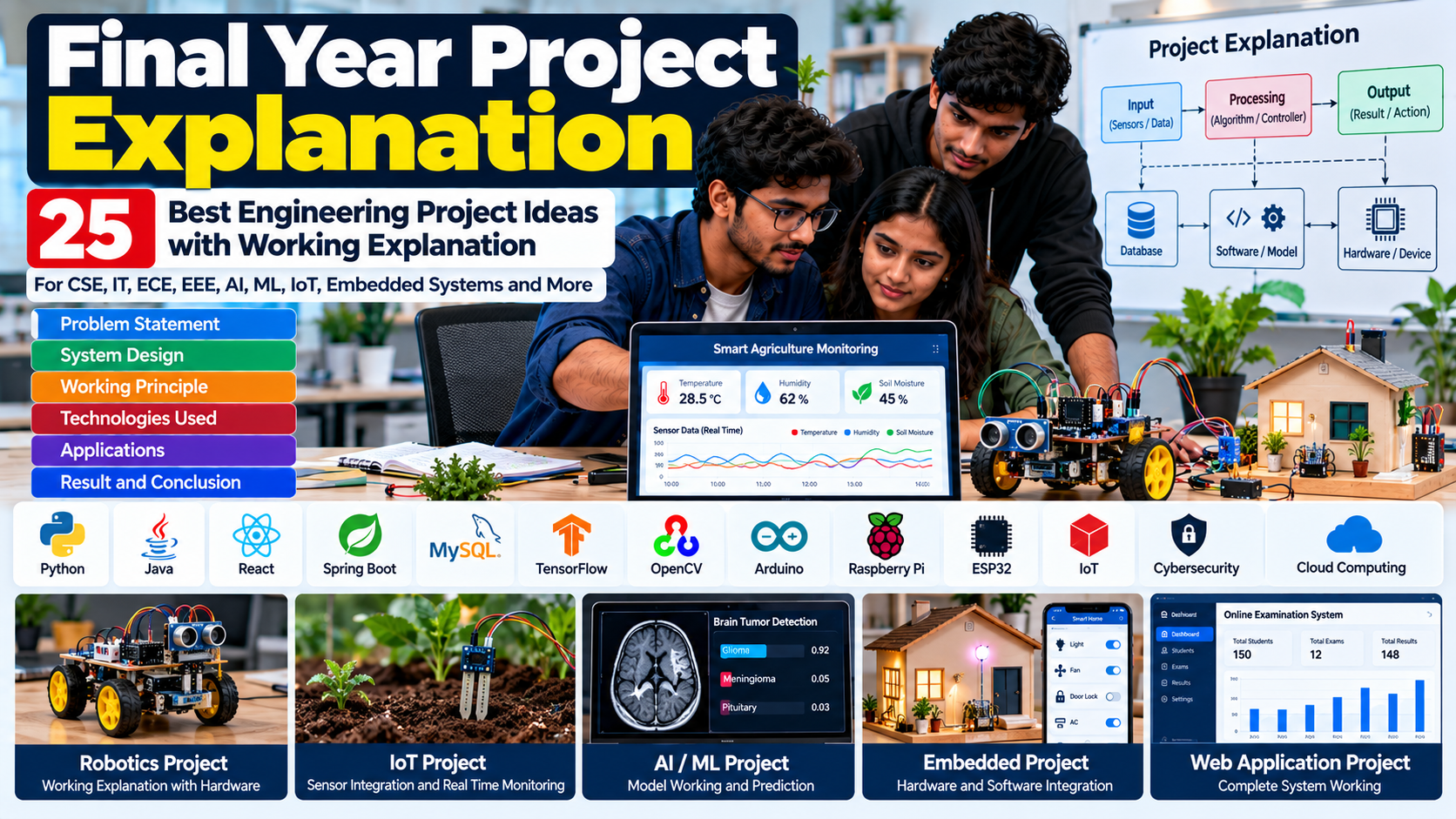
Are you searching for final year project explanations to understand how engineering projects work? A clear project explanation describes the problem statement, objectives, technologies, system architecture, working principles and expected or measured results. Understanding these elements helps students develop their projects, prepare technical presentations and answer questions during project reviews and viva examinations.
Aislyn Technologies, Bangalore, helps students explore project ideas and implementation approaches across Artificial Intelligence, Machine Learning, Web Development, IoT, Embedded Systems, Cybersecurity and other engineering domains.
Here are 25 final year project ideas with simple working explanations.
AI-Based Disease Prediction System: The system accepts selected healthcare dataset features and processes them using a trained machine learning model. It generates a prediction based on learned patterns. Its performance is evaluated using suitable classification metrics, and the output is intended for educational research rather than medical diagnosis.
Fake News Detection Using NLP: The application processes news text through cleaning, tokenization and feature extraction. A trained classification model analyzes the text and predicts whether it resembles misleading or reliable examples in its training dataset.
IoT-Based Smart Agriculture Monitoring: Sensors measure soil moisture, temperature and humidity. A microcontroller collects the readings and transmits them to a dashboard, where users can monitor field conditions and trigger irrigation according to configured thresholds.
AI-Based Smart Traffic Management: A camera captures traffic footage, and a computer vision model detects vehicles. The system estimates traffic density from the detections and can use the results to demonstrate adaptive signal timing in a controlled prototype.
Phishing Website Detection Using Machine Learning: The application extracts selected website or URL features and passes them to a trained classifier. The model produces a risk prediction that helps users investigate potentially fraudulent websites.
Face Recognition-Based Attendance System: A camera captures a face image, and the recognition system compares extracted features with enrolled identities. When a match satisfies configured criteria, the application records an attendance event in the database.
Vegetable Price Prediction Using LSTM: Historical vegetable price data is cleaned and arranged into time-series sequences. An LSTM model learns temporal patterns and produces forecasts that can be compared with actual values using forecasting error metrics.
Blockchain-Based Voting System: Authorized users cast votes through an application. The prototype records voting transactions on a blockchain or test ledger and provides a way to verify records and calculate results.
Network Intrusion Detection System: Network traffic features are extracted from a dataset and processed by a trained classification model. The system identifies traffic patterns associated with potential intrusions and evaluates detection performance using test data.
AI-Based Crop Disease Detection: The application processes a plant leaf image using an image classification model trained on labeled examples. It returns a predicted disease category, subject to image quality and the classes represented in the dataset.
IoT-Based Water Quality Monitoring: Sensors collect supported measurements such as pH and turbidity. A microcontroller sends the readings to a display or dashboard, where users can review measurements and identify readings requiring further investigation.
Student Performance Prediction: The system processes academic data such as attendance and assessment scores. A trained model estimates performance based on patterns in the training dataset and displays the prediction for educational analysis.
Cloud-Based File Management System: Users authenticate through a web application and upload files to a storage service. The backend manages file metadata, permissions and retrieval, while access controls protect user data.
Human Activity Recognition Using Sensors: Accelerometer and gyroscope readings are collected from a mobile device or wearable sensor. The model analyzes movement patterns and classifies activities such as walking, standing or running.
Driver Drowsiness Detection: A camera captures facial images, and computer vision algorithms analyze eye activity or other facial indicators. When selected indicators suggest possible fatigue, the prototype generates an alert.
Deep Learning-Based Recommendation System: The application analyzes available user interactions and item characteristics. A recommendation algorithm ranks relevant products, courses or content and presents personalized suggestions.
IoT-Based Predictive Maintenance: Sensors collect machine parameters such as vibration and temperature. The monitoring system compares readings with learned patterns or configured thresholds to identify abnormal conditions and generate maintenance alerts.
Sentiment Analysis Using NLP: Text data is cleaned and converted into numerical features or embeddings. A trained model classifies reviews or comments into sentiment categories such as positive, negative or neutral.
Electricity Consumption Forecasting: Historical energy consumption data is processed into suitable time-series inputs. A forecasting model estimates future demand, and the output is evaluated against observed values.
Automatic Number Plate Recognition: The system detects a vehicle number plate within an image, extracts the plate region and applies optical character recognition to read the characters. Performance depends on image clarity and environmental conditions.
Online Examination Management System: Students log in and answer questions through a web interface. The backend stores responses, evaluates supported question types, calculates scores and displays results to authorized users.
Brain Tumor Image Classification: A deep learning model processes labeled MRI images and predicts one of the categories represented in its training data. The project evaluates model performance using separate test data and is not a substitute for clinical diagnosis.
Smart Home Automation Using IoT: A microcontroller receives commands from an authorized application and controls compatible appliances through suitable switching hardware. Sensors can provide environmental readings and system status.
Cyberbullying Detection Using Machine Learning: The system processes text messages or comments and applies a trained classifier to identify potentially abusive language. Results require careful interpretation because language can be contextual and ambiguous.
AI-Based Resume Screening System: The application extracts relevant skills and experience from resumes and compares them with a job description. It produces matching scores or rankings to support human review rather than making final hiring decisions automatically.
These projects can use Python, Java, React, Spring Boot, PHP, MySQL, TensorFlow, OpenCV, Flask, ESP32, Arduino and other suitable technologies. The exact implementation depends on project scope and available hardware.
Key Features & Benefits
Applications of Final Year Project Explanations
Project explanations help students understand how engineering systems solve practical problems. They are useful when preparing project proposals, reports, demonstrations, technical presentations and viva answers.
Artificial Intelligence and Machine Learning explanations describe data processing, model training, prediction and performance evaluation. IoT and Embedded Systems explanations cover sensor connections, microcontrollers, communication protocols and automation logic. Web development explanations clarify frontend interfaces, backend services, database operations and APIs.
Cybersecurity explanations help students understand threat detection and security testing. Computer vision explanations cover image acquisition, preprocessing, detection and classification. Forecasting project explanations describe historical data, model selection, prediction outputs and error measurements.
A clear explanation connects the problem statement to the implementation and demonstrates why each component is necessary.
Implementation Guide
Who Can Benefit and Project Domains
Who Can Benefit from Final Year Project Explanations?
B.E. and B.Tech students can use project explanations to understand their implementations and prepare for academic reviews. M.E. and M.Tech students can explore advanced algorithms, research methods and system evaluation. MCA students can learn how software applications, databases and web technologies work together.
Research scholars can use explanations to understand technical approaches and identify opportunities for further experimentation. Faculty members and project supervisors can use structured explanations to assess student understanding. Students preparing for careers in software development, Artificial Intelligence, IoT, cybersecurity and embedded development can also strengthen their technical knowledge.
Popular Final Year Project Domains
Computer Science and Engineering (CSE)
Information Technology (IT)
Artificial Intelligence and Machine Learning
Data Science and Big Data Analytics
Internet of Things (IoT)
Embedded Systems and Robotics
Electronics and Communication Engineering (ECE)
Electrical and Electronics Engineering (EEE)
Cybersecurity and Ethical Security Research
Web and Mobile Application Development
Cloud Computing and Distributed Systems
Blockchain Technology
Computer Vision and Deep Learning
Smart Agriculture and Industrial Automation
Choose a project that matches your academic specialization, technical knowledge, available resources and university requirements.
Technical Specifications
Why Choose Aislyn Technologies for Final Year Project Support?
Aislyn Technologies, Bangalore, supports students exploring projects across software development, Artificial Intelligence, Machine Learning, IoT, Embedded Systems, web applications and related engineering domains.
Students can discuss their project requirements and identify suitable topics and implementation approaches. Depending on the selected project and agreed service scope, support may include topic selection, problem statement preparation, system architecture, programming guidance, database integration, dataset preparation, testing and documentation guidance.
Understanding the working principle is essential before demonstrating a project. Students should be able to explain each module, describe the input and output, discuss the algorithms used, demonstrate actual functionality and acknowledge system limitations.
For hardware projects, confirm component compatibility, circuit connections and testing requirements. For software projects, verify dependencies, database configuration, installation instructions and test results. Project explanations should reflect the actual implementation rather than assumed or fabricated functionality.
Conclusion & Next Steps
Contact Aislyn Technologies, Bangalore
Looking for final year project explanations, innovative engineering project ideas or implementation guidance? Contact Aislyn Technologies to discuss your academic requirements and explore projects in Artificial Intelligence, Machine Learning, Web Development, IoT, Embedded Systems, Cybersecurity and other technical domains.
Aislyn Technologies, Bangalore
Phone: +91 97395 94609
Email: info@aislyntech.com
Website: https://aislyn.in
Contact us today to discuss your final year project requirements and explore suitable project topics, implementation approaches and technical guidance.
Build your understanding of the project by learning its working principle, system architecture, technologies, testing process and practical applications.