Abstract
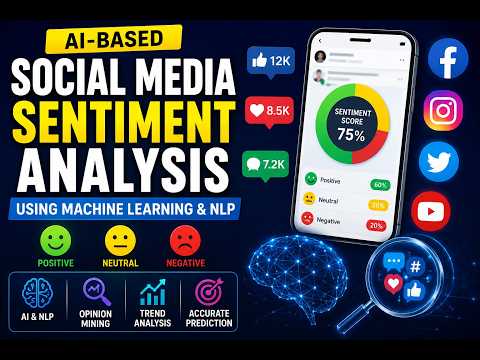
Social Media Sentiment Analysis is an important application of Natural Language Processing (NLP) used to identify and classify emotions from textual data shared on social media platforms and digital communication systems. The main objective of this project is to develop an intelligent web-based sentiment analysis system using the RoBERTa deep learning model for classifying text into emotional categories such as Positive, Negative, Neutral, and Fear/Surprise. The system performs several preprocessing operations including text cleaning, removal of special characters, URLs, hashtags, and tokenization to improve prediction accuracy. The RoBERTa transformer model is trained using optimized deep learning techniques and evaluated using performance metrics such as accuracy, precision, recall, and F1-score along with visualization methods like confusion matrix and ROC curve analysis. The trained model is integrated into a Flask-based web application with user authentication features using SQLite database management. Users can enter textual input and receive real-time emotion prediction results through an interactive interface. The proposed system provides an efficient, scalable, and accurate solution for automated sentiment analysis and can be applied in areas such as social media monitoring, customer feedback analysis, chatbot systems, opinion mining, and business intelligence applications.
Introduction
In recent years, the rapid growth of social media platforms, online communication systems, blogs, and digital applications has generated a huge amount of textual data across the internet. People continuously express their thoughts, emotions, opinions, and experiences through social networking sites, online reviews, discussion forums, and messaging applications. Understanding these emotions and sentiments from textual information has become an important research area in Natural Language Processing (NLP) and Artificial Intelligence (AI). Emotion and sentiment analysis helps organizations, researchers, and businesses understand customer behavior, public opinion, emotional responses, and user satisfaction more effectively. Due to the increasing demand for intelligent text analysis systems, deep learning based sentiment analysis models have gained significant attention because of their ability to understand complex language structures and contextual meanings. Traditional sentiment analysis systems mainly depended on machine learning algorithms such as Naive Bayes, Decision Trees, Logistic Regression, and Support Vector Machines. Although these methods produced acceptable results for simple classification tasks, they faced several limitations in handling contextual understanding, semantic relationships, sarcasm, emotional intensity, and long textual dependencies. These limitations reduced the overall prediction accuracy when processing real-world textual data. To overcome these problems, transformer-based deep learning models such as BERT and RoBERTa were introduced. These advanced models significantly improved Natural Language Processing performance by capturing bidirectional contextual information and understanding semantic relationships more effectively.
RoBERTa, which stands for Robustly Optimized Bidirectional Encoder Representations from Transformers, is an advanced transformer-based language model developed as an improved version of BERT. RoBERTa enhances contextual understanding through optimized training strategies, larger datasets, and dynamic masking techniques. Due to its superior language representation capability, RoBERTa has become one of the most effective models for sentiment analysis and emotion classification applications. In this project, the RoBERTa model is used to develop an intelligent emotion and sentiment analysis system capable of classifying textual data into four emotional categories namely Positive, Negative, Neutral, and Fear/Surprise. The system is designed to analyze user-provided text and predict the corresponding emotional category with high accuracy and efficiency. The implementation process begins with collecting and preprocessing a balanced emotional text dataset. Data preprocessing is an important stage because raw textual data often contains unwanted symbols, URLs, hashtags, punctuation marks, and inconsistent formatting. Several preprocessing techniques such as lowercase conversion, special character removal, URL elimination, whitespace normalization, and filtering of short texts are applied to clean the dataset effectively. After preprocessing, the textual data is converted into numerical representations using the RoBERTa tokenizer, which prepares the data for transformer-based deep learning processing. The dataset is then divided into training and validation datasets to ensure proper model evaluation and performance measurement.
The RoBERTa sequence classification model is trained using optimized parameters such as learning rate, batch size, number of epochs, weight decay, and early stopping mechanisms. During training, the system continuously evaluates performance metrics such as accuracy, precision, recall, and F1-score to measure model effectiveness. Visualization techniques such as confusion matrix analysis, ROC curves, training loss graphs, validation loss graphs, and accuracy graphs are also generated to analyze model behavior and prediction capability. These visualizations help identify model stability, overfitting conditions, and overall learning performance. The trained RoBERTa model is integrated into a Flask-based web application to provide real-time emotion prediction functionality. Flask is a lightweight Python web framework used for deploying machine learning applications through web interfaces. The developed web application includes user authentication modules such as registration and login systems using SQLite database management. Users can enter textual information into the prediction interface, and the system automatically processes the text and predicts the corresponding emotional category. The integration of deep learning with web technologies provides an efficient, scalable, and user-friendly platform for emotion analysis.
The proposed system can be applied in several real-world applications such as social media monitoring, customer feedback analysis, chatbot systems, opinion mining, business intelligence, and mental health monitoring. One of the major advantages of using RoBERTa is its ability to capture contextual relationships and semantic meanings more effectively than traditional machine learning approaches. The transformer-based self-attention mechanism allows the model to handle complex sentence structures and emotional variations efficiently. Overall, this project demonstrates the successful implementation of a deep learning based emotion and sentiment analysis system using RoBERTa and Flask technologies. The proposed system provides accurate, reliable, and real-time emotion classification, making it highly suitable for modern text analytics and intelligent NLP applications.
Objectives
• To develop an intelligent emotion and sentiment analysis system using the RoBERTa deep learning model.
• To classify textual data into emotional categories such as Positive, Negative, Neutral, and Fear/Surprise.
• To preprocess and clean textual data by removing noise, URLs, hashtags, and unwanted characters.
• To perform tokenization and convert textual information into numerical representations for deep learning processing.
• To train and evaluate the RoBERTa model using optimized transformer-based sequence classification techniques.
• To improve prediction accuracy and contextual understanding compared to traditional machine learning methods.
• To evaluate system performance using metrics such as Accuracy, Precision, Recall, and F1-Score along with graphical visualizations.
• To integrate the trained model into a Flask-based web application for real-time emotion prediction.
• To implement user authentication and database management using SQLite for secure system access.
• To provide a scalable and efficient solution for applications such as social media monitoring, customer feedback analysis, chatbot systems, and opinion mining.
Block Diagram