ABSTRACT:
The proposed project titled “Yoga Pose Recognition System using Deep Learning” aims to develop an intelligent system capable of identifying and classifying various yoga postures from images using Convolutional Neural Networks (CNNs). Yoga is an ancient physical and mental discipline that requires proper posture alignment and body awareness for maximum health benefits. However, beginners often struggle to perform yoga poses accurately without the guidance of an instructor. This project addresses that limitation by creating an automated pose recognition tool that can analyze a user’s yoga posture and provide instant feedback on the performed pose category. The system is developed in three major phases: training, testing, and deployment. In the training phase, a labeled dataset consisting of multiple yoga poses is preprocessed and fed into a CNN model designed using TensorFlow and Keras. The model learns the spatial features and patterns associated with each yoga pose through multiple convolutional, pooling, and dense layers. The trained model achieves efficient feature extraction and classification accuracy, ensuring reliable identification of yoga poses during testing.
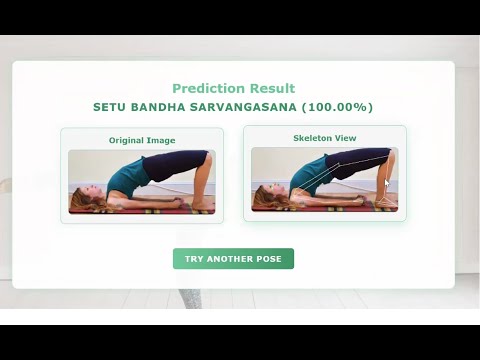
In the testing phase, a Graphical User Interface (GUI) built with Tkinter allows users to upload or select images for real-time prediction. The system preprocesses the input image, performs pose detection using MediaPipe, and overlays the skeletal structure on the body for better visualization. The predicted class label and confidence score are displayed to assist the user in understanding the correctness of their posture. Furthermore, a Flask-based web application has been implemented to provide an online platform for users to register, log in, and perform yoga pose predictions. The web app integrates SQLite for secure data storage, OpenCV for image handling, and MediaPipe for visual skeleton rendering. The deployment of the model on a web interface ensures broader accessibility and user convenience. The combination of CNN’s robust learning capability, MediaPipe’s accurate landmark detection, and Flask’s flexible web framework results in a powerful and interactive system for yoga pose recognition. This project demonstrates the practical integration of deep learning and computer vision techniques in the field of fitness and health. It encourages technology-assisted self-practice, improves posture accuracy, and reduces dependency on manual supervision.
INTRODUCTION
In recent years, the integration of Artificial Intelligence (AI) and Computer Vision into human lifestyle applications has shown remarkable potential in transforming health, wellness, and fitness practices. One of the most prominent applications of this technological advancement is Yoga Pose Recognition, where machine learning models are employed to identify and analyze various yoga postures from digital images or videos. Yoga, being an ancient discipline originating from India, emphasizes physical, mental, and spiritual well-being. It consists of a series of postures known as asanas, which must be performed accurately to achieve the intended physical and psychological benefits. However, for many individuals—especially beginners—the absence of expert supervision often leads to incorrect postures that may cause strain or injury. This challenge necessitates the development of an intelligent system capable of analyzing and classifying yoga poses automatically. The Yoga Pose Recognition System aims to bridge the gap between traditional yoga practice and modern computational technology. By leveraging the capabilities of Deep Learning—specifically Convolutional Neural Networks (CNNs)—the system can learn complex visual patterns and identify various yoga poses with high accuracy. CNNs are known for their proficiency in image recognition tasks, as they can automatically extract relevant features such as body orientation, limb position, and spatial relationships without the need for manual feature engineering. In this project, the CNN model is trained on a curated dataset containing images of multiple yoga poses, enabling it to classify unseen images into their respective pose categories during testing and real-world use. The system development process is divided into three major components: Model Training, Desktop-based Testing, and Web-based Deployment. During the training phase, a comprehensive dataset of yoga postures is collected and preprocessed. Each image is resized, normalized, and converted into tensor form before being fed into the CNN model. The training network consists of several convolutional, pooling, and fully connected layers that progressively learn the distinctive features of each pose. The model is optimized using the RMSprop optimizer and trained using categorical cross-entropy loss to achieve robust classification performance. After achieving a satisfactory validation accuracy, the model is saved as an H5 file for later integration into the testing and web application modules.
OBJECTIVES
The primary objective of the Yoga Pose Recognition System using Deep Learning is to design and develop an intelligent computer vision-based model capable of accurately identifying and classifying different yoga postures from digital images. The system aims to assist yoga practitioners, beginners, and fitness enthusiasts in performing yoga poses correctly without the need for continuous instructor supervision. By leveraging advanced techniques in artificial intelligence, image processing, and deep neural networks, the project seeks to build a reliable and user-friendly platform for automated yoga pose analysis.
One of the major objectives of this project is to train a Convolutional Neural Network (CNN) that can learn visual features from yoga pose images and distinguish between multiple categories of asanas. The CNN model is trained using a diverse dataset of yoga postures, where each image is processed and normalized to enhance learning accuracy. The goal is to achieve a model that can generalize well to new, unseen images while maintaining high prediction accuracy and minimal error rate.
Another important objective is to implement a graphical interface that allows users to easily interact with the system. This has been achieved using the Tkinter library in Python, which provides a simple yet efficient desktop-based GUI. Through this interface, users can upload images, view real-time predictions, and visualize their body structure overlaid with skeletal keypoints using MediaPipe Pose Detection. This integration helps users understand the alignment and positioning of their body, promoting correct posture and minimizing the risk of injury.
A further objective of the project is to develop a web-based platform using the Flask framework to enable broader accessibility and online deployment of the yoga pose recognition system. The web application incorporates secure user authentication, registration, and session management using SQLite3. Users can log in, upload yoga pose images, and receive predictions directly through their web browser. This objective ensures that the system is not limited to a single computer but can be accessed remotely from any device with internet connectivity.
Additionally, the system aims to enhance visualization and feedback by integrating pose landmark detection using MediaPipe and image rendering through OpenCV. By generating a skeleton overlay of the detected pose, users receive visual feedback that complements the model’s classification results. This feature bridges the gap between static classification and real-time analysis, making the system more interactive and educational.
The project also emphasizes data preprocessing, normalization, and model optimization as core objectives to improve the accuracy and robustness of predictions. Techniques such as image resizing, augmentation, and dropout regularization are employed to reduce overfitting and enhance generalization. The trained model is evaluated using validation data to ensure reliability and consistency in predictions.
Lastly, the system is designed with scalability and future enhancement in mind. The architecture allows the integration of real-time video processing, mobile app deployment, or voice-guided feedback in later stages. This ensures that the project serves as a foundation for future advancements in AI-assisted yoga training and digital wellness platforms.
In summary, the main objectives of the Yoga Pose Recognition System are to:
• Develop a deep learning-based model capable of accurately classifying yoga poses.
• Create an interactive desktop interface for offline testing and visualization.
• Build a secure web application for online prediction and user management.
• Integrate MediaPipe for pose landmark detection and skeleton visualization.
• Optimize the CNN model for high accuracy and efficient performance.
• Provide a scalable framework for future real-time and mobile-based extensions.
By fulfilling these objectives, the project contributes significantly to the application of artificial intelligence in the domain of health, fitness, and wellness, making yoga practice more accessible, personalized, and technology-driven.
Block Diagram