ABSTRACT
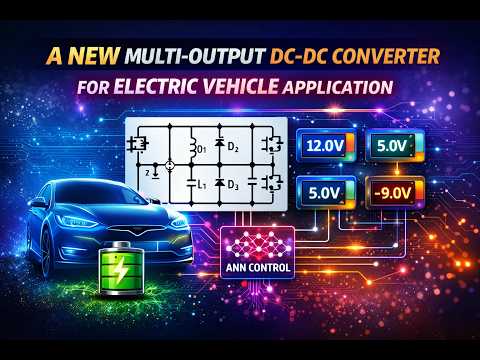
A SIMO topology is proposed in this study which can generate three different output voltages without constraint on the duty cycle and inductor currents (like iL1 > iL2 > iL3 or iL1 < iL2 < iL3). Cross regulation problems do not exist in the proposed topology, so the load voltage V01 (V02) (V03) is not affected by the variation of output current i03 (i02) (i01). The loads are isolated from each other during control. ANN control is introduced in the place of PI controller to improve the performance of the system under varying input conditions. The simulation work will be carried out using MATLAB/Simulink software.
I. INTRODUCTION
In the past decade, there has been an increase in demand for renewable energy sources utilization in electric vehicles (EVs), auxiliary power, and grid-connected applications. In these applications, multiport DC-DC converters are essential for Hybridizing energy sources which lead to, reduce the components count, complexity, and cost of the system compared to several separate single input DC-DC converters. Over the past decade, MPC converters have been presented. A new SIMO converter is proposed. This structure simultaneously generates boost, buck, and inverted outputs controlled independently. However, producing ’n’ voltage levels requires n + 2 switches, which increases the overall size and cost of the converter. Unexpected mistakes in calculating state-space equations and output voltages for a SIMO converter given are addressed and rectified. The single coupled inductor-based SIMO buck is presented with lesser output inductor current ripple than single inductor SIMO converters. Nayak and Nath elaborately presented the comparative performance of SIDO converters based on the coupled inductor and single inductor (SI) in terms of cross-coupling issues. Furthermore, they proposed that the coupled inductor SIDO converter has a better steadystate and transient performance. Nevertheless, in a SI SIMO configuration inductor is switched between the loads, which causes high ripples and cross-regulation problems. Different control approaches are proposed in the literature to overcome the cross-regulation issue in a single inductor-based SIMO converter; the current predictor controller is presented instead of the conventional chargebalance approach. However, generating the duty ratios for active switches has been somewhat complicated. Similarly, the deadbeat-based control approach is presented. It is based on output current observer, and hence it is sensitive to the noise and significant parametric variations. A multivariable digital controller-based SIMO converter is proposed to minimize the voltage ripples, suppress the cross-regulation problems, and regulate the output voltages. However, controller design may lead to an increase in complexity. A non-isolated and single switch SIMO converter topology is presented. It has fewer components and reduces the cost of the system. However, it may be challenging to regulate the outputs independently. To alleviate the problems in a single inductor SIMO converter, a non-isolated SIMO converter is proposed, which are independently regulated the output voltages and does not require an additional control circuit. A new SIDO converter topology is proposed to integrate buck and super lift converter for generating the step-up and step-down output voltages for electrical vehicle applications. It has a constraint on-duty ratio viz. D2 < D1, which limits the operation range of D1 by increasing D2. The topologies proposed have fewer semiconductor switches. However, the operation of the converter is based on the charging time of inductors (i.e., iL1 > iL2). So this keeps the constraint on-duty ratio. The combination of high gain step-up and SEPIC converter-based SIMO is suggested for PV applications. In this configuration, both the outputs are higher than the supply voltage and improve the output voltage by adding the capacitors and diodes. Nevertheless, the number of capacitors and diodes affects cost and conduction losses. A new SIDO buck-boost topology is developed to generate positive and negative outputs. A multi-output converter is suggested with the reduced part count. However, it has more diodes, which increases conduction losses. A structure of SIMO configuration is introduced with the advantages of reducing the passive filter size and low voltage stress. High-density multi-output converter is proposed for portable electronic applications based on the front-end switched-capacitor technique with improved power density and reduced switching losses. Modified SEPIC and interleaved-based high step-up SIMO converter are introduced. It consists of a voltage multiplier, coupled inductor, and switched capacitors to boost the output voltage in sustainable energy applications. However, it has complexity due to more components. The SEPIC-Cuk converter-based four-phase interleaved converter is suggested for SIMO applications. It has the advantages of low ripple voltage, compact size and is suitable for high power applications with a dynamic response. In the conventional approach, EVs’ auxiliary power supply system to handle the load requirements. It looks simple, but the main drawback of this approach is a cross-regulation problem, and the loads are not isolated from each other during their operation. There is also the chance of grounding issues while charging the battery with simultaneously turn-on loads and if the ground is involved. Further, the circuit complexity will increase to convert one of the negative output voltages into buck-boost operation mode.
Block Diagram