Abstract
The rapid increase in electricity consumption, driven by industrial expansion and modern lifestyle demands, has made accurate short-term load forecasting an essential requirement in smart-grid environments. Traditional forecasting models often fail to capture the highly nonlinear, volatile, and multivariate nature of energy consumption. This project presents an AI-enabled load prediction system built using Long Short-Term Memory (LSTM) networks, which excel at learning temporal dependencies and variations over time. The system preprocesses raw sensor data by applying hourly resampling, feature engineering, MinMax scaling, and formation of 24-hour sequential input windows, ensuring high-quality data representation for deep learning.
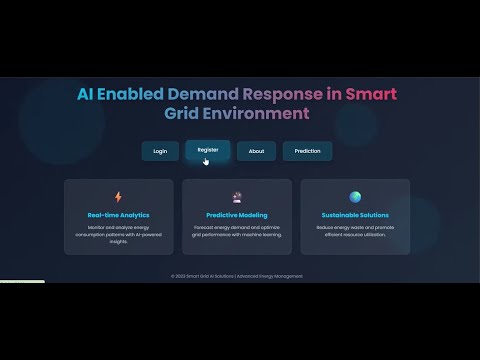
A secure Flask-based web platform integrates the trained LSTM model, allowing users to visualize predictions in real time. The system provides analytical outputs including actual vs predicted load curves, price trends, peak-load hours, and cost-saving estimations. A sliding-window forecasting mechanism extends the dataset with new hour-ahead predictions automatically, making the system suitable for continuous operational monitoring. Through comprehensive evaluation using RMSE and MAPE, the system demonstrates high accuracy and practical applicability. Overall, the proposed framework enhances smart-grid intelligence by enabling reliable energy forecasting, cost planning, and demand-response optimization.
Keywords
Smart Grid, Energy Load Forecasting, LSTM, Time-Series Prediction, Flask Web Application, Feature Engineering, Cost Optimization, Hourly Resampling, Deep Learning, Real-Time Prediction.
INTRODUCTION
The rapid growth in global electricity consumption, driven by urbanization, industrial expansion, and the proliferation of smart devices, has transformed energy management into a critical challenge for modern societies. As demand continues to fluctuate unpredictably across different hours, days, and seasons, traditional grid infrastructures struggle to maintain balance between supply and load. This imbalance often results in excessive power generation during low-demand periods or supply shortages during unexpected peaks, ultimately increasing operational costs and risking system instability. Smart-grid environments, equipped with advanced sensors and digital monitoring systems, have emerged as an effective solution to address these challenges. However, the true intelligence of a smart grid heavily depends on accurate short-term load forecasting, which enables utilities, industries, and households to make informed decisions regarding energy distribution, demand-response scheduling, and cost optimization.
Short-term load forecasting is particularly complex because energy consumption is influenced by a variety of interconnected factors such as voltage fluctuations, current variations, frequency behavior, user habits, weather patterns, and pricing dynamics. Traditional forecasting models—including ARIMA, exponential smoothing, and regression-based techniques—assume that data follows linear and stationary patterns. These assumptions fail in real-world scenarios where electricity usage exhibits strong nonlinear behavior, sudden variability, and long-term temporal dependencies. As a result, classical models struggle to capture the intricate patterns present in multivariate time-series data. This limitation has motivated the adoption of advanced artificial intelligence and deep-learning techniques capable of learning complex relationships from large datasets.
Among these techniques, Long Short-Term Memory (LSTM) networks have proven exceptionally effective due to their ability to retain information over extended sequences and learn nonlinear, time-dependent patterns. By integrating multivariate inputs such as voltage, current, frequency, and temporal features like hour, day, month, and weekend indicators, LSTM models significantly outperform traditional methods in prediction accuracy. The present project builds on this capability by developing an AI-enabled Smart Energy Load Prediction System that combines robust preprocessing, LSTM-based forecasting, real-time visualization, cost analysis, and a secure Flask web interface. Through automated sliding-window forecasting and continuous dataset updates, the system supports real-time energy monitoring and decision-making, contributing to more efficient, sustainable, and intelligent energy management in smart-grid ecosystems.
OBJECTIVES
1. To develop a complete preprocessing pipeline that transforms raw sensor data into structured hourly time-series, handles missing values, extracts engineered features such as hour, weekday, month, and weekend flags, and normalizes values for stable LSTM learning.
2. To design a robust LSTM architecture that learns complex temporal patterns, captures daily and weekly consumption cycles, and outperforms traditional methods in forecasting accuracy.
3. To integrate electricity price as an additional feature, enabling cost-aware forecasting and helping users understand financial implications of consumption patterns.
4. To implement a sliding-window prediction mechanism that forecasts the next hour using the most recent 24-hour window and automatically appends the prediction to the dataset.
5. To deploy the trained model using a Flask web interface that allows secure user login, real-time prediction generation, graph visualization, and display of cost savings and peak hours.
6. To evaluate model performance using standard metrics such as RMSE and MAPE to ensure reliability and generalizability of the forecasting system.
7. To create a scalable, modular system which can be expanded to include weather features, renewable energy data, or long-term forecasting in future.
Block Diagram