ABSTRACT
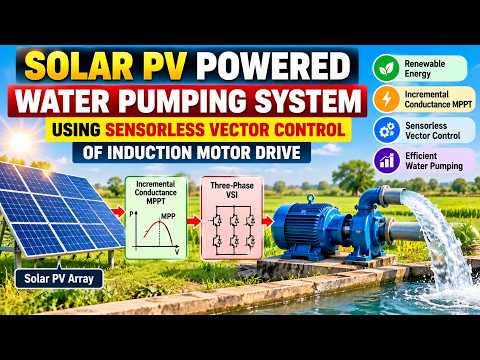
—This paper deals with a single stage solar powered speed sensorless vector controlled induction motor drive for water pumping system, which is superior to conventional motor drive. The speed is estimated through estimated stator flux. The proposed system includes solar photovoltaic (PV) array, a threephase voltage source inverter (VSI) and a motor-pump assembly. An incremental conductance (InC) based MPPT (Maximum Power Point Tracking) algorithm is used to harness maximum power from a PV array. The smooth starting of the motor is attained by vector control of an induction motor. The desired configuration is designed and simulated in MATLAB/Simulink platform
INTRODUCTION
In the modern era of development, renewable resources of energy, are being advocated by many countries to meet the increasing demand of electrical energy due to rapid depletion of non-renewable resources. Solar PV based energy generation, has come up as an important alternative for many purposes. The irrigation sector is one of the major sectors where solar PV power is extensively used for water pumping. Solar PV water pumping has been initially realized using the DC motor. However, with all due virtues associated with the induction motor in terms of mechanical simplicity, ruggedness, reliability, low cost, higher efficiency and lower maintenance than the DC motors, it has replaced DC motors. Here, a solar PV array fed induction motor drive using vector control is used. As one knows that solar PV power depends on solar insolation and temperature. The characteristic of PV module exhibits a single power peak. An extraction of maximum power is very important part of the PV system. Therefore, various MPPT (Maximum Power Point tracking) techniques have been developed and explained in the literature. These algorithms vary in their speed, range of effectiveness and complexities. Here, an incremental conductance (InC) based MPPT algorithm is used to track MPPT. This algorithm is developed to overcome some drawbacks of perturb and observe (P&O) algorithm. InC algorithm improves the tracking time and to produce increased energy on a vast irradiation changes. Moreover, it has advantage over P&O method, which increases losses in slow varying atmospheric condition as it oscillates around MPP. Most of the existing induction motor drives (IMDs) incorporate one DC-DC converter and a VSI (Voltage Source Inverter) for achieving MPPT and maximum efficiency of the motor. Moreover, the DC link voltage regulation is achieved by VSI itself. However, the system requires at least seven power converter switches and hence switching losses are increased. This further includes a DC-AC conversion with a VSI feeding a vector-controlled three-phase IMD. Therefore, there is a need to use single stage controlled drive for water pumping and thereby decreasing number of switches and losses. In single stage system, a VSI has to maintain the MPP as well as DC link voltage is also controlled by it. Therefore, variable DC link voltage cannot be achieved as explained. The vector control strategy is superior to scalar control in terms of speed of response and accuracy as explained. In the vector control technique, an AC motor is operated in such a manner to behave dynamically as a DC motor by using feedback control. This technique enables to vary the speed over the wide range. Hence with the advancement of power electronics and by using powerful microcomputer and DSPs, the vector control ousts scalar control. In this vector control scheme, the stator flux is estimated in stationery αβ frame, which is used to estimate the slip speed (ωsl), synchronous speed (ωe) and the motor speed.
Block Diagram