Depression is a significant mental health concern that can affect a person's emotions, behaviour, concentration, and daily activities. Identifying potential signs early and improving access to mental health support are important areas of ongoing research. Artificial intelligence and machine learning offer opportunities to study patterns in appropriately collected data and support research into mental health assessment.
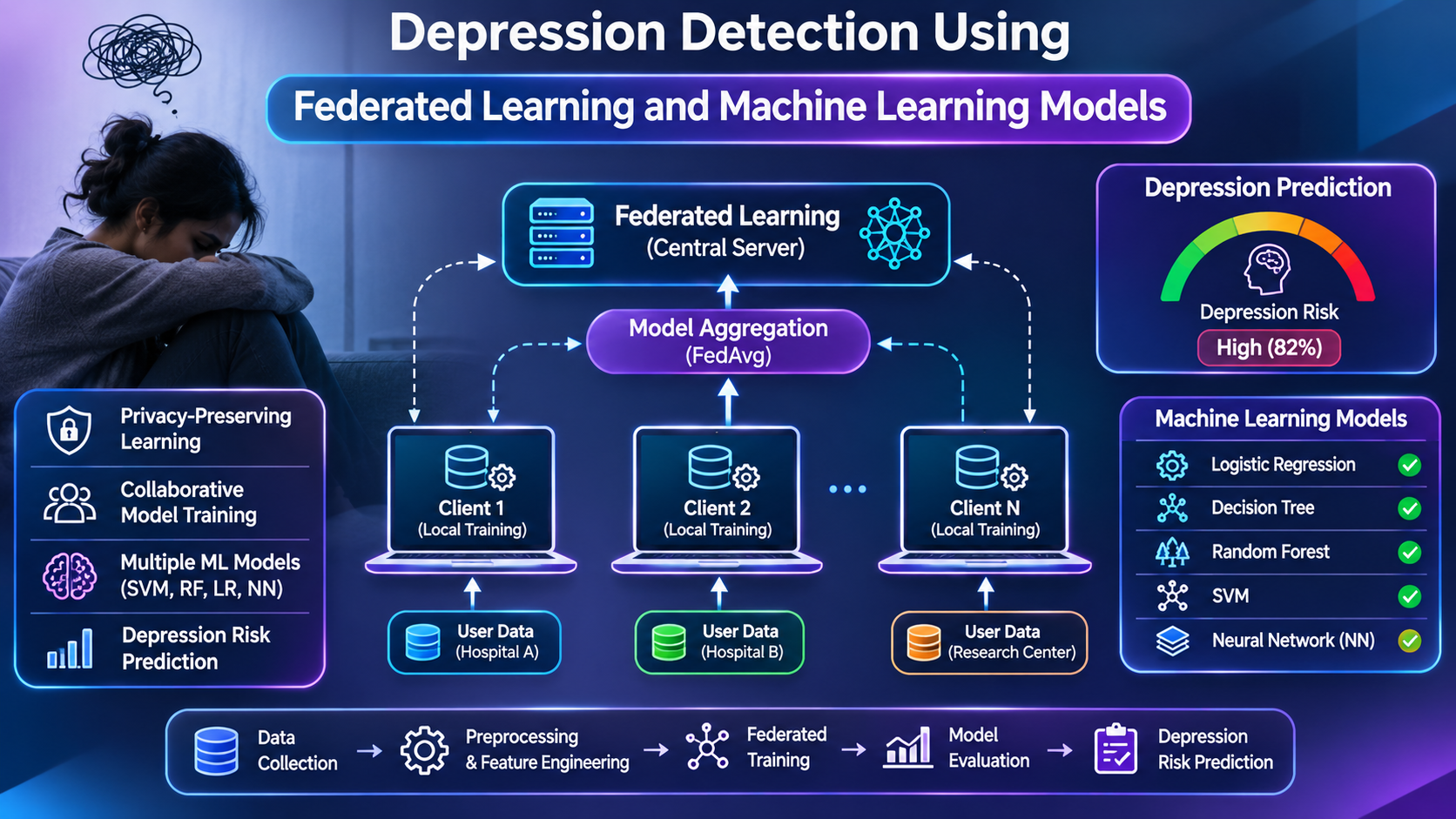
The Depression Detection Using Federated Learning and Machine Learning Models project explores an AI-based approach that combines machine learning with federated learning. Instead of requiring all participating data to be collected in one central location, federated learning allows participating devices or institutions to train models locally and share model updates with a central server.
This approach can help reduce the movement of sensitive personal data while supporting collaborative model development. The project demonstrates how Python, machine learning algorithms, and federated learning techniques can be combined to build a privacy-aware experimental system for depression-related research.
Key Features & Benefits
Project Overview and Working Principle
The proposed system uses machine learning models to identify patterns in structured or appropriately prepared datasets related to depression research. Depending on the selected dataset, input features may include questionnaire responses, behavioural indicators, lifestyle information, or other non-identifying research variables.
The system can be designed with multiple participating clients. Each client trains a local machine learning model using its own permitted dataset. The clients then send model parameters or updates to a central aggregation server rather than transferring their complete datasets.
The central server combines the updates using a federated aggregation technique, such as Federated Averaging (FedAvg), and distributes the updated global model to participating clients. This process can repeat over multiple training rounds to improve the shared model.
The final model can be evaluated using suitable classification metrics, including accuracy, precision, recall, F1-score, and confusion matrix analysis.
Implementation Guide
Technologies and Algorithms Used
Python provides the main development environment for implementing data processing, machine learning, and federated training.
Key technologies include:
Python: Main programming language for model development and system implementation.
Pandas and NumPy: Data cleaning, preprocessing, and numerical operations.
Scikit-learn: Implementation and evaluation of machine learning algorithms.
TensorFlow or PyTorch: Optional frameworks for neural network development.
Flower (FL Framework): Supports federated learning experiments across multiple clients.
Matplotlib and Seaborn: Model performance visualisation and analysis.
Flask or Streamlit: Optional interface for demonstrating the trained research model.
Depending on the dataset and project implementation, algorithms may include Logistic Regression, Random Forest, Support Vector Machine, Decision Tree, or neural network models. Federated Averaging can be used to combine local model updates.
Technical Specifications
Important Features and Applications
The project can include the following features:
Dataset Preprocessing: Cleans and prepares research data for model training.
Multiple Machine Learning Models: Compares different algorithms for depression-related classification tasks.
Federated Client Training: Allows multiple clients to train models locally.
Central Model Aggregation: Combines model updates to create a shared global model.
Privacy-Aware Architecture: Reduces the need to transfer raw datasets between participating clients.
Performance Evaluation: Displays metrics such as accuracy, precision, recall, and F1-score.
Visual Analytics: Presents model performance through graphs and comparison charts.
Prediction Demonstration: Provides an experimental interface to demonstrate model outputs using suitable sample inputs.
Potential research applications include privacy-aware collaborative machine learning, mental health data research, federated AI experimentation, and comparative evaluation of classification models.
Conclusion & Next Steps
Advantages, Future Scope, and Conclusion
Combining federated learning with machine learning provides an interesting approach to collaborative research involving sensitive datasets. Local training can reduce the need to centralise raw data, while a shared model can benefit from learning across participating clients.
Future improvements may include testing with larger and more diverse datasets, evaluating performance across different client distributions, applying differential privacy, investigating secure aggregation, and measuring communication overhead. Researchers can also compare federated and centralised training to understand their performance and limitations.
Important note: This project is an educational and research prototype. A model prediction must not be treated as a clinical diagnosis or a replacement for assessment by a qualified mental health professional. Federated learning also does not automatically guarantee privacy; model updates may require additional privacy and security protections.
In conclusion, the Depression Detection Using Federated Learning and Machine Learning Models project demonstrates how Python, machine learning, and distributed model training can be applied to privacy-aware mental health research. It is a useful academic project for exploring federated AI, data privacy, and machine learning model evaluation.