Abstract:
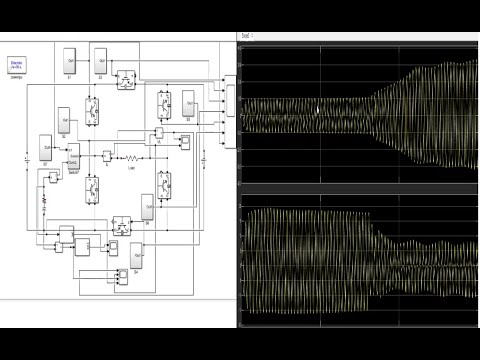
In this paper, a new single-phase multilevel inverter topology is proposed for induction motor speed control with battery as source. The battery voltage will be stepped up using the boost converter and provided to the multi level inverter. A control circuit is used in order to control the dc voltage which in turn controls the motor speed. The proposed inverter provides 9 level ac output with less number of switches, capacitors and dc voltage sources which leads to reduction in cost and also size of the inverter. In this, the capacitor voltage can be balanced naturally using the switching sequence of the inverter without the aid of any capacitor voltage control strategy. The proposed system is simulated in MATLAB/Simulink software.
Key words—Electric Vehicle, Induction motor drive, Boost Converter, Voltage mode controller.capacitor voltage balancing.
I. INTRODUCTION:
Various topologies of multilevel inverters (MLI) are used in order to overcome the limitations of restriction in voltages in the conventional 2-level voltage source inverter and to achieve the increase in power level by arranging series connection of power electronic devices using suitable control strategies. Since the MLIs are introduced, it is adapted in high power applications like renewable energy sources, AC drives active filters, etc. The MLIs also provides improvement in power quality, reduced switch voltage stress, THD and losses. The well known topologies of multi level inverters are flying capacitor (FC), Cascaded H-Bridge (CHB), Neutral point clamped (NPC) needs more number of power electronic components along with the respective auxiliary components such as driver circuit components, heat sinks and voltage sources which causes increase in complexity, cost, space and minimizes the efficiency in the system. The challenge here is to increase the number of levels without adding more components or reducing it. A MLI topology was proposed in the cascaded configuration, however the requirement of bi directional power electronic switches results in increase in losses. Also it operates in symmetrical voltage sources only.
The balancing of power between different voltage sources is hard to achieve and results in reduction in the life. A cascaded structure is proposed but as it needs more bidirectional switches which causes increase in power losses. Also the switch voltages are equal to input voltage, the stresses on the switch is higher. Hence for more number of voltage levels, it is not suitable. A new MLI topology with less number of switches is proposed and the switching losses are also greatly reduced. But due to absence of modular feature, the number of levels cannot be extended further. Moreover, the loads supplied by these MLI topologies should be near to the unity power factor. Another two MLI topologies are proposed based on H-Bridge structure but it needs individual dc voltage sources which results in increase in cost. The multiple dc sources are replaced with capacitors having dc voltage source connected in parallel to the capacitors. In this four power electronic switches have voltage stress across them same as input voltage. As the sub blocks are connected in cascaded structure, it can be used for high voltage applications. This can be used for asymmetrical voltage sources also and the maximum number of voltage levels are also achieved. The capacitor voltages are controlled by introducing a new modulation strategy using phase shifting. A four leg inverter of NPC structure is proposed with selective harmonic elimination/mitigation strategy and it also balances the capacitor voltages even at minimum switching frequencies. These MLI topologies possess self voltage balancing of capacitors but more number of power electronic devices are needed.
In this paper, new topology of MLI is presented which possess modular structure as it is connected in a cascaded fashion and provides reliable operation with less voltage stress on the semiconductor switches. It does not require any external circuit for balancing its capacitor voltage due to its self voltage balancing capability. The proposed topology generate the higher number of output levels with less number of switches and isolated DC sources compared to conventional MLI topologies such as Cascaded H-Bridge MLI, Flying capacitor topology, etc. The number of bidirectional switches also reduces significantly in the proposed topologies. A single phase Induction Motor acts as load and the speed control is provided by controlling the DC voltage with the help of boost converter which is added between DC source and inverter.
Block Diagram