ABSTRACT
Breast cancer remains one of the most significant health challenges among women across the globe, accounting for a large percentage of cancer-related deaths. Early diagnosis and accurate stage identification play a vital role in determining appropriate treatment and improving survival rates. Traditional methods of detection often rely on manual image inspection, biopsy results, and clinical tests, which may be time-consuming, prone to human error, and dependent on expert interpretation. To overcome these limitations, advancements in machine learning and deep learning have opened new avenues for automated, accurate, and efficient diagnosis systems. This project proposes a comprehensive Breast Cancer Prediction System that integrates multiple intelligent models to assist in early detection and stage classification. The system leverages the power of Convolutional Neural Networks (CNN) for image-based diagnosis and Random Forest Classifier for data-based analysis using clinical features. The CNN model is trained on breast cancer image datasets to predict whether a given image represents a normal or malignant case, while a specialized stage prediction CNN model is developed to classify the cancer into stages such as Stage 1, Stage 2, or Stage 3. Alongside image-based predictions, the project also includes a machine learning model trained on tabular clinical data, where parameters such as age, menopause status, tumor size, invasive nodes, breast quadrant, and metastasis are processed to predict the cancer condition with high accuracy. To provide accessibility and ease of use, the system is deployed through a Flask-based web application, which allows users to interact with the models via a simple and intuitive interface. Users can register and log in securely using a SQLite3 database, upload breast cancer images for CNN-based predictions, and input clinical data for Random Forest predictions. The web interface also displays prediction results along with confidence scores, helping users interpret outcomes effectively.
The CNN models are trained using augmented image data to improve generalization and prevent overfitting, with accuracy monitored through validation datasets and checkpoints to save the best-performing models. The Random Forest model is built using a structured clinical dataset, preprocessed through label encoding and feature scaling to ensure consistency and robustness. After rigorous training and evaluation, the integrated system demonstrates strong accuracy and reliability in classifying cancer presence and stages. This project not only showcases the practical application of machine learning and deep learning in healthcare but also emphasizes the importance of hybrid systems that combine multiple data sources for enhanced diagnostic performance. By offering a unified platform for image and data-based prediction, the system serves as a valuable decision-support tool for medical practitioners and a preliminary screening tool for patients. In conclusion, the proposed Breast Cancer Prediction System represents a significant step toward automated, data-driven healthcare solutions. It demonstrates how artificial intelligence can be harnessed to support medical diagnosis, reduce dependency on manual interpretation, and improve early detection rates. With further development, integration with hospital databases, and deployment on cloud platforms, this system has the potential to assist healthcare professionals in real-world clinical environments and contribute to more informed and timely cancer diagnosis and treatment.
INTRODUCTION
Breast cancer is one of the most common and life-threatening diseases affecting women across the world. It occurs due to the uncontrolled growth of abnormal cells in the breast tissue, which can eventually invade surrounding tissues and spread to other parts of the body. According to global health statistics, breast cancer accounts for a significant percentage of cancer diagnoses and deaths each year. The World Health Organization (WHO) reports that early detection is the key to effective treatment and improved survival rates. However, the process of diagnosing breast cancer can often be complex, requiring multiple diagnostic tests such as mammography, biopsy, and imaging techniques. These conventional diagnostic methods, while accurate, are often time-consuming, expensive, and heavily reliant on the expertise of medical professionals. Additionally, human error and the subjective interpretation of medical images can sometimes lead to misdiagnosis or delayed treatment.
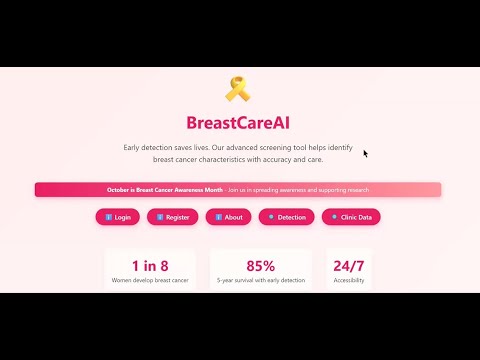
In recent years, the field of artificial intelligence (AI), particularly machine learning (ML) and deep learning (DL), has demonstrated remarkable potential in addressing such medical challenges. By leveraging computational models that can learn from data, AI-based systems can assist healthcare professionals by providing faster, more consistent, and more accurate diagnostic predictions. Among various deep learning architectures, Convolutional Neural Networks (CNNs) have emerged as a powerful tool for image classification and recognition tasks, including medical imaging. CNNs can automatically extract meaningful patterns and features from medical images, enabling precise classification of diseases such as breast cancer. Similarly, machine learning algorithms like Random Forest Classifiers are highly effective in analyzing structured data such as patient demographics, clinical history, and laboratory measurements to predict disease outcomes. The Breast Cancer Prediction System developed in this project is designed to harness the strengths of both CNNs and Random Forest models. It integrates image-based prediction using CNN and data-based prediction using Random Forest into a single, user-friendly platform. The CNN models are trained to classify medical images of breast tissue into categories such as “normal” or “malignant” and to further identify cancer stages like Stage 1, Stage 2, and Stage 3. Meanwhile, the Random Forest model is trained on a structured dataset containing clinical attributes such as age, menopause status, tumor size, number of invasive nodes, metastasis, breast quadrant, and family history, enabling it to predict whether the patient is likely to have cancer or not. To ensure accessibility and ease of use, the entire system is deployed through a Flask web application, which provides a graphical user interface for interaction. Users can register and log in securely using credentials stored in a SQLite3 database, upload breast cancer images for prediction, and input their clinical data for analysis. The application processes these inputs through the pre-trained models and displays the predicted outcomes along with confidence levels. This interactive design allows both healthcare professionals and patients to benefit from the system’s predictive capabilities.
The CNN model is trained using augmented datasets to enhance its ability to generalize on unseen images, reducing the risk of overfitting. Image preprocessing techniques such as rescaling, rotation, and horizontal flipping are applied to improve model robustness. During training, a checkpoint mechanism is implemented to save the best-performing model based on validation accuracy. Similarly, the Random Forest model is built after rigorous data preprocessing, including label encoding for categorical variables and feature scaling to standardize numerical attributes. The dataset used (breast-cancer-5000.csv) provides a diverse set of patient records to ensure balanced learning and reliable predictions. The goal of this project is to build an intelligent, hybrid system that can support the early detection and classification of breast cancer with high accuracy. By combining both image-based and data-based approaches, the system provides a more holistic analysis compared to single-model solutions
OBJECTIVES
The primary objective of this project is to design and develop a comprehensive Breast Cancer Prediction System that integrates advanced machine learning and deep learning techniques to accurately predict the presence and stage of breast cancer using both image data and clinical data. This system aims to overcome the limitations of traditional diagnostic methods by providing a robust, automated, and accessible solution that supports medical professionals and assists patients in early detection. The project focuses on combining Convolutional Neural Networks (CNNs) for medical image analysis with Random Forest Classifiers for tabular clinical data prediction, creating a hybrid decision-support system that leverages the strengths of both data modalities. The first objective is to collect, preprocess, and analyze datasets that contain both medical images of breast tissue and clinical data including patient age, tumor size, node involvement, menopause status, and metastasis information. Proper data preprocessing such as normalization, augmentation, label encoding, and feature scaling is essential to ensure model accuracy and stability. By ensuring high-quality and well-balanced datasets, the system can learn to distinguish between benign and malignant cases effectively and classify cancer stages with precision. The second objective is to develop and train a CNN-based image classification model capable of analyzing breast cancer images (such as histopathological or mammogram images) and predicting whether they indicate normal, benign, or malignant conditions. The CNN architecture will be optimized through layers of convolution, pooling, and activation functions to extract deep visual features that are significant for classification. The model will be trained on a diverse image dataset with sufficient augmentation to improve generalization and tested on unseen data to validate accuracy and performance.
Block Diagram
SYSTEM REQUIREMENTS
To successfully develop and deploy the breast cancer prediction system, the following software requirements are essential:
1. Operating System
o Windows 10/11 (64-bit) / Linux (Ubuntu 20.04 or later) / macOS.
o Provides compatibility with Python, TensorFlow, Flask, and SQLite3.
2. Programming Language & Frameworks
o Python 3.8 or above: Used as the core programming language for implementing machine learning, deep learning, and web application logic.
o Flask Framework: For developing the web application and handling user interaction with the models.
3. Libraries and Packages
o TensorFlow/Keras: For building, training, and deploying the CNN deep learning models.
o Scikit-learn: For preprocessing, feature encoding, and implementing the Random Forest classifier.
o Pandas & NumPy: For data handling, manipulation, and numerical computations.
o Matplotlib: For visualizing training accuracy and loss curves.
o Joblib: For saving and loading machine learning models, scalers, and encoders.
4. Database
o SQLite3: Lightweight relational database for storing user registration details, login information, and session data.
o Integrated seamlessly with Flask for authentication and user management.
5. Development Tools
o Jupyter Notebook / VS Code / PyCharm: For writing and testing Python code interactively.
o Tkinter: For testing models via desktop-based GUI during experimentation.
o Browser (Chrome/Firefox/Edge): For running and testing the Flask web application.
6. Other Dependencies
o Werkzeug & Flask-SQLAlchemy: For secure password hashing and database connectivity.
o Pip / Anaconda Environment: For managing Python packages and virtual environments.