ABSTRACT
Image restoration is a critical area of computer vision that focuses on improving the quality of degraded images by removing unwanted distortions and recovering lost details. In many real-world applications, images captured by digital devices are often affected by various types of noise, blur, or compression artifacts, which can significantly reduce their usability and visual appeal. The goal of this project is to design and implement a deep learning-based image restoration system capable of enhancing degraded images to near-original quality.
This work utilizes both Discriminative and Generative deep learning approaches for restoration. The first method is the Denoising Convolutional Neural Network, which has proven effective in removing Gaussian noise by learning residual noise patterns. The second method is a Generative Adversarial Network based framework that aims to produce visually realistic restored images. The GAN approach combines a U-Net generator for high-quality reconstruction with a Patch GAN discriminator to ensure perceptual realism.
The dataset used in this project is prepared with artificial noise injection to simulate real-world image degradation. Training images undergo transformations such as Gaussian noise addition and random cropping to create a robust learning process. The models are trained using a combination of loss functions, including Mean Squared Error loss, L1 reconstruction loss, perceptual loss using a pretrained VGG network, and adversarial loss to balance between pixel accuracy and perceptual quality.
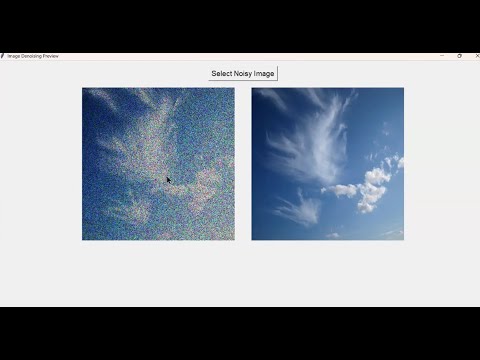
Model evaluation is carried out using the Peak Signal-to-Noise Ratio metric, which measures the ratio between the maximum possible power of a clean image and the power of the corrupting noise. Higher PSNR values indicate better restoration performance. The proposed system is implemented in PyTorch, making it flexible for experimentation and scalable for larger datasets. The modular design allows for easy switching between the DnCNN and GAN modes depending on the application requirements. During testing, the system takes in a noisy or degraded image and outputs a restored image with improved clarity and reduced noise.
Potential applications of this research include photography enhancement, where low-light images suffer from high noise levels; medical imaging, where denoising can reveal important diagnostic details; and security surveillance, where restored footage can assist in identification and investigation. This project demonstrates that deep learning models, when trained with the right architecture, data, and optimization strategy, can effectively restore degraded images and outperform traditional image processing methods.
In conclusion, the combination of discriminative models like DnCNN and generative models like GANs provides a powerful toolkit for image restoration tasks. While DnCNN offers stable and high PSNR results, GANs introduce perceptual enhancements that make restored images visually more appealing. Future improvements could include integrating attention mechanisms, multi-scale architectures, and transfer learning from large-scale vision models to further enhance restoration performance and generalization to unseen noise patterns.
INTRODUCTION
Image restoration is a fundamental and continuously evolving research area within the domains of computer vision and digital image processing, aiming to recover high-quality images from degraded or corrupted observations. In real-world scenarios, images are often affected by various forms of degradation introduced during acquisition, transmission, storage, or processing stages. These degradations may include noise caused by sensor limitations, poor lighting conditions, electronic interference, motion blur due to camera or object movement, atmospheric distortions, and compression artifacts resulting from bandwidth constraints. As images play a crucial role in numerous applications such as medical diagnostics, satellite imaging, surveillance systems, autonomous navigation, forensic analysis, and digital photography, the ability to restore degraded images to a visually and structurally accurate form is of significant practical importance. Traditional image restoration techniques primarily rely on mathematical modeling and signal processing approaches, including linear and non-linear filtering, frequency domain transformations, and statistical estimation methods. Techniques such as Wiener filtering, median filtering, bilateral filtering, and wavelet-based denoising have been widely used to suppress noise and improve image quality. While these methods are computationally efficient and theoretically grounded, they depend heavily on predefined assumptions about noise distribution and image characteristics. As a result, their performance degrades when confronted with complex, non-uniform, or mixed noise patterns commonly found in real-world data. Moreover, conventional methods often involve a trade-off between noise suppression and detail preservation, frequently leading to over-smoothed images and loss of fine structural information.
The emergence of deep learning has significantly transformed the landscape of image restoration by enabling data-driven approaches that learn complex mappings directly from examples. Convolutional Neural Networks have demonstrated remarkable success in various low-level vision tasks due to their ability to automatically extract hierarchical features from raw image data. Unlike traditional methods, CNN-based restoration models do not require explicit noise modeling; instead, they learn noise characteristics implicitly through training on large datasets. Among these models, the Denoising Convolutional Neural Network has gained particular attention for its residual learning strategy, which focuses on predicting noise components rather than reconstructing the entire clean image. This approach improves convergence speed, enhances restoration accuracy, and achieves superior performance in terms of objective metrics such as Peak Signal-to-Noise Ratio and Structural Similarity Index. Despite the effectiveness of CNN-based denoising models, they are typically optimized using pixel-wise loss functions such as Mean Squared Error or Mean Absolute Error. Although these losses improve numerical accuracy, they often fail to capture perceptual aspects of image quality that are important to human observers. Consequently, restored images may appear visually unnatural, overly smooth, or lacking in high-frequency texture details. This limitation highlights the gap between objective quality metrics and subjective visual perception, which remains a major challenge in image restoration research.
Generative Adversarial Networks have emerged as a powerful solution to address perceptual quality limitations. GANs introduce an adversarial learning mechanism in which a generator network produces restored images while a discriminator network evaluates their realism by distinguishing them from real clean images. This competitive process encourages the generator to synthesize images that are not only noise-free but also visually convincing and rich in texture. By incorporating adversarial loss along with reconstruction and perceptual losses, GAN-based restoration models achieve a better balance between structural fidelity and perceptual realism. However, GANs are known to be difficult to train and may introduce artifacts if not properly constrained, especially when used as standalone denoising solutions. To overcome the individual limitations of discriminative and generative approaches, recent research has focused on hybrid frameworks that combine the strengths of both. In this project, a two-stage image restoration system is proposed, integrating DnCNN for robust noise removal and a GAN-based architecture for texture refinement and perceptual enhancement. The DnCNN stage ensures stable and accurate denoising across multiple noise levels, while the GAN stage restores fine details and natural textures that may be lost during denoising. This combination enables the system to achieve high numerical accuracy without compromising visual quality.
The training process involves artificially degrading clean images using controlled noise injection techniques to simulate real-world conditions. This supervised learning strategy allows precise comparison between restored outputs and ground truth images. Multiple loss functions, including reconstruction loss, perceptual loss using a pretrained feature extractor, and adversarial loss, are employed to guide the optimization process. The system is implemented using the PyTorch deep learning framework, providing flexibility, scalability, and ease of experimentation. The significance of this work lies in its applicability to a wide range of real-world scenarios. In medical imaging, improved image clarity can assist in accurate diagnosis and treatment planning. In surveillance and security, enhanced images can improve object recognition and identification. In photography and multimedia applications, image restoration enhances visual appeal and user experience. By addressing both quantitative accuracy and perceptual quality, the proposed generative AI–based image restoration framework represents a practical and effective solution to modern image degradation challenges. Furthermore, the rapid advancement of generative artificial intelligence has opened new possibilities for solving complex image restoration problems that were previously difficult to address using conventional techniques. Modern deep learning architectures are capable of learning rich contextual representations, allowing models to infer missing or corrupted information more effectively. By leveraging large-scale datasets and high-performance computing resources, generative models can capture intricate relationships between image structures, textures, and noise patterns. This capability enables the restoration system to adapt dynamically to varying degradation conditions without manual parameter tuning. Additionally, the integration of perceptual optimization ensures that restored images align more closely with human visual expectations rather than relying solely on numerical accuracy. As image-based data continues to grow exponentially across domains such as healthcare, remote sensing, smart cities, and multimedia platforms, the demand for intelligent and automated image restoration solutions becomes increasingly critical. The proposed generative AI–based framework contributes to this growing field by offering a balanced, scalable, and application-ready approach that bridges the gap between technical precision and visual realism.
Block Diagram