Abstract
This project presents an AI-driven aerial drone monitoring system designed to automate construction-site analysis using computer vision and deep learning. The system employs MobileNetV2 for classifying construction progress into four stages—Foundation, Framing, Roofing, and Completed—and integrates YOLOv5 for real-time detection of personnel to ensure site safety and resource tracking. Drone-captured images are preprocessed, augmented, and analyzed to enhance accuracy and adaptability across varied environments. The trained models are deployed through a Flask web application, enabling users to upload images, visualize progress stages, count workers, and generate reports through an intuitive interface. Experimental results demonstrate high classification accuracy and reliable personnel detection, significantly reducing manual monitoring efforts while improving operational efficiency. The proposed system offers a scalable and practical solution for remote site inspection, progress tracking, and safety compliance in modern construction management.
Keywords
Aerial Drone, Deep Learning, Computer Vision, MobileNetV2, YOLOv5, Construction Monitoring, Image Classification, Personnel Detection, Flask Web Application, Automation.
Introduction
In recent years, the integration of aerial drones and artificial intelligence (AI) has become a transformative force across multiple industries, offering efficient, scalable, and data-driven solutions to complex real-world challenges. Among the many sectors benefiting from this technological evolution, the construction industry stands out as one of the most promising areas for innovation. Modern construction projects are often large-scale, geographically dispersed, and involve multiple phases, including foundation work, structural framing, roofing, and final completion. Monitoring such diverse activities manually requires significant time, labor, and financial resources, while being prone to delays and human errors. To overcome these limitations, the use of unmanned aerial vehicles (UAVs)—commonly known as drones—has emerged as a powerful tool for real-time observation and data collection.
Drones are capable of capturing high-resolution aerial imagery and videos, providing a comprehensive view of the entire construction site. When combined with computer vision and deep learning algorithms, these images can be analyzed to automatically classify construction progress, detect the presence of workers, and assess safety conditions. Such automation significantly reduces manual supervision while enhancing accuracy and reliability. This project, titled “Aerial Drone”, aims to develop an intelligent drone-based monitoring system that leverages MobileNetV2 and YOLOv5 models to classify construction stages and detect personnel respectively, thereby creating an automated and efficient progress monitoring framework.
The motivation behind this work stems from the increasing demand for smart construction management systems that can deliver timely, objective, and data-rich insights. Traditional progress monitoring relies heavily on periodic site visits, manual photography, and written reports. These methods are not only labor-intensive but also subject to subjective interpretation, often leading to inconsistencies in progress tracking. In contrast, drone-based monitoring enables the acquisition of continuous and standardized visual data from multiple angles, providing a more accurate and holistic understanding of site activities. When augmented with AI-powered analytics, this data can be transformed into actionable insights—such as identifying the current stage of construction, estimating percentage completion, and detecting workforce density for safety compliance.
To achieve these objectives, the proposed system follows a multi-stage approach. First, a dataset of aerial images representing various stages of construction is collected and preprocessed. The preprocessing phase includes resizing, normalization, and data augmentation (such as rotation, flipping, and color variation) to enhance model generalization and performance. A convolutional neural network (CNN) based on MobileNetV2 architecture is then trained using transfer learning to classify images into four categories—Foundation, Framing, Roofing, and Completed. MobileNetV2 is chosen for its lightweight structure and high accuracy, making it suitable for real-time deployment on edge devices and web servers.
Parallelly, YOLOv5 (You Only Look Once, version 5) is employed for real-time personnel detection and counting. The YOLOv5 model is a state-of-the-art object detection algorithm capable of identifying multiple objects in a single frame with high precision and speed. By applying YOLOv5 to drone-captured images, the system can detect construction workers, assess crowd density, and ensure that safety protocols—such as the presence of safety helmets or vests—are being followed. The integration of stage classification and personnel detection into a unified pipeline allows the system to deliver a comprehensive overview of both project progress and site safety.
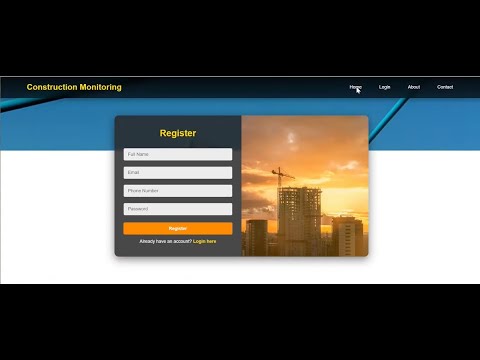
To make the solution user-friendly and accessible, the trained models are deployed using a Flask web application. Through this platform, users can easily upload drone-captured images, view construction stage predictions, visualize personnel detection results, and generate summarized reports. The application provides interactive visual feedback, displaying bounding boxes for detected workers and textual summaries of construction progress. This real-time interface bridges the gap between AI-based analytics and end-user accessibility, ensuring that construction managers and engineers can make informed decisions efficiently.
The proposed Aerial Drone system offers several advantages. It automates routine inspection tasks, minimizes human intervention, and provides continuous and objective data for project evaluation. Moreover, the combination of lightweight neural networks and web-based deployment ensures scalability and cost-effectiveness. Such a system can be further expanded for integration with Building Information Modeling (BIM) platforms and Internet of Things (IoT) sensors, enabling predictive analytics, resource optimization, and risk management in future construction projects.
In conclusion, this project represents a step toward digital transformation in the construction industry by merging aerial drone technology with deep learning-based automation. The outcome is an intelligent, efficient, and practical tool for monitoring construction progress, ensuring safety compliance, and enhancing decision-making. By leveraging advanced AI models and user-centered design, the system demonstrates the potential of drones not just as aerial photographers but as intelligent collaborators in the evolution of modern infrastructure management.
Objectives
The primary goal of this project is to develop an AI-powered aerial drone monitoring system capable of automating the process of construction-site analysis through image classification and object detection. The system integrates deep learning models with a Flask-based web application to deliver accurate, real-time, and user-friendly insights into project progress and personnel monitoring.
The specific objectives of the project are as follows:
1. To design and implement an automated aerial monitoring system using drones for capturing high-resolution construction-site images from various angles and altitudes.
2. To develop a deep learning model using MobileNetV2 for classifying construction progress into four distinct stages — Foundation, Framing, Roofing, and Completed — with high accuracy and computational efficiency.
3. To integrate YOLOv5 for personnel detection and counting in order to monitor workforce presence, ensure safety compliance, and assess site activity levels.
4. To preprocess and augment image datasets using resizing, normalization, rotation, and flipping techniques to improve the model’s robustness and adaptability to different environmental conditions.
5. To build a Flask-based web application that allows users to upload aerial images, view analysis results, and generate progress reports with visual and textual outputs.
6. To evaluate system performance using metrics such as accuracy, precision, recall, and inference time to ensure reliability in real-world conditions.
7. To enhance safety and productivity in construction sites by reducing manual supervision, minimizing human error, and enabling data-driven decision-making through intelligent automation.
8. To propose a scalable framework that can be extended for future integration with IoT sensors, BIM platforms, and cloud-based project management systems for complete smart construction monitoring.
Block Diagram