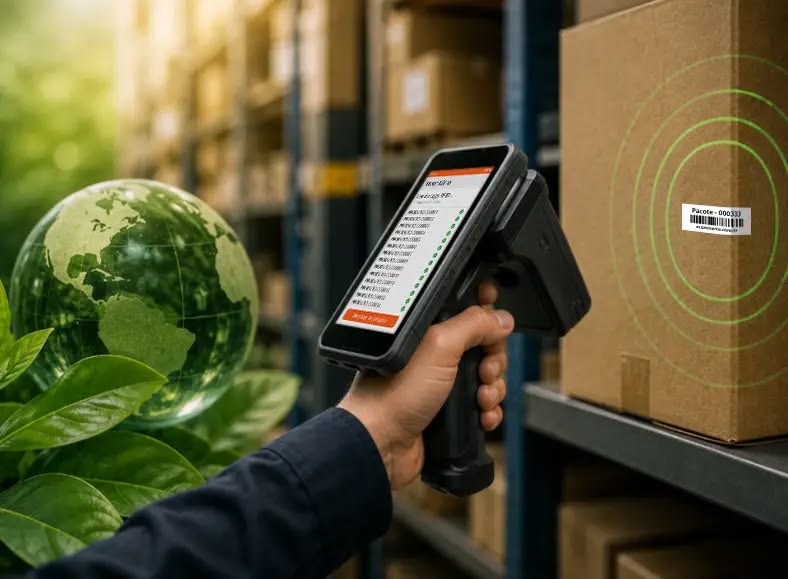
Inventory management is an essential part of retail stores, warehouses, manufacturing industries and supply chain operations. Traditional inventory systems often depend on manual data entry, barcode scanning and periodic stock verification. These methods can consume time and may lead to inaccurate stock records, misplaced products and delays in updating inventory information.
Radio Frequency Identification (RFID) technology provides an automated approach to identifying and tracking products. RFID tags store identification information that can be read by compatible RFID readers using radio waves. By connecting RFID technology with web applications and machine learning, businesses can develop smarter inventory management solutions.
The RFID-Powered Inventory System Using Python Flask and Machine Learning is a project designed to automate inventory tracking, maintain product records and analyze stock movement. When an RFID-tagged product is scanned, the system captures its identification number and communicates with a Python Flask backend. The application retrieves the corresponding product information from the database and updates the inventory records.
Machine learning can further improve the system by analyzing historical stock movement, identifying frequently requested products and predicting future inventory requirements. This helps users make better decisions about stock replenishment and inventory planning.
The primary objective is to build an intelligent inventory management platform that combines RFID-based identification, Flask web development, database management and machine learning analytics in a single application.
Key Features & Benefits
Existing System and Proposed System
Existing System
Traditional inventory management systems commonly use manual registers, spreadsheets or barcode-based applications. Although these approaches are useful for basic stock management, they may become difficult to maintain when the number of products increases.
Some common challenges include:
Manual product entry can introduce human errors.
Barcode scanning generally requires individual line-of-sight scanning.
Stock updates may be delayed when inventory is recorded manually.
Tracking product movement across storage locations can be difficult.
Stock shortages and excess inventory may not be identified early.
Proposed System
The proposed system integrates RFID technology, Python Flask and machine learning to provide automated inventory monitoring.
Each product is associated with an RFID tag containing a unique identifier. When the tag is detected by an RFID reader, the system receives its identifier and checks the product information stored in the database.
The Flask backend processes the RFID reading and updates the appropriate inventory transaction. A web dashboard displays product information, available quantities, stock movement and inventory statistics.
The machine learning component analyzes historical inventory records to generate useful predictions, such as estimated product demand or potential stock shortages.
Main Objectives
Automate product identification using RFID technology.
Maintain centralized product and inventory records.
Record stock-in and stock-out transactions.
Display updated inventory information through a web dashboard.
Analyze historical inventory data using machine learning.
Support stock planning and replenishment decisions.
Implementation Guide
Proposed Methodology and System Architecture
The proposed system follows an integrated architecture consisting of RFID hardware, a Python Flask backend, a database and a machine learning module.
1. RFID Tag Registration
Each product is assigned an RFID tag with a unique identifier. The product identifier is registered in the application along with details such as product name, category, quantity and storage location.
2. RFID Data Acquisition
An RFID reader detects nearby compatible tags and captures their identifiers. Depending on the reader model, the data can be transmitted through USB, serial communication, UART, Wi-Fi or another supported interface.
3. Flask Backend Processing
The RFID reader sends the captured identifier to the Python Flask application. The backend validates the input and checks whether the identifier exists in the product database.
If the tag is registered, the system retrieves the associated product details and processes the inventory transaction.
4. Database Management
A database such as MySQL or PostgreSQL stores product details, RFID identifiers, stock quantities and transaction history.
Typical database records include:
Product ID
RFID Tag ID
Product Name
Product Category
Available Quantity
Stock-In Quantity
Stock-Out Quantity
Transaction Date and Time
Storage Location
5. Inventory Dashboard
The Flask application provides a web dashboard that displays product information, current stock levels, recent RFID scans and transaction history. Administrators can add products, update records and monitor inventory activity.
6. Machine Learning Integration
The machine learning module processes historical inventory transactions to identify demand patterns. A regression or time-series forecasting model can estimate future product demand when sufficient historical data is available.
The prediction results can be displayed on the dashboard to support stock replenishment planning. The model should be evaluated using suitable metrics such as MAE, RMSE or MAPE, depending on the forecasting approach and dataset.
7. Inventory Alerts
The application can compare current stock quantities against predefined minimum stock levels. When a product falls below its threshold, the system can generate a low-stock notification for the administrator.
System Workflow
RFID Tag Registration → RFID Reader Detection → Tag ID Transmission → Python Flask Backend → Database Verification → Inventory Update → Machine Learning Analysis → Dashboard and Stock Alerts
Technical Specifications
Technologies, Features and Applications
Technologies Used
Programming Language: Python
Backend Framework: Flask
Frontend: HTML, CSS, JavaScript and Bootstrap
Database: MySQL or PostgreSQL
RFID Hardware: RFID reader and compatible RFID tags, such as supported 125 kHz or 13.56 MHz systems
Machine Learning: Scikit-learn, Pandas, NumPy and suitable forecasting algorithms
Data Visualization: Matplotlib, Plotly or Chart.js
Development Tools: Visual Studio Code, Jupyter Notebook and Arduino IDE when a microcontroller-based reader interface is used
Major Features
RFID-Based Product Identification: Detects registered RFID tags and retrieves their associated product information.
Automated Inventory Updates: Records stock-in and stock-out transactions based on configured scanning workflows.
Product Management: Allows administrators to register products, assign RFID identifiers and maintain product details.
Real-Time Dashboard: Displays inventory quantities, recent scans and stock movement records.
Machine Learning-Based Demand Prediction: Analyzes historical inventory data to estimate future product demand.
Low-Stock Alerts: Identifies products that fall below configured inventory thresholds.
Transaction History: Maintains a record of inventory operations for monitoring and auditing.
Inventory Analytics: Presents stock summaries and product movement trends through charts and reports.
Conclusion & Next Steps
Conclusion
The RFID-Powered Inventory Management System using Python Flask and Machine Learning demonstrates how automatic identification and intelligent data analysis can improve inventory operations. RFID technology helps identify tagged products, while the Flask backend manages inventory transactions and the database maintains product information and stock history.
Machine learning adds analytical capabilities by examining historical inventory data and estimating future demand. The dashboard provides a centralized interface for product management, stock monitoring, transaction tracking and inventory analysis.
This project provides practical experience in RFID integration, Python programming, Flask application development, database management and machine learning. It is suitable for machine learning students and final-year academic projects focused on smart inventory management and intelligent automation.