ABSTRACT
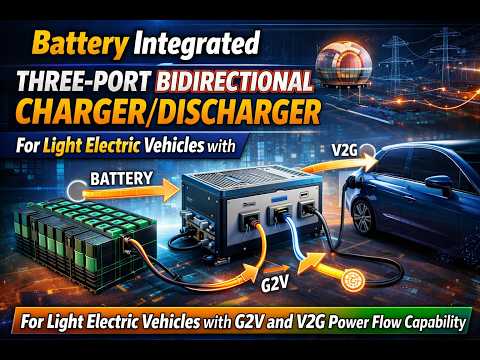
In this paper, a non-isolated battery integrated three-port bidirectional dc-dc converter (BIBTPC) is proposed and analyzed for interfacing light electric vehicles (LEVs) with solar photovoltaic (SPV)-fed low voltage dc distribution system (LVDDS). Depending upon the power generation, the converter can be controlled to operate in grid-to-vehicle (G2V) or vehicle-to-grid (V2G) arrangement. BIBTPC can implement maximum power point tracking (MPPT), simultaneously regulating the dc bus voltage of LVDDS. It also has an inherent feature of pulse charging and pulse discharging of the battery which improves its charging/discharging rate. The control strategy to ensure MPPT simultaneously managing the power flow among SPV, LVDDS, and LEV battery is developed and implemented. The proposed system is simulated in MATLAB/Simulink software.
INTRODUCTION
Over the last one decade, electric vehicles (EVs), plug-in light electric vehicles (LEVs), and hybrid electric vehicles (HEVs) have gained popularity as a clean mode of transportation as they do not emit gasses. However, the carbon footprint can be further reduced if the charging of EVs/LEVs is carried out using the renewable energy sources (RES) such as solar photovoltaic (SPV), wind, and fuel cell. The EVs house on/off-board batteries to meet the propulsion and other power requirements and are charged through an “ac” grid, via a suitable battery charger/discharger, which has its own merits and limitations. Owing to the increased penetration of the renewable energy sources, the low voltage (48 V) dc distributions systems (LVDDS) have emerged as practical solutions to power the dc loads. The generalized structure of an SPV fed LVDDS is shown wherein the LEVs are charged/discharged using the on/off-board unidirectional/bidirectional dc-dc converter. The dc-dc boost converters, connecting SPV, ensures maximum power point tracking (MPPT), while the load side converters ensure load voltage regulation. However, the requirement of several stages of dc-dc converters reduces the overall system efficiency, increases size, and leads to performance degradation due to sub-system interactions between the converters. Unidirectional dc-dc converters such as boost, cuk, and sepic are reported in the literature for the direct charging of LEV from RES, but these are only suitable to meet the battery charging requirement which is generally termed as grid-to-vehicle (G2V) operation. However, the vehicle-to-grid (V2G) operation is highly desirable when the LEVs are interfaced with RES fed LVDDS. Although the requirement of G2V and V2G power flow can be met by using a bidirectional dc-dc converter, it leads to increased switching devices (SD) and passive energy storage elements (PESE). Several three-port dc-dc converters (TPC) have been reported in the literature to integrate the RES and battery with LVDDS. Non-isolated TPCs are cost-effective for low voltage applications because of their compact size and the low number of components counts. However, non-isolated TPCs have restricted power flow options due to the sharing of the components under different modes of operation. Power flow restrictions can be overcome by using more switches which increases the complexity of the control. Also, most of the topologies reviewed and proposed are focused on loads that do not have the current reversibility feature. Thus, loads with current reversibility or bidirectional features such as battery and LVDDS grid cannot be integrated using such TPCs. Multiphase bidirectional converter is reported in the literature to integrate the multiple bidirectional elements for the application of electric vehicles. However, this converter requires a coupled inductor for each bidirectional element added. A bidirectional dc-dc converter with the capability to add two bidirectional elements for electric vehicles is also proposed but has used four power switches, three bidirectional power switches, two inductors, and two capacitors. Few TPCs are reported in literature to integrate the one unidirectional and two bidirectional elements. The TPC reported by Cheng et al. has used four switches, four diodes, one inductor, and two capacitors for integration of one unidirectional and two bidirectional elements. Although this converter has the bidirectional capability for both the LVDDS grid and battery, the number of switching elements has increased to eight. Similarly, another three-port converter for integrating one unidirectional and two bidirectional elements by Zolfi and Ajami26 has a high number of components counts, i.e., one uncoupled inductor, coupled inductor pair, five switches, five diodes, and two capacitors to enable the power flow among three ports. Multiport converter TP-B3 based on dc-link inductor can integrate the bidirectional elements, but this also requires two switching elements and one inductor per port, i.e., three inductors and six switching elements (SEs) in total. In view of the above discussion, it is inferred that there is a requirement of TPCs with can integrate more than one bidirectional element so that power can be managed among PV panel, EV battery, and LVDDS grid.
Block Diagram