ABSTRACT
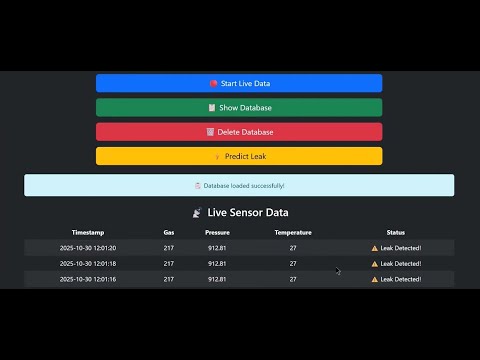
Pipeline leakage is a critical issue in industrial infrastructure, particularly in oil, gas, and chemical transportation systems, as it can lead to severe environmental damage, economic losses, and safety hazards. Traditional pipeline monitoring methods rely heavily on manual inspection or rule-based threshold systems, which are often inefficient, slow to respond, and prone to human error. To address these limitations, this project presents a real-time pipeline leak detection and monitoring system using a machine learning-based Random Forest classifier integrated with live sensor data. The proposed system utilizes key pipeline parameters such as gas concentration, internal pressure, and temperature as input features to intelligently classify pipeline conditions as either safe or leaking. A labeled dataset is constructed by defining leak conditions based on domain-specific thresholds, and the Random Forest model is trained and evaluated for accuracy and reliability. Once trained, the model is deployed for real-time inference by continuously fetching sensor data from a remote API endpoint, enabling instant leak detection and alert generation. To enhance usability and monitoring efficiency, a Flask-based web application is developed to display live pipeline readings, prediction status, and historical logs stored in a CSV-based database.
INTRODUCTION
Pipeline transportation systems play a vital role in modern industrial infrastructure by enabling the efficient and continuous transfer of critical resources such as oil, natural gas, water, and chemical substances across long distances. These pipelines form the backbone of energy distribution networks and industrial supply chains, supporting economic growth and meeting the rising global demand for energy and raw materials. However, due to aging infrastructure, harsh environmental conditions, material fatigue, corrosion, improper maintenance, and accidental damage, pipelines are highly susceptible to leaks and failures. Even minor leakages can escalate into major incidents, leading to substantial financial losses, environmental pollution, safety hazards, and threats to human life. Consequently, ensuring the safety, reliability, and integrity of pipeline systems has become a top priority for industries and regulatory bodies worldwide. Traditional pipeline monitoring and leak detection techniques have primarily relied on manual inspections, periodic pressure testing, acoustic sensing, and rule-based threshold systems. While these methods have been widely used for decades, they often suffer from significant limitations, including delayed detection, high operational costs, limited accuracy, and an inability to adapt to dynamic operating conditions. Manual inspections are labor-intensive and cannot provide continuous monitoring, while threshold-based systems may fail to detect subtle anomalies or generate false alarms due to normal fluctuations in sensor readings. As pipeline networks expand in size and complexity, there is an increasing need for intelligent, automated, and real-time monitoring solutions capable of detecting leaks at an early stage and responding promptly to abnormal conditions. In recent years, the rapid advancement of sensor technologies and the Internet of Things (IoT) has enabled continuous data acquisition from pipeline systems in real time. Sensors deployed along pipelines can continuously measure critical parameters such as gas concentration, internal pressure, temperature, and flow rate. These sensors generate large volumes of data that reflect the operational state of the pipeline under varying conditions. However, collecting data alone is not sufficient; extracting meaningful insights from this data in a timely manner remains a significant challenge. Conventional data analysis techniques struggle to handle the complexity, volume, and non-linear relationships present in sensor data, particularly in scenarios involving multiple interacting parameters. This challenge has led to the increasing adoption of machine learning techniques for intelligent fault detection and predictive monitoring in industrial systems.
Machine learning offers powerful tools for analyzing large datasets, identifying hidden patterns, and making accurate predictions based on historical and real-time data. Among various machine learning algorithms, ensemble learning methods such as Random Forest have gained considerable attention due to their robustness, high accuracy, and ability to handle noisy and non-linear data. Random Forest is a supervised learning algorithm that combines multiple decision trees to improve classification performance and reduce overfitting. Its ability to model complex relationships between input features makes it particularly suitable for pipeline leak detection, where leak conditions are influenced by multiple interdependent parameters. By learning from historical sensor data, a Random Forest model can effectively distinguish between normal operating conditions and abnormal patterns indicative of leakage. The integration of machine learning models with real-time sensor data creates new opportunities for developing intelligent pipeline monitoring systems. Such systems can continuously analyze live data streams, detect anomalies as they occur, and provide immediate alerts to operators. This proactive approach significantly reduces the time required to identify leaks and initiate corrective actions, thereby minimizing damage and improving overall system safety. Furthermore, machine learning-based systems can adapt to changing operating conditions and improve their performance over time as more data becomes available, making them more reliable than static rule-based methods.
OBJECTIVES
The primary objective of this project is to design and develop an intelligent, reliable, and real-time pipeline leak detection system that leverages machine learning techniques to enhance the safety and efficiency of pipeline infrastructure. The system aims to automatically analyze sensor data related to gas concentration, pressure, and temperature in order to accurately classify pipeline conditions as either safe or leaking. By moving beyond traditional rule-based and manual monitoring approaches, the project seeks to provide a data-driven solution that can detect leak conditions early, reduce response time, and minimize the potential impact of pipeline failures. This objective directly addresses the growing need for proactive monitoring systems capable of handling large volumes of real-time data in complex industrial environments. Another key objective of the project is to implement a robust Random Forest classification model that can effectively learn from historical sensor data and generalize well to unseen real-time inputs. Random Forest is selected due to its high accuracy, resistance to overfitting, and ability to model non-linear relationships between multiple input parameters. The project aims to train and evaluate the model using a well-structured dataset and standard performance metrics to ensure reliability and consistency in leak detection. By achieving high classification accuracy and low false alarm rates, the system aspires to build operator trust and improve decision-making in pipeline monitoring operations. A further objective is to integrate the trained machine learning model with live sensor data obtained through an external API, enabling continuous real-time monitoring of pipeline conditions. This integration is crucial for transitioning from offline data analysis to practical, real-world deployment. The system is designed to periodically fetch sensor readings, process the data, and generate instant predictions without manual intervention. Through this objective, the project emphasizes the importance of automation and real-time intelligence in reducing human dependency and ensuring rapid detection of abnormal conditions in pipeline systems.
Block Diagram
SYSTEM REQUIREMENTS
Hardware Requirements
• A personal computer or laptop with a minimum Intel Core i3 processor or equivalent is required to develop and run the application.
• Minimum 4 GB RAM is required, while 8 GB RAM is recommended for smooth execution of machine learning tasks.
• At least 20 GB of free hard disk space is required for dataset storage, model files, and log files.
• An active internet connection is required to fetch real-time sensor data from the API.
• Standard keyboard and mouse are required for user interaction and development.
• Optional IoT sensors such as gas sensors, pressure sensors, and temperature sensors can be used for real-time hardware integration (simulated via API in this project).
• A display monitor with minimum 1366 × 768 resolution for viewing the web dashboard clearly.
Software Requirements
• Operating System: Windows 10 / Windows 11 / Linux / macOS.
• Programming Language: Python 3.8 or above.
• Development Environment: Visual Studio Code, PyCharm, or any Python-supported IDE.
• Web Framework: Flask for developing the web-based monitoring application.
• Machine Learning Library: Scikit-learn for implementing the Random Forest classifier.
• Data Handling Libraries: Pandas and NumPy for data processing and numerical operations.
• Model Persistence: Joblib for saving and loading the trained machine learning model.
• API Communication: Requests library for fetching real-time sensor data from the external API.
• Data Storage: CSV file format for storing historical sensor data and prediction results.
• Web Browser: Google Chrome, Mozilla Firefox, or any modern web browser for accessing the dashboard.