ABSTRACT
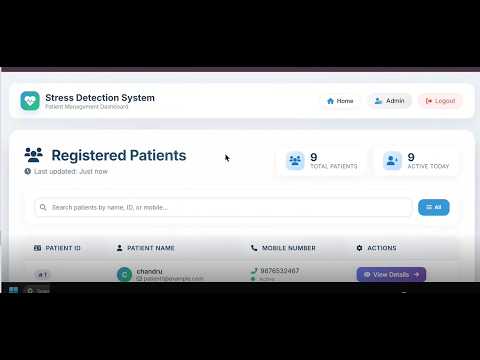
The rapid rise of stress-related health conditions has increased the need for intelligent, real-time physiological monitoring systems capable of early detection and intervention. This project presents an integrated Real-Time Stress Detection and Analysis System that leverages IoT-based sensor acquisition, advanced feature engineering, and a hybrid machine-learning model for reliable stress classification. Physiological parameters such as temperature, humidity, SpO₂, heart rate, and fall detection are collected from an external API and processed to compute additional biomedical indicators including Systolic Blood Pressure (SBP), Diastolic Blood Pressure (DBP), Pulse Pressure (PP), Mean Arterial Pressure (MAP), Heat Index, and Oxygen Delivery, improving the discriminative power of the model. A hybrid classification framework combining Random Forest, Support Vector Machine, and Neural Network through a soft-voting ensemble enhances prediction accuracy, outperforming individual models. The system uses a Flask web application for seamless patient registration, real-time monitoring, and backend prediction integration. A visually optimized dashboard built with Chart.js provides continuous live graphs for SpO₂ and heart rate, along with dynamic vital indicators that classify each parameter into normal, warning, or critical states. Each prediction cycle generates an automatically formatted PDF medical report using Report Lab and stores all results in a SQLite database for future reference and clinical analysis. The system also features an admin panel for patient-wise record inspection, ensuring structured data management. This solution demonstrates a highly responsive, clinically meaningful framework that supports healthcare professionals with actionable insights while empowering users with transparent, real-time stress analytics. The project successfully integrates IoT sensing, biomedical computation, machine learning intelligence, and interactive web technologies into a single end-to-end monitoring ecosystem capable of functioning in real-world environments.
INTRODUCTION
Stress has become one of the most pervasive physiological and psychological burdens of modern life, exerting a significant influence on overall health, productivity, emotional stability, and quality of life. As lifestyles accelerate and work demands intensify, the early detection and continuous monitoring of stress have transformed from optional wellness practices into essential healthcare requirements. Stress, when unmanaged, triggers a cascade of biological responses involving the autonomic nervous system, endocrine system, and cardiovascular mechanisms, often manifesting through measurable physiological changes such as elevated heart rate, reduced oxygen saturation, temperature fluctuation, and alterations in blood pressure. Traditional stress assessment approaches—based on self-report questionnaires, clinical observations, or periodic checkups—lack real-time precision, are subjective in nature, and fail to capture moment-to-moment variations in physiological states. This gap necessitates a technologically advanced system capable of capturing live biometrics, applying intelligent computation, and predicting stress reliably before it escalates into critical health conditions. In recent years, the convergence of IoT-based wearable sensors, biomedical feature engineering, and machine learning algorithms has opened new pathways for automated, continuous, and accurate health monitoring. This project builds upon that paradigm, introducing a comprehensive Real-Time Stress Detection and Analysis System that integrates sensor data acquisition, advanced statistical calculations, and ensemble machine-learning classification within a single, unified architecture. The system collects crucial physiological metrics such as temperature, humidity, SpO₂, heart rate, and fall detection output via an IoT-enabled API and augments them with derived medical indicators including Systolic Blood Pressure (SBP), Diastolic Blood Pressure (DBP), Pulse Pressure (PP), Mean Arterial Pressure (MAP), Heat Index, Relative Humidity effects, and Oxygen Delivery. These engineered features significantly elevate the predictive richness of the dataset by incorporating cardiovascular, thermoregulatory, and respiratory dynamics, all of which are strongly influenced by stress. The core analytical engine of the system employs a hybrid machine-learning model, combining Random Forest, Support Vector Machine, and Neural Network through a soft-voting ensemble to exploit the strengths of each algorithm. Random Forest provides robustness against noise and non-linearity, SVM contributes high-margin separation for complex boundaries, and the Neural Network captures deep nonlinear feature interactions. Together, they form an ensemble that achieves higher accuracy, stability, and generalization performance than any individual model alone.
The intelligent backend is deployed through a Flask-based web server that manages data flow, patient registration, state maintenance, database operations, and prediction execution. The application not only processes physiological data but also ensures real-time visualization using an interactive dashboard created with Chart.js. This dashboard presents live line charts for SpO₂ and heart rate, dynamic color-coded indicators representing normal, warning, and critical thresholds, and auto-refreshed parameter cards for temperature, humidity, blood-pressure-related metrics, oxygen delivery, and MAP. This visualization layer transforms raw biomedical data into intuitive, clinically meaningful insights that users and healthcare professionals can interpret at a glance. The system’s design prioritizes operational simplicity and user accessibility, enabling even non-technical individuals to understand vital changes. Additionally, the application automatically generates a structured, professional PDF stress assessment report after every analysis, capturing patient details, all physiological readings, derived biomedical parameters, and the final ML-based classification. These reports are stored in a SQLite database along with historical timestamps, enabling time-series tracking and retrospective analysis of patient stress patterns. The inclusion of an admin interface further elevates the system into a practical medical record-keeping tool, offering access to patient histories and enabling systematic clinical review.
This project therefore addresses the longstanding challenge of objective, scalable, real-time stress evaluation by integrating IoT sensing, biomedical computation, and hybrid machine learning within a cohesive, production-ready ecosystem. Unlike conventional manual stress assessments—which are episodic and subjective—this system is automated, data-driven, and continuously responsive, making it suitable for diverse applications including remote patient monitoring, workplace stress evaluation, elderly safety surveillance, athletic performance tracking, and personalized wellness management. In healthcare environments, early stress detection enables timely interventions that reduce risks of cardiovascular strain, immune suppression, and long-term chronic conditions. For individuals, it empowers self-awareness and informed lifestyle decisions.
OBJECTIVES
1. Design and develop a fully integrated real-time stress detection system that combines IoT-based physiological sensing, biomedical feature computation, machine learning models, and interactive web visualization.
2. Continuously acquire physiological parameters such as temperature, humidity, SpO₂, heart rate, and fall detection using a sensor-enabled IoT API.
3. Transform raw sensor data into biomedical features, including:
o Systolic Blood Pressure (SBP)
o Diastolic Blood Pressure (DBP)
o Pulse Pressure (PP)
o Mean Arterial Pressure (MAP)
o Oxygen Delivery
o Heat Index
4. Improve stress analysis accuracy by capturing multiple physiological indicators instead of relying on single-signal monitoring.
5. Develop a hybrid machine-learning model combining Random Forest, Support Vector Machine, and Neural Network classifiers.
6. Implement a soft-voting ensemble technique to improve prediction accuracy, reduce model bias, and handle noisy or inconsistent sensor data.
7. Build a Flask-based backend system capable of handling:
o Patient registration
o Session management
o Stress prediction requests
o Database operations
o PDF report generation
o Automated timestamps
8. Develop an interactive real-time dashboard using Chart.js to visualize physiological parameters clearly.
9. Display live physiological data including:
o Line graphs for SpO₂ and heart rate
o Vital-status indicators
o Dynamic value cards for measured and computed parameters
10. Generate automated medical reports in PDF format containing patient details, sensor readings, biomedical indicators, timestamps, and predicted stress status.
11. Store all reports and historical records in a SQLite database to support long-term tracking, telemedicine, and clinical review.
12. Ensure system scalability and adaptability, allowing easy addition of new sensors, machine-learning models, or biomedical calculations.
13. Develop a modular and efficient architecture with clean APIs and structured data storage.
14. Provide a user-friendly interface so that users without technical or medical knowledge can easily understand stress monitoring results.
15. Enable historical data analysis for clinicians, caregivers, and researchers to identify long-term stress patterns.
16. Bridge the gap between IoT hardware, biomedical computation, and machine learning by providing a deployable real-time stress monitoring solution.
17. Reduce dependence on expensive wearable devices by supporting low-cost sensors and IoT APIs.
18. Improve system reliability through fault handling, managing missing values, sensor errors, and abnormal environmental conditions.
19. Support remote monitoring and telehealth applications for distributed healthcare environments.
20. Provide a foundation for future enhancements, including:
• Stress trend analytics
• Anomaly detection
• Mental health forecasting
• Mobile application integration
• AI-based personalized health recommendations
Block Diagram