ABSTRACT
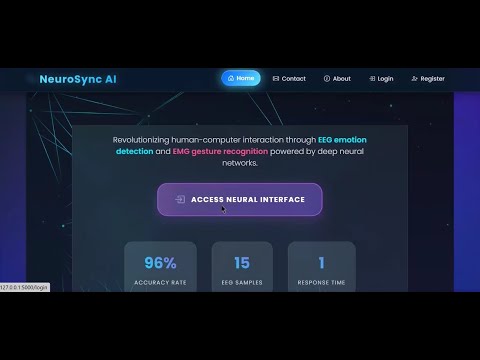
Brain–Computer Interface (BCI) systems provide a direct communication pathway between human neural activity and external devices, enabling advanced interaction without dependence on conventional muscular functions. This project aims to enhance human–machine collaboration by integrating both Electroencephalography (EEG) and Electromyography (EMG) signals within a unified intelligent framework. EEG signals reflect the emotional and cognitive states of the brain, while EMG signals represent muscle movement patterns, particularly hand gestures. By combining these two biophysiological modalities, this system supports improved interaction and control mechanisms essential for assistive applications. The proposed methodology includes data preprocessing, feature extraction, and model training using various supervised machine learning algorithms. Emotion recognition from EEG data is performed using classifiers such as Random Forest and Support Vector Machine, whereas EMG gesture classification employs Gaussian Naïve Bayes, SVM, and Random Forest models. The system evaluates the performance of each algorithm to identify the most optimal model for deployment. A secure, user-friendly web interface is developed to allow real-time prediction, user authentication, and result logging for continuous analysis. The implementation ensures scalability, accurate decision-making, and smooth data handling through the integration of Python-based machine learning and a Flask-driven application. The experimental results indicate strong performance in emotion and gesture classification, validating the reliability of the developed BCI system. The approach presented here supports users with motor impairments, enabling them to interact with digital environments more naturally and independently. Furthermore, this technology has wide-ranging potential applications in prosthetic control, smart rehabilitation systems, immersive gaming, and adaptive robotics. The integration of human cognition and muscular responses in a single system demonstrates a significant advancement in intelligent human–machine interaction. This project therefore contributes to the evolving field of BCI by providing a more effective, adaptable, and user-centric interface capable of enhancing quality of life through improved communication and control.
INTRODUCTION
Human–Machine Collaboration has become an essential component in modern technological advancements, especially in fields that focus on enhancing human capabilities and supporting individuals with disabilities. Brain–Computer Interface (BCI) systems serve as a revolutionary approach to bridging the communication gap between humans and external devices by directly interpreting physiological responses generated by the nervous system. Unlike traditional interfaces that rely on manual input or voice-based commands, BCIs utilize neurological and muscular signals to control machines, making them suitable for users with severe motor impairments. Among various biosignals, Electroencephalography (EEG) captures electrical activity from the brain, providing valuable insights into cognitive and emotional states, while Electromyography (EMG) records electrical signals from muscle contractions, particularly useful for gesture recognition and motor intention detection. Integrating EEG and EMG modalities within a single framework significantly enhances interaction, offering improved reliability and responsiveness in BCI applications. With advancements in artificial intelligence and machine learning, automated analysis and classification of these signals have become increasingly efficient and accurate. Machine learning models are capable of identifying subtle patterns in biosignals that are not easily distinguishable through manual inspection, leading to superior performance in real-time prediction and decision-making. This project focuses on developing a hybrid BCI system that utilizes EEG signals to classify human emotions and EMG signals to recognize hand gestures, ensuring both cognitive and motor-based communication are supported. Such a dual-modal strategy promotes more natural and intuitive interaction with assistive technologies. The system employs preprocessing techniques to standardize and clean the dataset, followed by training multiple machine learning models such as Random Forest, Support Vector Machine, and Naïve Bayes to determine the most effective classifier for deployment. A web-based application is implemented using Flask to provide real-time operational visualization, secure user authentication, and systematic storage of prediction outcomes. This ensures that the system is accessible, user-friendly, and adaptable for various environments. Human–machine collaboration using BCIs has vast potential in rehabilitation, prosthetics, smart home control, virtual reality, robotics, and emotion-aware computing systems. By understanding a user’s emotional state, the system can adapt behavior dynamically, reducing cognitive load and enhancing user comfort. Similarly, gesture recognition enables precise control of mechanical devices, making it beneficial for individuals with limb disabilities seeking independence in daily activities. The motivation behind this work is to contribute an innovative and practical solution that supports seamless interaction between humans and intelligent systems, thereby improving overall quality of life. The integration of both emotional and motor data establishes a comprehensive communication channel, moving beyond traditional single-modal BCI concepts. This project demonstrates how machine learning-based interpretation of neural and muscular signals can transform human-centered technology. As global research progresses in neuroscience, signal processing, and embedded intelligence, hybrid BCI models like the one proposed in this study will continue to advance, offering enhanced performance, adaptability, and real-world usability. The work presented here stands as a step toward future assistive systems that are more intuitive, secure, and deeply aligned with human intention, ultimately shaping a new era of intelligent human-machine collaboration. The evolution of Brain–Computer Interface systems has increasingly shifted toward multi-modal data fusion to overcome limitations observed in single-signal-based implementations. Traditional EEG-only BCIs often face challenges such as low signal-to-noise ratio, variations in user attention, and difficulties during prolonged operation, which may limit classification accuracy. Similarly, EMG-only systems may fail in cases of neuromuscular damage or fatigue, reducing system reliability. Therefore, integrating both EEG and EMG signals enables a more robust interpretation of user intent by simultaneously analyzing emotional and physical responses. This hybrid approach enriches the interaction model, improving adaptability and supporting users across diverse functional abilities. Machine learning plays a vital role in this advancement by enabling automated feature learning, pattern recognition, and intelligent decision support. In this project, physiological data collected from EEG and EMG sensors is preprocessed to remove noise and standardized to enhance learning performance. Different machine learning algorithms are then trained to observe how their behaviors vary with distinct biosignal patterns. Performance comparison helps identify the most efficient model for real-time prediction, thus optimizing accuracy and responsiveness. The implementation includes a secure backend database to maintain user information, authentication credentials, and prediction histories, establishing a personalized and traceable interaction environment. By deploying the trained models into a Flask-based web application, the system ensures accessibility from any device connected to a network, transforming laboratory-based BCI innovations into a portable and user-friendly solution. The project also emphasizes data privacy and ethical usage considerations, as biosignals contain sensitive neurological and muscular information.
Block Diagram
1. Software Requirements
The software requirements for the hybrid Brain–Computer Interface system include all tools, environments, platforms, and dependencies necessary for successful implementation and deployment of both machine learning models and the user-interactive web interface. The proposed system is developed primarily using the Python programming language due to its strong machine learning support libraries such as Scikit-Learn, TensorFlow, Pandas, NumPy, and Joblib. Flask framework is used for designing the web interface, enabling efficient routing, real-time prediction requests, and smooth backend processing. SQLite database is integrated to securely store user authentication details, prediction logs, and timestamped records for system validation. The application is executed on Windows or Linux operating systems to support Python runtime environments and ensure compatibility with all development tools. The software stack also includes Jupyter Notebook for model experimentation and Visual Studio Code (or PyCharm) for debugging, editing, and modular programming. Web development components incorporate HTML, CSS, and Bootstrap to provide a clean and responsive user interface for users with different access needs. Browser compatibility is ensured for Chrome, Firefox, and Edge. Additional utilities such as Anaconda or pip package manager are used to install required dependencies. GitHub or local version control is optionally utilized to maintain code updates and collaborative modifications. Overall, the software environment ensures reliability, extensibility, and real-time deployment support for the hybrid EEG-EMG BCI system.
Software List Summary
• Operating System: Windows 10/11 or Linux (Ubuntu recommended)
• Programming Language: Python 3.8+
• Frameworks: Flask, Scikit-Learn, TensorFlow/Keras
• Developer Tools: VS Code / Jupyter Notebook
• Database: SQLite
• Libraries: Pandas, NumPy, Joblib, Pickle, OpenCV (optional)
• Web Technologies: HTML5, CSS3, Bootstrap
• Browser Support: Chrome / Firefox / Edge
2. Hardware Requirements
The hardware requirements define the physical infrastructure necessary for training models, executing predictions, and supporting assistive input devices during experimentation. The proposed system is compatible with standard computing hardware that includes a processor with multi-threading support to handle real-time signal input and classification algorithms without latency. A minimum of 8 GB RAM is recommended for smooth execution of machine learning model training and database operations. Sufficient storage capacity is required to maintain datasets, trained models, logs, and system files — ideally 256 GB or higher. Hardware support for wired or wireless data acquisition devices is included to integrate biosignal sensors. If EEG and EMG sensors are used in real-time deployment, compatible USB connectivity or Bluetooth modules must be available for signal transmission. The system may be tested using pre-recorded datasets; however, real sensor-based execution requires electrodes or wearable devices that can measure brainwave and muscle activity accurately. A stable power supply and cooling system are essential to maintain performance during extended runtime operations, especially in continuous prediction environments. Users must also have access to a secure personal device such as a laptop or desktop capable of running a browser for accessing the web application. Optional hardware components like microcontrollers (ESP32, Arduino) or robotic actuators may be integrated in future enhancements to physically demonstrate gesture-based interaction with external devices. Overall, the hardware environment ensures reliable execution, communication, and scalability for real-world hybrid BCI deployment.
Hardware List Summary
• Processor: Intel i5 / AMD Ryzen 5 or higher (multi-core)
• RAM: Minimum 8 GB (Recommended 16 GB for faster model training)
• Storage: Minimum 256 GB HDD/SSD
• GPU: Optional — for deep learning acceleration (NVIDIA CUDA recommended)
• Network: Wi-Fi/Ethernet for web application access
• Input Devices (optional for real-time):
o EEG Headset / Electrodes
o EMG Sensor / Myo Armband
• Display: HD Monitor for interface visualization