ABSTRACT
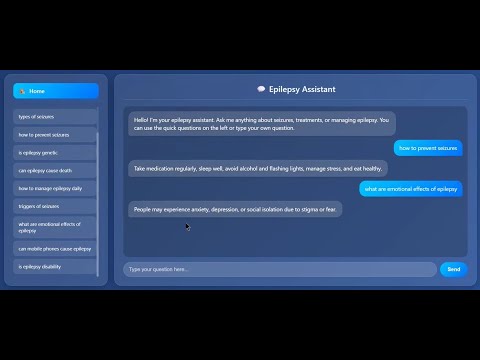
This project presents an intelligent EEG-based health monitoring system designed to support early detection of epileptic seizures and accurate recognition of human emotional states. The system integrates advanced machine learning and deep learning techniques with a user-friendly web application to provide reliable, real-time decision support for neurological analysis. Electroencephalogram signals are used as the primary data source, as they capture brain wave patterns that reflect both abnormal seizure activity and emotional variations. For seizure detection, a hybrid convolutional neural network and recurrent neural network model is employed to effectively learn spatial and temporal characteristics of EEG signals. For emotion detection, multiple machine learning models and a deep neural network are trained using extracted EEG wave features along with derived neuro-physiological ratios and indices. To enhance classification performance, data preprocessing techniques such as feature scaling, class balancing using SMOTE, and dimensionality reduction using principal component analysis are applied. The system evaluates multiple models, including ensemble and deep learning approaches, and selects the best-performing model based on accuracy and F1-score. A secure Flask-based web application is developed to manage user authentication, input EEG feature values, and display prediction results in an accessible format. Additionally, a simple medical chatbot is integrated to provide basic guidance and informational responses to users. The proposed system demonstrates effective performance in both seizure and emotion classification tasks, highlighting its potential as a supportive tool for neurological monitoring and mental state assessment. This project emphasizes the practical application of artificial intelligence in healthcare and showcases how intelligent systems can assist clinicians and caregivers in making timely and informed decisions.
INTRODUCTION
The rapid advancement of artificial intelligence and machine learning has significantly transformed the healthcare domain, enabling the development of intelligent systems capable of assisting medical professionals in diagnosis and monitoring. Among various biomedical signals, the electroencephalogram plays a crucial role in understanding brain activity, as it captures electrical signals generated by neuronal interactions within the brain. EEG signals are widely used for analyzing neurological disorders and mental states because they provide non-invasive, real-time insight into brain function. One of the most critical neurological conditions that can be studied using EEG signals is epilepsy, a chronic disorder characterized by sudden and recurrent seizures caused by abnormal brain activity. Early and accurate detection of epileptic seizures is essential to prevent severe health complications and to improve the quality of life of affected individuals.
Epileptic seizures often occur unpredictably, making continuous monitoring and automated detection systems highly valuable in clinical and home-care environments. Traditional seizure detection methods rely heavily on manual EEG interpretation by trained neurologists, which is time-consuming, subjective, and not feasible for continuous monitoring. This limitation has motivated researchers to explore automated seizure detection systems using machine learning and deep learning techniques. By learning patterns directly from EEG data, intelligent models can identify subtle changes in brain activity that may indicate seizure onset. Such systems can support clinicians by providing faster and more consistent detection results, especially in resource-constrained healthcare settings.
In addition to seizure detection, understanding human emotional states has gained significant importance in modern healthcare and human–computer interaction systems. Emotional states influence cognitive performance, mental health, and overall well-being. EEG-based emotion recognition has emerged as a promising approach because brain wave patterns vary according to emotional responses such as stress, relaxation, engagement, and anxiety. Unlike facial expressions or speech signals, EEG signals are difficult to manipulate consciously, making them a reliable source for emotion analysis. This reliability makes EEG-based emotion detection particularly useful in applications related to mental health monitoring, stress assessment, and assistive healthcare systems.
Recent advancements in signal processing and deep learning have enabled the extraction of meaningful features from raw EEG data. EEG signals are typically decomposed into frequency bands such as delta, theta, alpha, beta, and gamma waves, each associated with specific cognitive and emotional states. By analyzing the intensity and entropy of these frequency bands, it is possible to derive informative features that represent underlying brain activity. However, EEG data is inherently noisy, high-dimensional, and often imbalanced across classes, which poses challenges for traditional machine learning models. Therefore, robust preprocessing techniques are required to ensure reliable model performance.
Machine learning algorithms such as Random Forest, Gradient Boosting, and Support Vector Machines have shown promising results in EEG-based classification tasks. These models are capable of handling complex nonlinear relationships within the data. More recently, deep learning models have gained attention due to their ability to automatically learn hierarchical representations from input features. Convolutional neural networks are particularly effective in capturing local spatial patterns, while recurrent neural networks, such as long short-term memory networks, excel at modeling temporal dependencies in sequential data. By combining these architectures, hybrid models can effectively learn both spatial and temporal characteristics of EEG signals.
Despite the availability of advanced models, practical deployment of EEG-based detection systems remains limited due to challenges related to usability, accessibility, and system integration. Many existing research solutions focus solely on model development and evaluation, without providing an interactive platform for real-world usage. To address this gap, there is a growing need for integrated systems that combine robust machine learning models with user-friendly web interfaces. Such systems can enable users to input EEG-derived features, obtain real-time predictions, and visualize results in an intuitive manner. Secure user authentication and data management are also essential to ensure privacy and reliability in healthcare applications.
This project focuses on the design and development of an intelligent EEG-based healthcare monitoring system that addresses both epileptic seizure detection and emotion recognition. The system leverages advanced preprocessing techniques, multiple machine learning and deep learning models, and a hybrid CNN–RNN architecture for seizure detection. For emotion classification, derived EEG features, data balancing methods, and dimensionality reduction techniques are employed to improve performance. A secure and interactive web application is developed to integrate these models into a single platform. The proposed system aims to demonstrate how artificial intelligence can be effectively applied to neurological monitoring and mental state assessment, offering a scalable and practical solution for modern healthcare applications.
Block Diagram
SOFTWARE REQUIREMENTS
The proposed EEG-based seizure and emotion detection system requires a carefully selected software environment to ensure accurate model development, reliable execution, and smooth deployment. The software requirements include the programming language, development environment, machine learning libraries, deep learning frameworks, database systems, and visualization tools. Each software component plays a critical role in enabling efficient data processing, model training, evaluation, and web-based integration. The selection of these tools is based on stability, compatibility, community support, and suitability for healthcare-oriented artificial intelligence applications.
Python 3.8 Programming Language
Python 3.8 is used as the core programming language for developing the entire system due to its simplicity, flexibility, and extensive ecosystem of scientific libraries. Python provides an intuitive syntax that allows rapid development and easy maintenance of complex systems. This makes it particularly suitable for interdisciplinary projects that combine healthcare, machine learning, and web technologies. Python 3.8 offers improved performance, enhanced debugging features, and long-term stability, which are essential for developing reliable medical applications.
Python supports both procedural and object-oriented programming paradigms, enabling modular and structured system design. This flexibility allows different components such as data preprocessing, model training, and web integration to be developed independently and later integrated seamlessly. Python’s dynamic typing and automatic memory management reduce development complexity and minimize runtime errors, which is critical in healthcare-related systems.
NumPy Library
NumPy is a fundamental library used for numerical computing in the proposed system. It provides support for large multidimensional arrays and matrices, which are essential for handling EEG feature data. NumPy enables efficient mathematical operations such as matrix multiplication, reshaping, normalization, and statistical computation. These operations are heavily used during EEG preprocessing and feature transformation.
Pandas Library
Pandas is used for data manipulation and analysis in the system. It provides high-level data structures such as DataFrames, which allow easy handling of tabular EEG datasets. Pandas simplifies operations such as data loading, cleaning, filtering, and feature selection. It enables
Scikit-learn Library
Scikit-learn is used extensively for machine learning tasks and data preprocessing. It provides implementations of algorithms such as Random Forest and tools for feature scaling, dimensionality reduction, and performance evaluation.
TensorFlow and Keras Frameworks
TensorFlow is a powerful deep learning framework used for building and training neural network models in the system. Keras, which operates on top of TensorFlow, provides a high-level interface for designing deep learning architectures.
Imbalanced-learn Library
The imbalanced-learn library is used to address class imbalance in EEG datasets. It provides techniques such as synthetic minority oversampling, which generates artificial samples for underrepresented classes. This helps improve model performance on minority classes such as seizure events or rare emotional states.
Matplotlib and Seaborn Libraries
Matplotlib and Seaborn are used for data visualization and performance analysis. These libraries help generate plots such as accuracy curves, loss graphs, and confusion matrices. Visualization aids in understanding model behavior and diagnosing potential issues during training.
Flask Web Framework
Flask is a lightweight web framework used to develop the system’s web application. It enables routing, form handling, session management, and integration with machine learning models. Flask allows trained models to be deployed as web services, enabling real-time prediction.
SQLite Database
SQLite is used as the database management system for storing user information securely. It provides a lightweight and serverless database solution that is easy to integrate with Flask. SQLite supports structured storage of user credentials and session-related data.
Joblib Library
Joblib is used for saving and loading trained models and preprocessing objects such as scalers and encoders. It provides efficient serialization for large NumPy arrays and machine learning models. Joblib ensures that trained models can be reused without retraining.
H/W CONFIGURATION:
Processor - I3/Intel Processor
Hard Disk - 160GB
Key Board - Standard Windows Keyboard
Mouse - Two or Three Button Mouse
Monitor - SVGA
RAM - 8GB