ABSTRACT
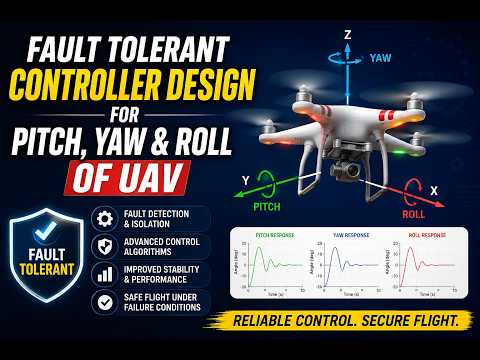
Faults in UAV dynamics can induce dangerous roll, pitch, and yaw deviations. This project develops a fault tolerant control framework to detect and compensate for such errors, ensuring stable flight and mission continuity. This work combines development of the classical and robust controllers, which are used for the pitch, yaw and roll autopilots. One of the important steps in the thesis is development of the non-linear dynamic model of the UAV, which is developed in MATLAB/Simulink environment. Two different strategies of the controller design imply development of the PID and fault tolerant adaptive controllers. Simulation results illustrate the performances of the designed controllers. Simulation is performed for the nominal model of the UAV and for the model that includes uncertainties, sensor noises and motor failures.
INTRODUCTION
Unmanned Aerial Vehicles (UAVs) are one of the fastest growing sectors of the world’s aerospace industry. High demand for UAVs in the commercial industry arises by taking into account the advantages of UAVs over manned aircraft: low manufacturing and operational costs of the systems; elimination of the aircrew and related life support systems allows UAVs to be smaller than manned aircraft [1] and eliminates the risk of human lifes in difficult and dirty missions [2]. Removal of aircrew and their support systems means that UAVs are capable of flying longer, higher and faster without endangering lives. Furthermore, they promise better costeffectiveness and greater utility than manned aircraft [3]. Some of the military and civil applications of UAVs are listed below [2]. Military applications: reconnaissance surveillance and target acquisition (RSTA), surveillance for peacetime and combat Synthetic Aperture Radar (SAR), deception operations, maritime operations (naval fire support, over the horizon targeting, anti ship missile defense, ship classification), UCAV (Unmanned combat air vehicle) applications, meteorology missions, route and landing reconnaissance support, electronic warfare (EW) and SIGINT (SIGnals INTelligence), radio and data relay. Civil applications: security, search and rescue, wild fire suppression, topographical material and agriculture, communications relay, disaster and emergency management, industrial applications, etc. Unmanned Aerial Vehicles rely on two basic approaches in implementing unmаnned flight-autonomy аnd pilot-in-the-looр - which rely predominantly on microрroсessor and communication technologies, respectively. Both are used in differing lеvеls in UАV’s fields, together they compensate the absence of an onboard pilot and thus enable unmanned flight [4]. Autonomy of UAVs requires efficient and accurate control systems. One of the most important steps in control system design is the development of the aircraft model. The full model of an aircraft includes models of its subsystems such as: aerodynamics, propulsion, actuators. Development of the dynamic model of a UAV is of primary importance. For an accurate dynamic model it is necessary to have accurate data of UAVs’ aerodynamics, which can be obtained by various means such as wind tunnel tests, CFD analyses or calculated by empirical formulas [5]. Physically an aircraft is a complicated system, which includes variation of its aerodynamic coefficients, sensor noise, and limited information of the system. Controllers designed with PID methods are unable to take into account errors in the system modeling and signal uncertainties. In cases, when it is impossible to obtain an accurate aerodynamic data for dynamical modeling of a UAV or there are simplifications used in the modelling (linearization of nonlinear dynamics), classical controller, implemented to the actual physical system, might not show the desired performance. Robust control theory provides methods for designing controllers that would produce accurate and fast response in the face of uncertainties or disturbances in the plant model. The main objective of this thesis is the development, implementation and comparison of performances for pitch attitude and roll autopilots for the simulation of the METU TUAV, designed by means of classical and robust control theories. The problem for a controller design for the METU TUAV is the absence of an accurate data of the UAV’s aerodynamics. In [6] aerodynamic coefficients and derivatives are obtained by empirical formulas. [7] provides the aerodynamic data obtained by wind tunnel test for a very similar UAV SCAUT, designed and developed at Politecnico Di Torino, which has similar geometrical properties to the METU TUAV. The purpose of this thesis is the comparison of performances of the PID controller and robust controller. Simulations are performed for the nominal model of the UAV and the models, which include uncertainties and sensor noise. Uncertainties are assumed to be present in the aerodynamic coefficients of the UAV. In the literature, many different approaches can be seen related to the autonomous control of UAVs. In [8] Andrievsky B.R et.al. propose an algorithm of a combined adaptive controller, which uses both adaptation methods based on the parameter identification and variable-structure control technique. In [9] authors introduce flight control system is based on PID controller and uses gain scheduling algorithm based on the airspeed to improve performance of the controller. In [10] PID controller is used for autonomous landing for the METU TUAV. Model inversion is used in landing algorithm. S. Kurnaz et.al. [11] introduce fuzzy logic based control system for an autonomous UAV system. Robust nonlinear controller design is employed in [12] by M. Sadraey et.al. [13] by Etkin B. describes design of a robust flight control system for a mini-UAV using coupled stability derivatives.
Block Diagram