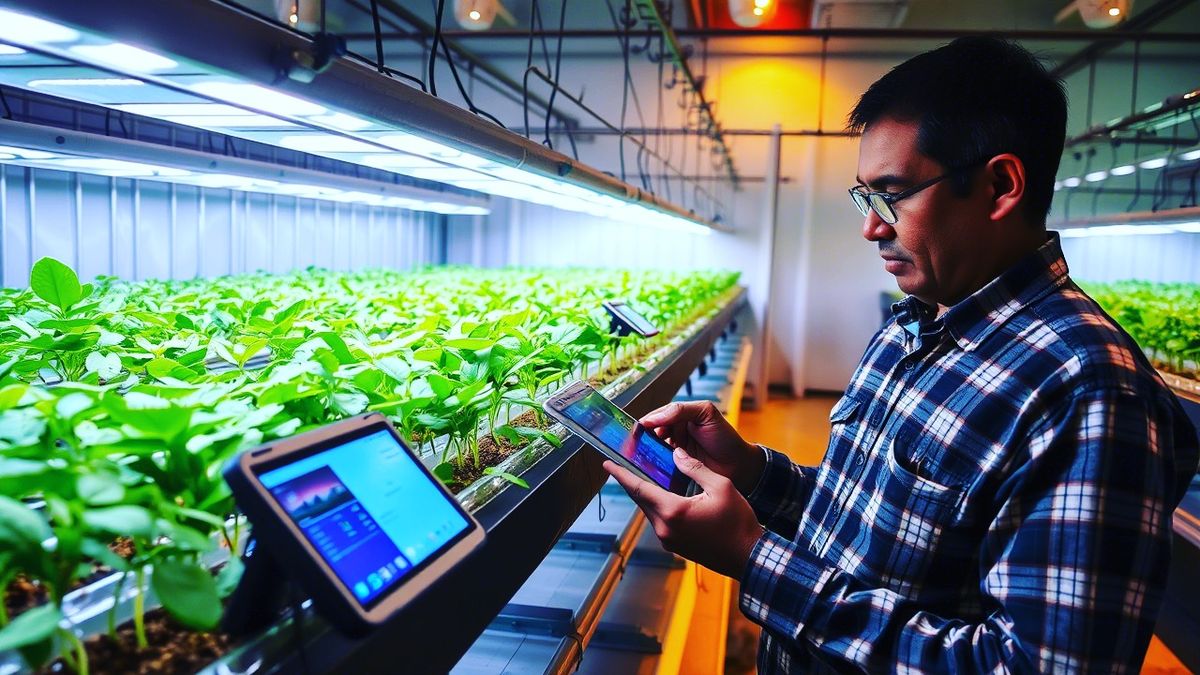
Hydroponics is a modern agricultural cultivation method in which plants are grown without traditional soil. Instead, plants receive essential nutrients through a water-based solution. This technique is increasingly used in smart farming, urban agriculture, greenhouse cultivation, and controlled-environment agriculture.
Water quality plays an important role in hydroponic plant growth. Parameters such as pH, electrical conductivity (EC), water temperature, and nutrient concentration can influence nutrient availability and plant development. Continuous monitoring helps growers understand changing water conditions and make timely adjustments.
The Agriculture Hydroponic Water Quality Monitoring and Crop Suggestion System Using Machine Learning project focuses on combining embedded systems, IoT-based sensor monitoring, and machine learning to support hydroponic cultivation.
The system collects water quality readings through sensors connected to a microcontroller. The readings can be transmitted to a monitoring application, where users can view current conditions and historical measurements. A machine learning model can analyze selected water parameters and suggest suitable crops based on the dataset used for training.
This project demonstrates how smart agriculture technologies can support data-driven hydroponic farming. It is suitable for students interested in embedded systems, IoT, machine learning, Python, and precision agriculture.
Key Features & Benefits
Project Concept and Working Methodology
The main objective of this project is to monitor important hydroponic water parameters and use machine learning to generate crop suggestions based on the collected readings.
The embedded system collects measurements using connected sensors. A microcontroller processes the readings and sends them to a server or monitoring dashboard. The machine learning module receives the available parameters and compares them with patterns learned from a suitable crop dataset.
Typical Project Workflow
Sensor Data Collection – Sensors measure hydroponic water parameters such as pH, electrical conductivity, and temperature.
Microcontroller Processing – An embedded controller collects and processes the sensor readings.
Data Transmission – Measurements are transmitted through Wi-Fi or another suitable communication technology.
Data Storage – The readings can be stored in a database for monitoring and historical analysis.
Water Quality Analysis – The application evaluates the collected readings against configured reference ranges.
Machine Learning Prediction – A trained model analyzes the selected water parameters and generates crop suggestions.
Dashboard Visualization – Users can view sensor values, water quality status, and suggested crops.
Alert Generation – Notifications can be generated when measured parameters move outside configured ranges.
Possible Sensor Components
pH sensor for measuring acidity or alkalinity.
EC sensor for estimating dissolved ionic concentration.
Water temperature sensor for monitoring solution temperature.
Water level sensor for checking the nutrient solution level.
Optional dissolved oxygen sensor for additional water quality information.
The exact crop suggestions depend on the training dataset, crop requirements, and growing conditions. A recommendation should consider more than water parameters alone, including light, humidity, temperature, plant growth stage, and nutrient formulation.
Implementation Guide
Key Features and Applications
The project combines embedded monitoring and machine learning to provide useful information for hydroponic cultivation.
Key Features
Real-Time Water Monitoring: Collects readings from connected hydroponic sensors.
pH Measurement: Monitors the acidity or alkalinity of the nutrient solution.
EC Monitoring: Measures electrical conductivity as an indicator of dissolved ionic content.
Temperature Monitoring: Tracks nutrient solution temperature.
Water Level Monitoring: Can identify low solution levels when a suitable sensor is installed.
IoT Data Transmission: Sends sensor measurements to a remote monitoring application.
Machine Learning Crop Suggestions: Uses a trained model to suggest crops based on available water quality data.
Dashboard Visualization: Displays sensor readings and prediction results.
Abnormal Condition Alerts: Notifies users when readings exceed configured limits.
Historical Data Analysis: Supports tracking water quality changes over time when data storage is implemented.
Potential Applications
Hydroponic farming systems.
Smart greenhouse monitoring.
Urban and indoor agriculture.
Precision farming research.
Agricultural IoT projects.
Educational demonstrations of machine learning in agriculture.
Controlled-environment crop cultivation.
The system provides decision-support information rather than guaranteeing crop growth. Users should validate recommendations against crop-specific nutrient requirements and actual growing conditions.
Technical Specifications
Technologies, Software and Hardware Requirements
The project can be implemented using an embedded controller, water quality sensors, IoT communication, and a machine learning application. The exact components depend on the implementation.
Software Requirements
Programming Language: Python
Embedded Programming: Arduino IDE or suitable microcontroller development environment
Machine Learning: Scikit-learn
Data Processing: Pandas and NumPy
Data Visualization: Matplotlib
IoT Communication: MQTT or HTTP
Backend: Flask or FastAPI
Frontend: HTML, CSS, and JavaScript
Database: MySQL or SQLite
Development Environment: Visual Studio Code or Arduino IDE
Operating System: Windows or Linux
Hardware Requirements
Microcontroller: ESP32 or Arduino with a suitable communication module
pH Sensor: For nutrient solution pH measurement
EC Sensor: For electrical conductivity measurement
Temperature Sensor: Waterproof temperature probe
Water Level Sensor: For solution level monitoring
Power Supply: Suitable regulated power source
Wi-Fi Connectivity: For remote data transmission
Hydroponic Reservoir: Water and nutrient solution container
Connecting Wires: For sensor and controller connections
Machine Learning Implementation
A labelled dataset containing water quality measurements and crop suitability labels is required for supervised crop prediction. Data preprocessing may include missing-value handling, scaling, and categorical encoding.
Potential algorithms include:
Random Forest Classifier.
Decision Tree Classifier.
K-Nearest Neighbors.
Support Vector Machine.
Gradient Boosting.
Model performance can be evaluated using accuracy, precision, recall, F1-score, and a confusion matrix. The model should be tested on independent data and compared with established crop-specific growing requirements.
Sensor calibration is also essential. pH and EC readings should be checked using appropriate calibration solutions, and sensor measurements should be validated periodically to maintain reliability.
Conclusion & Next Steps
Advantages, Future Scope and Conclusion
Advantages
Supports continuous monitoring of hydroponic water conditions.
Reduces the need for repeated manual measurement.
Combines embedded systems with machine learning.
Provides data-based crop suggestions.
Helps identify changes in nutrient solution conditions.
Supports historical analysis when readings are stored.
Offers practical experience in IoT and smart agriculture.
Future Scope
The system can be enhanced by adding nutrient dosing automation, water circulation control, and automatic pH adjustment with suitable safety mechanisms. Integration with environmental sensors can provide additional information about air temperature, humidity, light intensity, and growing conditions.
Advanced machine learning models could analyze historical sensor readings and crop growth data to improve recommendation quality. Cloud-based dashboards and mobile applications may allow farmers to monitor multiple hydroponic units remotely.
Future versions could also include predictive alerts for changing water conditions, crop growth monitoring using computer vision, and integration with smart greenhouse automation systems.
Conclusion
The Agriculture Hydroponic Water Quality Monitoring and Crop Suggestion System Using Machine Learning demonstrates how IoT and artificial intelligence can support modern agricultural practices. By combining water quality sensors, embedded processing, remote monitoring, and machine learning, the project provides a foundation for data-driven hydroponic cultivation.
This project is suitable for students interested in embedded systems, IoT, machine learning, and smart agriculture. It also provides opportunities to explore automated monitoring, crop recommendation, and intelligent greenhouse technologies.