ABSTRACT
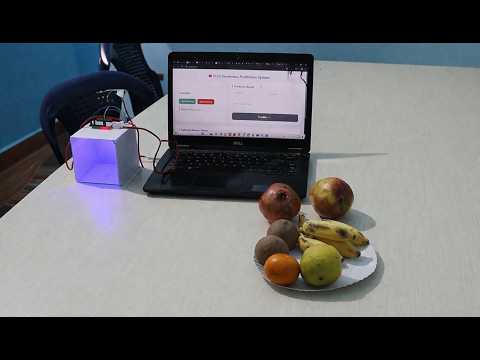
This project presents the development of an intelligent sweetness prediction system using Machine Learning and a Flask-based web application for real-time monitoring and analysis. The main aim of the system is to predict the sweetness level of a sample based on live sensor data collected from an external API source. In many food processing and agricultural industries, sweetness is considered an important quality parameter, and manual measurement methods can be time-consuming, inconsistent, and less efficient. To overcome this problem, the proposed system automates the prediction process by using a trained machine learning model that can estimate sweetness accurately from sensor values. The application loads a previously trained model, scaler, and feature configuration files to ensure consistency between training and deployment. It continuously fetches the latest sensor readings from the API, preprocesses the values, and passes them to the model for prediction. The predicted sweetness value is then converted into a meaningful quality grade such as A, B, C, D, or Below D based on predefined threshold ranges. The system also records the timestamp and displays the model used for prediction, making the process more transparent and informative. A Flask web framework is used to build the backend and serve the prediction results through both a web interface and a JSON API endpoint. This makes the solution lightweight, practical, and easy to integrate into real-time industrial or agricultural environments. The project demonstrates how machine learning can be combined with IoT-style sensor data and web technologies to create a smart prediction system. It reduces human effort, improves decision-making speed, and provides consistent quality assessment. Overall, this system offers a simple, scalable, and effective approach for sweetness estimation and grading, which can be further extended for smart farming, food quality monitoring, and automated classification applications.
INTRODUCTION
Sweetness is one of the most important quality indicators in food products, fruits, beverages, and several agricultural commodities. In many practical environments such as food processing units, storage facilities, fruit grading centers, and smart farming systems, the sweetness level of a product plays a major role in determining its quality, ripeness, consumer acceptance, and market value. Traditionally, sweetness is measured using manual testing methods, laboratory instruments, or human inspection, which may require more time, effort, and cost. In addition, manual evaluation may not always produce consistent results, especially when large quantities of samples need to be tested continuously. Due to these limitations, there is a growing need for an automated and intelligent system that can estimate sweetness quickly, accurately, and in real time. With the rapid advancement of machine learning, Internet of Things (IoT), and web technologies, it has become possible to build smart systems that can monitor sensor data and make predictions automatically. Machine learning is especially useful in such applications because it can learn hidden patterns from historical data and make predictions for new input values without requiring explicit rule-based programming. This project focuses on the development of a real-time sweetness prediction system using a trained machine learning model integrated into a Flask-based web application. The main purpose of the system is to predict the sweetness level of a sample using sensor values obtained from an external API and then classify the result into a quality grade for easy interpretation. The system is designed to act as a practical solution for real-time quality monitoring, where live data can be fetched, processed, and analyzed automatically without manual intervention.
In this project, a machine learning model is first trained using previously collected sensor data and sweetness-related output values. Once the best-performing model is selected, it is saved and later loaded into the deployment environment using Python libraries such as Joblib. Along with the trained model, the project also uses a scaler and feature column configuration to ensure that the same preprocessing steps used during training are applied during prediction. This is very important in machine learning deployment because the prediction input must follow the same structure and scale as the training data to maintain accuracy. The developed Flask application acts as the main platform that connects the trained machine learning model with live sensor data and the user interface. The application automatically fetches the latest sensor values from a given API endpoint using HTTP requests. These values are then extracted, cleaned, converted into numerical form, and arranged into a structured tabular format using Pandas DataFrame. If the selected model requires scaled input, the system applies the scaler before passing the data to the prediction model. The machine learning model then predicts the sweetness value of the given sample, and the result is rounded for better readability. To make the output more meaningful for users, the predicted sweetness value is further converted into a quality grade such as A, B, C, D, or Below D based on predefined threshold ranges. This grading mechanism makes the system easier to understand and more useful in real-world quality control applications.
The integration of Flask in this project provides an efficient way to deploy the prediction system as a web-based application. Flask is a lightweight and flexible Python web framework that allows developers to create backend logic, define routes, serve web pages, and return API responses with ease. In this system, Flask is used to create a home page for the user interface and an API endpoint for fetching live prediction results. When the user accesses the application, the Flask server loads the trained machine learning model and waits for prediction requests. Once the prediction route is triggered, the system fetches the most recent sensor data, processes it, and returns the final prediction output in JSON format. This design makes the application simple, responsive, and suitable for real-time deployment. The use of API-based sensor data collection also makes the system highly adaptable, as it can be connected to external IoT devices, cloud databases, or live monitoring platforms. Instead of manually entering values into the system, real-time sensor readings can be directly used to generate predictions, which increases efficiency and reduces the possibility of human error. This makes the proposed system a useful example of combining machine learning with real-time data communication and web deployment.
The importance of this project lies in its practical application and scalability. In modern agricultural and food technology sectors, there is an increasing demand for intelligent quality assessment systems that can support automation and smart decision-making. Sweetness is a valuable parameter in assessing the maturity and quality of fruits, juices, syrups, and other food products. A real-time sweetness prediction system can help farmers, quality inspectors, and industrial operators monitor product quality more effectively and take immediate actions when required. For example, such a system can be used to determine the best harvest time, classify produce into quality categories, monitor processing consistency, or support automated packaging and sorting systems. Since the system uses machine learning, it can also be improved over time by retraining the model with more data and selecting better-performing algorithms. In addition, the web-based nature of the system makes it accessible and easy to integrate with dashboards, mobile applications, or industrial control systems. The prediction output can also be stored for future analysis, trend monitoring, or report generation. Therefore, this project not only demonstrates a technical implementation of machine learning deployment but also addresses a real-world problem in a meaningful and efficient way.
Another important aspect of this project is its modular and maintainable design. The code is organized in a way that separates model loading, grade classification, data fetching, prediction logic, and route handling into different sections. This improves readability and makes the system easier to modify, test, and extend. The error handling included in the code also improves reliability by checking whether the API response contains valid data, whether the required fields are present, and whether the number of sensor values matches the expected model input features. If any issue occurs, the system returns a clear error message instead of crashing unexpectedly. This is a valuable feature in real-time applications where data inconsistency or network issues may occur. Overall, this project serves as a strong example of how machine learning models can be transformed from offline experiments into live intelligent applications using Python and Flask. It combines data science, real-time API communication, and web development into a single practical system. The proposed sweetness prediction system is simple in implementation, effective in performance, and highly useful for real-time quality assessment scenarios. It represents an important step toward smart monitoring and automation in agriculture and food technology domains, and it can be further expanded in the future with advanced models, richer user interfaces, database integration, and live dashboards for continuous monitoring and analysis.
OBJECTIVES
To develop an intelligent sweetness prediction system using machine learning techniques.
The system should accurately estimate sweetness values based on input sensor data collected from external sources.
To fetch real-time sensor data automatically from an API for live prediction.
This helps eliminate manual data entry and enables continuous monitoring of the sample quality.
To integrate the trained machine learning model into a Flask-based web application.
The web platform should allow smooth prediction processing and user-friendly result display.
To classify predicted sweetness values into quality grades such as A, B, C, D, and Below D.
This makes the prediction results easier to understand and useful for practical quality assessment.
To create a scalable and efficient system for food or agricultural quality monitoring applications.
Block Diagram
SYSTEM REQUIREMENTS
1. PROGRAMMING LANGUAGE – PYTHON 3.8
Python 3.8 is used as the primary programming language for developing the sweetness prediction system due to its simplicity, readability, and extensive support for machine learning and web development. Python provides a wide range of libraries that make it easy to implement data processing, model training, and deployment. The syntax of Python is user-friendly, which allows faster development and easier debugging. Version 3.8 is stable and widely supported by most machine learning and data science libraries, ensuring compatibility across different modules used in the project. It also supports efficient memory management and improved performance compared to earlier versions. Python enables seamless integration of backend logic with web frameworks like Flask, making it ideal for building end-to-end applications. The availability of large community support and documentation further simplifies the development process. In this project, Python is used for fetching API data, processing inputs, loading the trained model, performing predictions, and running the web application. Its flexibility allows developers to modify and extend the system easily in the future. Overall, Python 3.8 serves as a strong foundation for building a scalable and efficient machine learning-based system.
2. WEB FRAMEWORK – FLASK
Flask is a lightweight and flexible web framework used to develop the backend of the application. It is chosen because of its simplicity and ease of integration with machine learning models. Flask allows developers to create web routes, handle HTTP requests, and return responses in various formats such as HTML and JSON. In this project, Flask is used to create the main application server, define routes for the home page and prediction API, and handle incoming requests from users. It acts as the bridge between the machine learning model and the user interface. Flask is highly customizable and does not require complex configurations, making it suitable for small to medium-scale applications. It also supports integration with templates for building user interfaces and APIs for data communication. The framework ensures that the system can run locally or be deployed on a server for remote access. Flask’s lightweight nature ensures faster execution and lower resource consumption. It also supports debugging features that help in identifying and fixing errors during development. Overall, Flask plays a key role in making the system interactive, accessible, and easy to use.
3. MACHINE LEARNING LIBRARY – SCIKIT-LEARN & JOBLIB
Scikit-learn is one of the most popular machine learning libraries in Python, used for training and evaluating predictive models. In this project, Scikit-learn is used to build models such as Linear Regression, Support Vector Regression, or other algorithms for predicting sweetness. It provides simple and efficient tools for data analysis and modeling. Once the model is trained, it is saved using Joblib, which is a library designed for serializing Python objects. Joblib allows the trained model to be stored in a file and loaded later for prediction without retraining. This significantly reduces computation time during deployment. The combination of Scikit-learn and Joblib ensures that the model can be reused efficiently in the Flask application. These libraries also support preprocessing techniques such as scaling and feature transformation. They are well-documented and widely used in industry, making them reliable for real-world applications. In this system, they form the core of the prediction mechanism. Overall, these tools enable accurate, efficient, and reusable machine learning implementation.
4. DATA PROCESSING LIBRARY – PANDAS & NUMPY
Pandas and NumPy are essential libraries used for data manipulation and numerical operations in this project. Pandas provides powerful data structures such as DataFrames, which are used to organize and manage input data in a tabular format. In this system, sensor values fetched from the API are converted into a Pandas DataFrame to match the format required by the machine learning model. NumPy is used for performing numerical computations and handling arrays efficiently. These libraries help in cleaning, transforming, and preparing data before it is passed to the model. They ensure that the data is consistent, structured, and ready for processing. Pandas also supports easy integration with other libraries, making it suitable for end-to-end data workflows. The use of these libraries improves performance and reduces the complexity of handling large datasets. They are widely used in data science applications and provide reliable and efficient operations. Overall, Pandas and NumPy play a critical role in managing and preprocessing data within the system.
5. API COMMUNICATION – REQUESTS LIBRARY
The Requests library is used to handle communication with the external API from which sensor data is fetched. It allows the system to send HTTP requests and receive responses in a simple and efficient manner. In this project, the GET method is used to retrieve the latest sensor values from the API endpoint. The response is usually in JSON format, which is then parsed and processed for further use. The Requests library simplifies API interaction by handling connection details, headers, and response parsing automatically. It also supports features such as timeout handling, which prevents the system from hanging if the API does not respond. This ensures that the application remains stable and responsive. By using this library, the system can fetch real-time data continuously without manual intervention. It plays a crucial role in enabling live prediction functionality. Overall, the Requests library ensures smooth and reliable communication between the application and external data sources.
6. DEVELOPMENT ENVIRONMENT – VS CODE / ANY IDE
A development environment such as Visual Studio Code (VS Code) is used for writing, editing, and managing the project code. VS Code is a popular and lightweight code editor that supports multiple programming languages, including Python. It provides features such as syntax highlighting, code completion, debugging tools, and extensions that improve productivity. In this project, the IDE is used to write Python scripts, manage Flask application files, and organize project folders. It also allows easy integration with virtual environments and version control systems like Git. Debugging tools help in identifying errors and improving code quality. The environment supports running and testing the application locally before deployment. Developers can install extensions for Python, Flask, and data science tools to enhance functionality. Overall, a good development environment ensures efficient coding, testing, and maintenance of the system.
7. HARDWARE REQUIREMENTS
The system requires basic hardware resources for development and execution. A computer or laptop with a minimum of 4 GB RAM and a modern processor is sufficient to run the application smoothly. For better performance, 8 GB RAM is recommended, especially when working with larger datasets or more complex models. The system does not require high-end GPU hardware since the model is already trained and only used for prediction. A stable internet connection is required to fetch real-time data from the API. Storage space is needed to save model files, datasets, and application code. The hardware requirements are minimal, making the system accessible to a wide range of users. This ensures that the application can be developed and deployed without expensive infrastructure. Overall, the system is lightweight and can run efficiently on standard computing devices.
8. SOFTWARE REQUIREMENTS
The software requirements include Python 3.8, required libraries, and a web browser for accessing the application. All dependencies such as Flask, Pandas, NumPy, Scikit-learn, Joblib, and Requests must be installed using package managers like pip. The operating system can be Windows, Linux, or macOS, as Python and Flask are cross-platform. A web browser such as Chrome or Edge is used to access the Flask application interface. The system may also require tools like Git for version control and virtual environments for managing dependencies. Proper installation of software ensures smooth execution of the application. The software setup is simple and does not require complex configurations. This makes the system easy to deploy and use in different environments. Overall, the software requirements support the development, execution, and accessibility of the sweetness prediction system.