ABSTRACT:
Air pollution has become one of the most significant environmental and health concerns worldwide, particularly in urban and industrial regions. Continuous monitoring of air quality is essential to assess environmental conditions, protect public health, and support sustainable development. Traditional air monitoring stations are often expensive and limited in number, which makes it difficult to monitor air quality at a local or indoor level. To address this challenge, this project presents an IoT-based intelligent air quality monitoring system using machine learning.
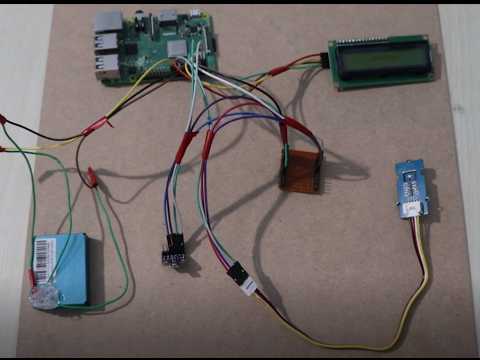
The proposed system is designed using a Raspberry Pi as the central processing unit, integrated with multiple environmental sensors including the BME680 environmental sensor, SGP30 gas sensor, and PMS7003 particulate matter sensor. These sensors are used to measure various air quality parameters such as temperature, humidity, atmospheric pressure, volatile organic compounds (VOC), total volatile organic compounds (TVOC), equivalent carbon dioxide (eCO₂), and particulate matter (PM1.0, PM2.5, and PM10). The PMS7003 sensor provides accurate particulate matter measurements, which are used to calculate the Air Quality Index (AQI) based on PM2.5 concentration.
The collected sensor data is processed by the Raspberry Pi in real time. The AQI is calculated using PM2.5 values, while additional environmental parameters provide contextual information about air conditions. To enhance the system's intelligence, machine learning algorithms such as Random Forest and XGBoost are implemented to classify air quality into four categories: Good, Moderate, Unhealthy, and Poor. The models are trained using a generated dataset containing environmental and gas parameters along with AQI values, enabling the system to predict air quality status accurately.
The predicted air quality information and real-time sensor readings are displayed on a 16×2 LCD display and printed on the terminal for monitoring purposes. The system continuously analyzes environmental data and provides immediate feedback about current air conditions. This enables users to understand pollution levels and take preventive actions when air quality becomes unhealthy.
The proposed system offers a low-cost, scalable, and intelligent solution for real-time air quality monitoring. It demonstrates how Internet of Things (IoT) devices combined with machine learning techniques can improve environmental monitoring and decision-making. The system can be deployed in homes, offices, schools, and industrial environments to monitor indoor and outdoor air pollution effectively. Future improvements may include cloud-based data storage, web dashboards for remote monitoring, and predictive analysis for pollution trends.
INTRODUCTION:
Air pollution has emerged as one of the most critical environmental challenges affecting human health, ecosystems, and climate worldwide. Rapid urbanization, industrial growth, increasing vehicle emissions, and energy consumption have significantly contributed to the degradation of air quality. Poor air quality can lead to serious health issues such as respiratory diseases, cardiovascular problems, allergies, asthma, and even premature death. According to various environmental studies and health organizations, exposure to polluted air is responsible for millions of deaths globally every year. Therefore, continuous monitoring and assessment of air quality have become essential for protecting public health and maintaining environmental sustainability.
Traditional air quality monitoring systems are typically implemented through large-scale monitoring stations installed by environmental agencies. Although these stations provide accurate measurements, they are expensive to install and maintain, and their coverage is often limited to specific locations. As a result, many regions, particularly indoor environments and smaller urban areas, lack continuous and accessible air quality monitoring. To overcome these limitations, the development of low-cost, portable, and intelligent air monitoring systems has gained significant attention in recent years.
Advancements in Internet of Things (IoT) technology have enabled the integration of sensors, microcontrollers, and communication systems to build smart environmental monitoring systems. IoT-based systems allow real-time data collection, processing, and monitoring from multiple sensors connected through embedded devices. These systems provide a cost-effective and scalable solution for monitoring environmental parameters such as temperature, humidity, gas concentration, and particulate matter. By combining IoT technology with machine learning techniques, it becomes possible not only to monitor air quality but also to analyze patterns and predict pollution levels more intelligently.
In this project, an IoT-based intelligent air quality monitoring system using machine learning is developed using a Raspberry Pi as the central processing unit. The system integrates multiple environmental sensors to measure important air quality parameters. The BME680 sensor is used to measure environmental conditions such as temperature, humidity, atmospheric pressure, and gas resistance, which can be used to estimate volatile organic compounds (VOC). The SGP30 gas sensor is employed to measure Total Volatile Organic Compounds (TVOC) and equivalent carbon dioxide (eCO₂) levels, which are important indicators of indoor air pollution. Additionally, the PMS7003 particulate matter sensor is used to measure airborne particulate concentrations including PM1.0, PM2.5, and PM10, which represent particles of different sizes present in the air.
Among these particulate measurements, PM2.5 plays a crucial role in determining the Air Quality Index (AQI) because fine particulate matter can penetrate deeply into the lungs and bloodstream, posing severe health risks. In this system, the AQI is calculated based on PM2.5 concentration obtained from the PMS7003 sensor. The calculated AQI value is then used along with other environmental parameters such as temperature, humidity, VOC index, TVOC, and eCO₂ to analyze air quality conditions.
To enhance the intelligence of the monitoring system, machine learning algorithms such as Random Forest and XGBoost classifiers are implemented. These models are trained using a dataset containing environmental sensor readings and corresponding AQI categories. The machine learning model analyzes the collected data and predicts the air quality category in real time. The predicted air quality is classified into four categories: Good, Moderate, Unhealthy, and Poor, enabling users to understand pollution levels quickly and take appropriate precautions.
The entire system operates in real time using the Raspberry Pi platform. Sensor data is continuously collected, processed, and passed to the trained machine learning model to predict air quality. The results are displayed on a 16×2 LCD display as well as printed in the terminal for monitoring purposes. This provides an easy and user-friendly way for individuals to observe environmental conditions and air pollution levels in their surroundings.
The proposed system offers several advantages including low cost, portability, real-time monitoring capability, and intelligent analysis through machine learning. It can be deployed in various environments such as homes, offices, schools, laboratories, and industrial areas to monitor air pollution effectively. By providing real-time feedback on air quality conditions, the system helps raise awareness about environmental pollution and supports preventive measures to protect human health.
In conclusion, the integration of IoT technology, environmental sensors, and machine learning techniques provides an efficient and scalable solution for air quality monitoring. The developed system demonstrates how intelligent sensing and data analysis can contribute to better environmental management and healthier living conditions.
OBJECTIVES:
The main objective of this project is to design and develop an intelligent air quality monitoring system using Internet of Things (IoT) technology and machine learning techniques. The system aims to continuously monitor environmental parameters using multiple sensors and process the collected data using a Raspberry Pi. By calculating the Air Quality Index (AQI) and applying machine learning algorithms, the system is able to classify air quality levels and provide real-time information about environmental conditions. The project focuses on creating a low-cost, efficient, and intelligent solution for monitoring air pollution and improving environmental awareness.
1. To develop a low-cost air quality monitoring system using Raspberry Pi and environmental sensors for continuous monitoring of air quality.
2. To measure environmental parameters in real time such as temperature, humidity, atmospheric pressure, VOC, TVOC, eCO₂, and particulate matter (PM1.0, PM2.5, PM10) using sensors like BME680, SGP30, and PMS7003.
3. To calculate the Air Quality Index (AQI) based on particulate matter values, particularly PM2.5 concentration, in order to determine the level of air pollution.
4. To apply machine learning algorithms such as Random Forest and XGBoost to analyze sensor data and classify air quality into categories such as Good, Moderate, Unhealthy, and Poor.
5. To display the air quality information in real time on a 16×2 LCD display and terminal for easy monitoring by users.
6. To improve awareness about environmental pollution by providing real-time information about air quality conditions.
7. To demonstrate the integration of IoT and machine learning technologies in building an intelligent environmental monitoring system.
Block Diagram